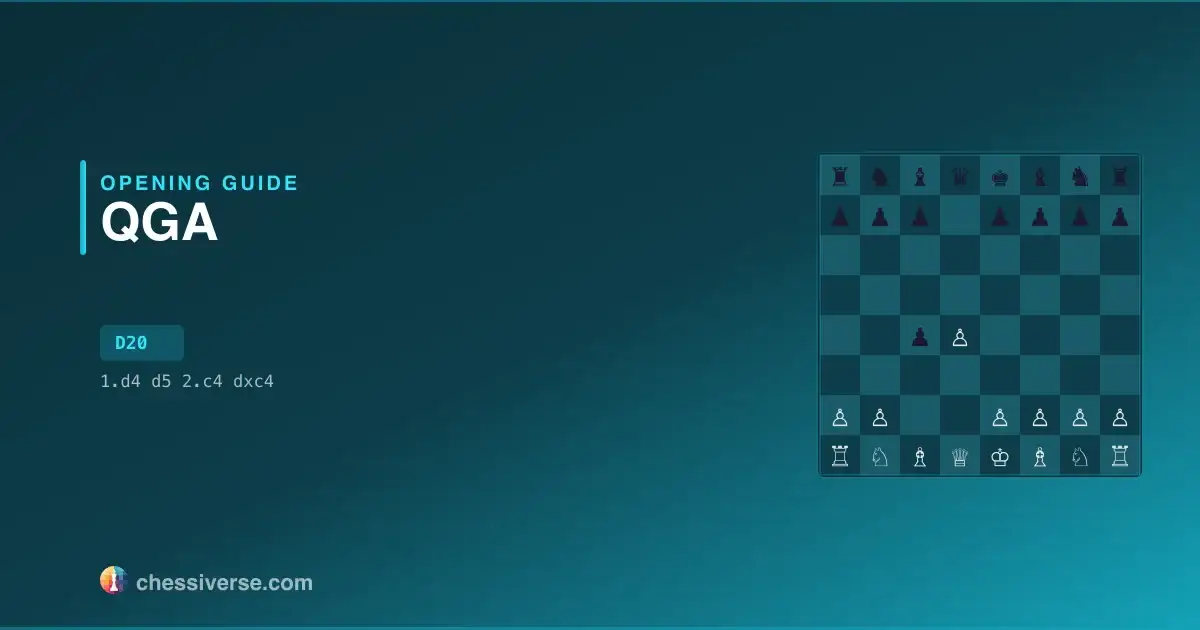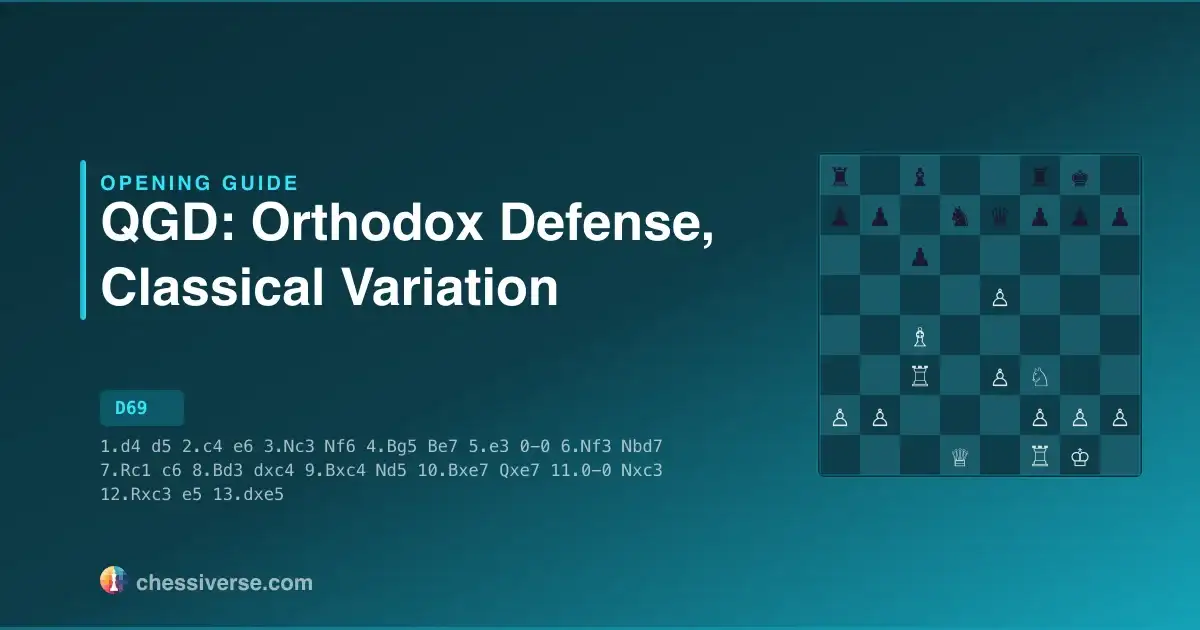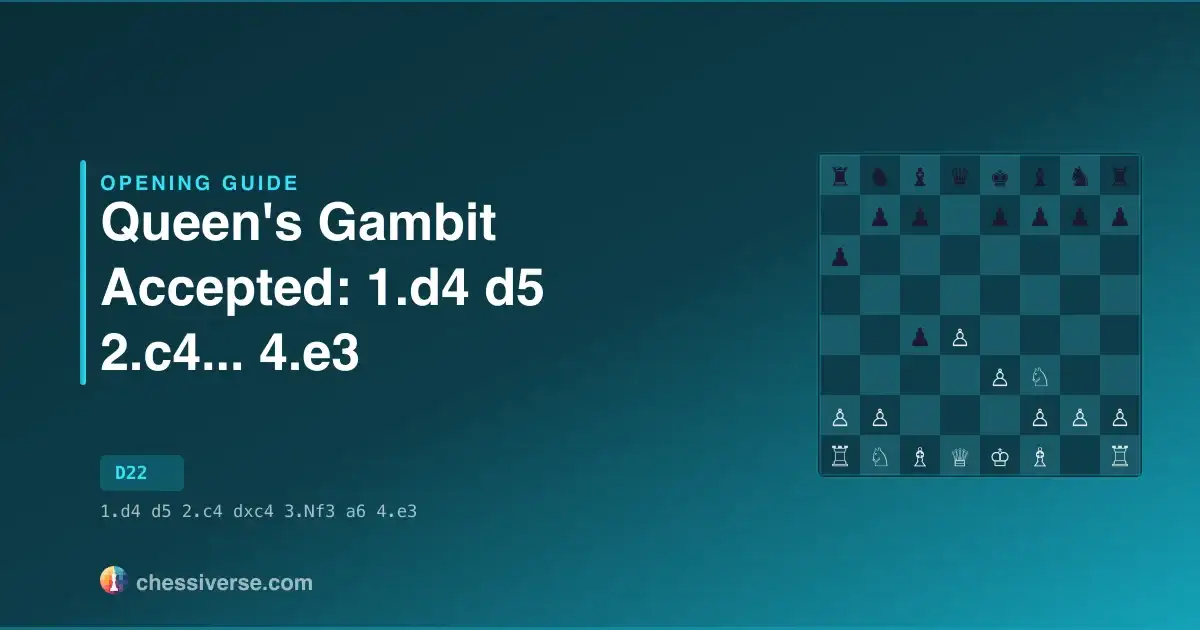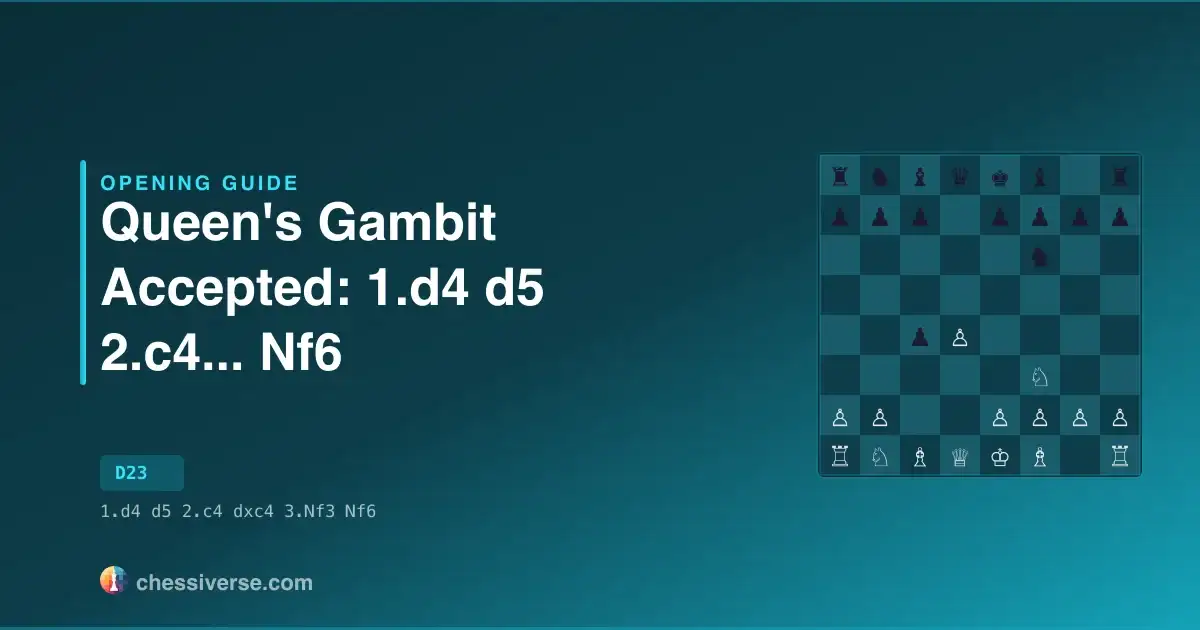


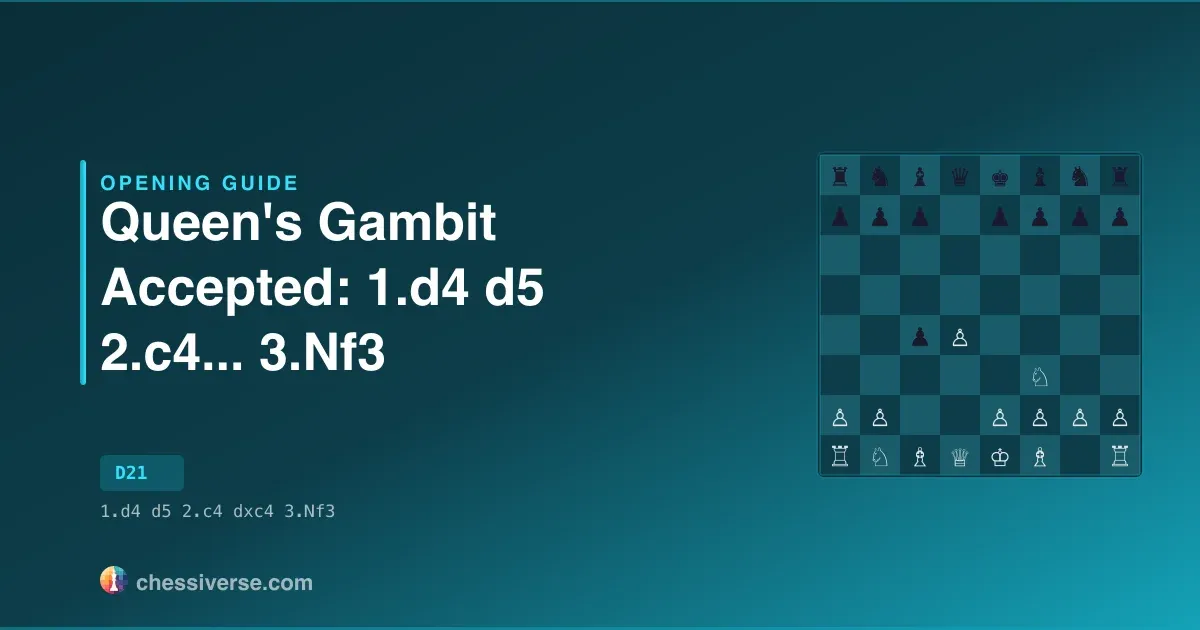
Starting from 1.d4 d5 2.c4 dxc4 3.Nf3, players enter the Queen's Gambit Accepted: Normal Variation — ECO D21. The classical move-three of the QGA. White ignores the missing pawn, develops naturally, and gets ready to take e5 off the menu before recovering the material at leisure.
Strategic Overview
3.Nf3 is the principled main line against the Queen's Gambit Accepted. The whole strategic question of the QGA is whether White can recover the c4-pawn without losing the central or developmental advantage that's supposed to come with the gambit. By playing 3.Nf3 first, White solves two problems at once: a piece is developed, the e5-square is controlled (denying Black the ...e5 break that would otherwise free the position), and Bxc4 is one move away when the moment is right. The alternative 3.e4 is sharper but allows Black various concrete responses, while 3.e3 commits the dark-squared bishop to a passive future. 3.Nf3 keeps options open. Black's main reply 3...Nf6 is the natural developing move that prevents White from establishing the ideal e4 centre. From this position the QGA branches into classical main lines where both sides finish development and the strategic battle is about the central pawn-structure and minor-piece play. It's a respected, solid opening that scores well at all levels because the plans for both sides are concrete and the typical positions are well-understood.
Key Ideas
The recurring motifs below distinguish a confident handler of this opening from a beginner:
- Nf3 controls e5 and prepares recapture — The knight does double duty — develops a piece toward its best square and stops Black from playing ...e5 to liberate the centre. The c4-pawn isn't going anywhere, and White recovers it on their own schedule.
- Don't rush to recover the pawn — Trying to win c4 with an early Qa4+ or rushed Bxc4 wastes time and lets Black equalise easily. The QGA philosophy for White is patience — develop first, take later, and the small lead in mobilisation becomes the real edge.
- Black's ...e5 break is the central question — If Black gets ...e5 in, the QGA becomes very comfortable. White's whole opening plan is preventing that break (with Nf3 controlling e5) while completing development, then recovering material in a way that keeps the central advantage.
History and Notable Players
It arises from the Queen's Gambit Accepted. On the White side, Zdenko Kozul (65 games), Svetozar Gligoric (53 games), Ivan Farago (52 games) top the database. Notable Black exponents: Hrvoje Stevic (75 games), Zoltan Varga (75 games), Harmen Jonkman (47 games).
Performance Across Rating Levels
The picture changes a lot as you climb the rating ladder. Among 1200-rated players, it appears in 0.08% of games — 552,226 of them on record — with White winning 56.8% and Black 39.4%. By 1800, popularity is 0.09% and White's score is 57.6% to Black's 37.8%. At the top end (2500+ Elo), popularity is 0.29% with 12.4% draws — a clear sign of how much theory rules the line at master level. White's edge erodes by 13.1pp from 1200 to 2500 Elo, suggesting Black's counterplay is easier to find with experience.
Time Control Patterns
Time control matters here: blitz players reach for this opening more than others. In bullet, it appears in 0.07% of games (1,969,967); White wins 55.8%. Blitz shows 0.09% adoption across 3,173,878 games, White scoring 55.6%. In rapid, the share rises to 0.08% — 896,571 games, White 58.9%. White's score swings 3.3pp across formats, so time control isn't just a stylistic choice here — it shifts the actual results.
Move Diversity and Theory Depth
What players actually play after the opening moves depends heavily on rating. At 1200 Elo (551,027 games), the top reply is Nf6, played 27.6% of the time. Five other moves each take at least 5% of games, and the top three moves account for 58.7% of games. Entropy: 3.01. By 2500 (39,714 games), Nf6 dominates at 72.7% of replies; only two other moves still reach 5% and the top three moves account for 91.9% of games. Entropy drops to 1.42. The narrowing is significant — strong players consolidate around a small set of best moves, while amateurs scatter across many plausible-looking options.
Historical Trends
Tracking the Queen's Gambit Accepted: Normal Variation year over year shows a clear story. Adoption peaked in 2015 at 0.14% (31,126 games). By 2025 it sits at 0.08%, 41% below the peak and 36% under its 2013 level, leaving the line in decline.
Main Lines and Variations
The main branches off 1.d4 d5 2.c4 dxc4 3.Nf3 include:
Each branch leads to a different middlegame character — the resulting pawn structure decides what kind of game you get.
Common Mistakes
- Neglecting development — Extra pawn moves in the opening are tempting, especially when you "know the moves". Developing a piece each turn is the simple correction.
- Overextending the attack — Gambits look like permission to throw everything forward. They aren't — every attacking move should improve a piece. Random checks and threats burn the initiative once they fail to coordinate.
Practice on Chessiverse
Ready to try the Queen's Gambit Accepted: Normal Variation against a bot? Pick an opponent at your level and play a game.