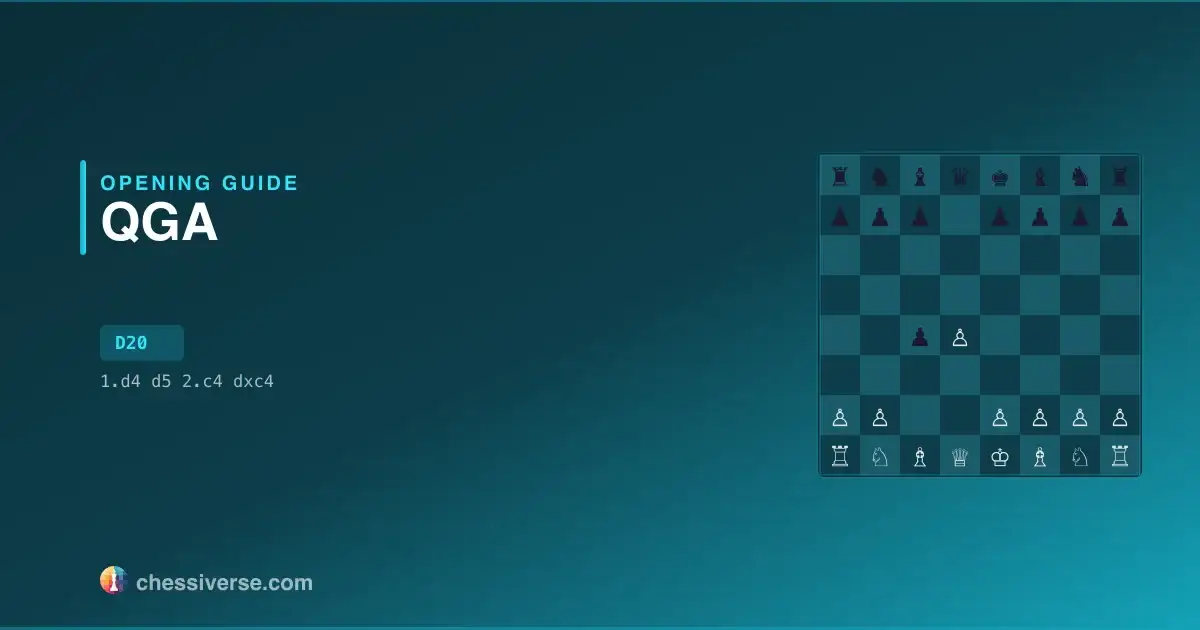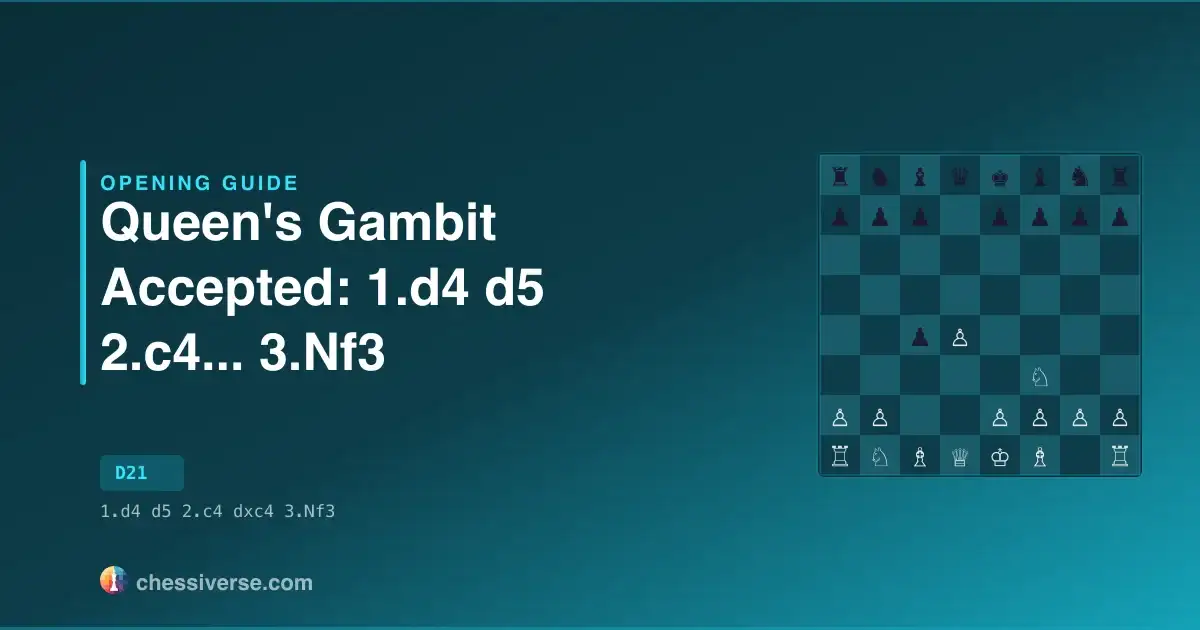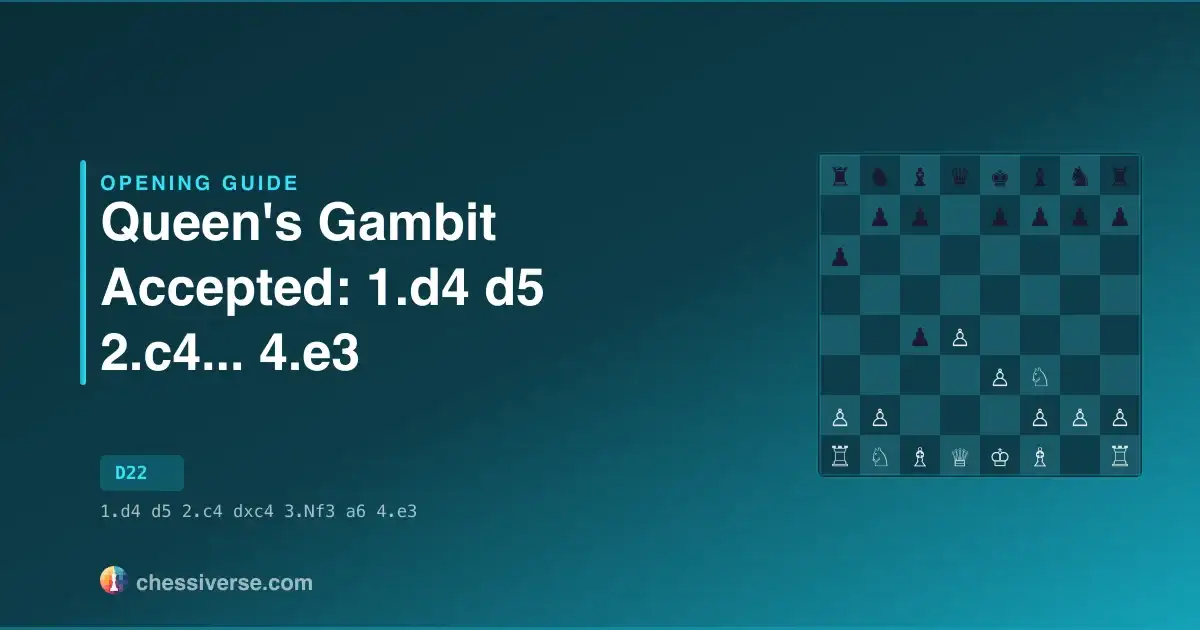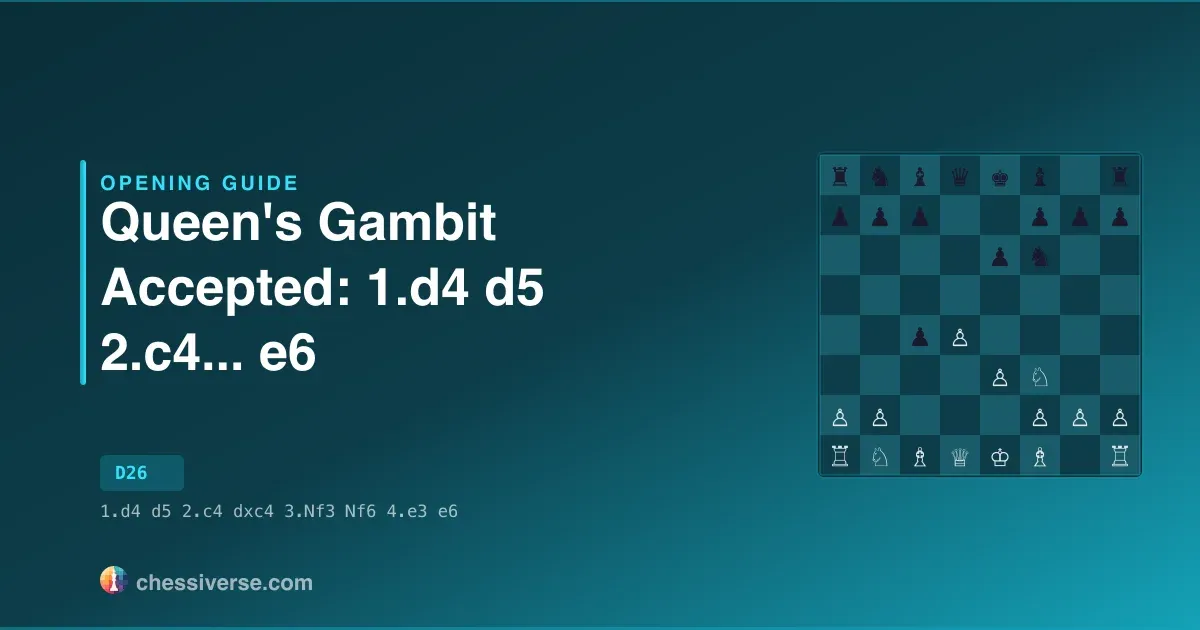
Starting from 1.d4 d5 2.c4 dxc4 3.Nf3 Nf6 4.e3 e6, players enter the Queen's Gambit Accepted: Normal Variation, Traditional System — ECO D26. Black opens the diagonal for the dark-squared bishop and prepares to bring the rest of the pieces out. The light-squared bishop wants to fianchetto on b7 — though sometimes it has to settle for the duller d7-square.
Strategic Overview
4...e6 is the classical fourth move for Black in the modern QGA. The pawn opens the diagonal for the f8-bishop (which usually goes to e7 or sometimes b4) and supports the upcoming ...c5 break that challenges White's centre. The light-squared bishop is the trickier piece — ideally it heads to b7 via a future ...b6 fianchetto, where it eyes the long diagonal and supports the central squares. But that plan isn't always available; sometimes the bishop ends up on the more modest d7 square instead, depending on how the central play develops. White's correct continuation is the straightforward 5.Bxc4, finally recovering the gambit pawn after spending four moves preparing the recapture properly. From here the typical QGA middlegame unfolds: White has a small space advantage and slightly more active pieces, Black has a solid structure and the ...c5 break to look forward to. The opening's reputation as a draw-friendly choice is somewhat justified at master level — the structures are well-understood and accurate play tends to lead to balanced positions — but at amateur level there's plenty of room for both sides to play for a win.
Key Ideas
When players succeed in this line, they usually do so by leaning on the following themes:
- ...e6 prepares dark-squared bishop development — The pawn opens the diagonal for the f8-bishop, which typically goes to e7. Combined with the upcoming ...c5 break, Black gets natural piece development and a concrete plan to challenge the centre.
- The light-squared bishop wants b7 — The ideal post for Black's queen's bishop is b7 via a later ...b6 fianchetto. The diagonal is excellent and the bishop pressures e4 and the long diagonal. When that plan isn't available, ...Bd7 is the consolation square.
- 5.Bxc4 finally takes the pawn — After four moves of preparation, White recovers the material. The bishop reaches its natural diagonal, all pieces are coordinated, and the slow positional middlegame begins with a small but real White edge in space and development.
History and Notable Players
It arises from the Queen's Gambit Accepted: Normal Variation (4.e3). Among the most prolific White practitioners are Zdenko Kozul (41 games), Vladimir Kramnik (30 games), Svetozar Gligoric (25 games). Black-side regulars include Hrvoje Stevic (65 games), Jordan Ivanov (42 games), Elina Danielian (42 games).
Performance Across Rating Levels
The picture changes a lot as you climb the rating ladder. The 1200 bracket has 98,940 games (0.01% of all games at that level); White wins 54.7%, Black 41.4%, 3.9% are drawn. Move up to 1800 Elo and the share shifts to 0.02%, with White winning 53.5% versus Black's 41%. Among 2500-rated players the line appears in 0.18% of games and draws spike to 15%, indicating tight preparation. White's edge erodes by 10.1pp from 1200 to 2500 Elo, suggesting Black's counterplay is easier to find with experience.
Time Control Patterns
Time control matters here: bullet players reach for this opening more than others. In bullet, it appears in 0.04% of games (1,018,801); White wins 52.6%. Blitz shows 0.02% adoption across 856,135 games, White scoring 52.2%. In rapid, the share rises to 0.01% — 150,310 games, White 54.9%. White's score swings 2.7pp across formats, so time control isn't just a stylistic choice here — it shifts the actual results.
Move Diversity and Theory Depth
Looking at move selection shows how forcing — or not — the position really is. At 1200 Elo (98,742 games), the top reply is Bxc4, played 86.9% of the time. One other move takes at least 5% of games, and the top three moves account for 96.9% of games. Entropy: 0.80. By 2500 (24,354 games), Bxc4 dominates at 99% of replies; no other move reaches 5% and the top three moves account for 99.9% of games. Entropy drops to 0.10. That entropy collapse is the signature of a line where preparation pays off: at the top, players know the best move and play it.
Historical Trends
Year-over-year data tells you whether this opening is a contemporary fixture or a fading one. Adoption peaked in 2015 at 0.03% (6,344 games). By 2025 it sits at 0.02%, 29% below the peak and 22% under its 2013 level, leaving the line in decline.
Main Lines and Variations
From the position after 1.d4 d5 2.c4 dxc4 3.Nf3 Nf6 4.e3 e6, the recognised continuations are:
Each branch leads to a different middlegame character — the resulting pawn structure decides what kind of game you get.
Common Mistakes
- Neglecting development — It can feel productive to make extra pawn moves early, but falling behind in piece development is what loses most amateur games — especially in open positions where active pieces find squares fast.
- Overextending the attack — Gambits look like permission to throw everything forward. They aren't — every attacking move should improve a piece. Random checks and threats burn the initiative once they fail to coordinate.
Practice on Chessiverse
Ready to try the Queen's Gambit Accepted: Normal Variation, Traditional System against a bot? Pick an opponent at your level and play a game.