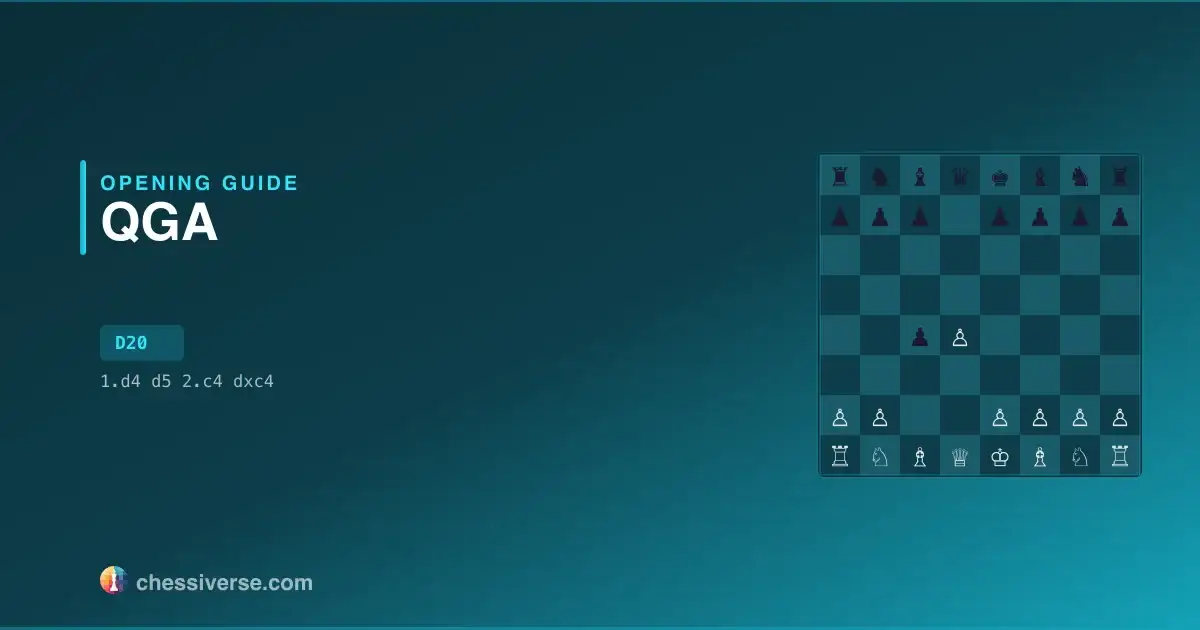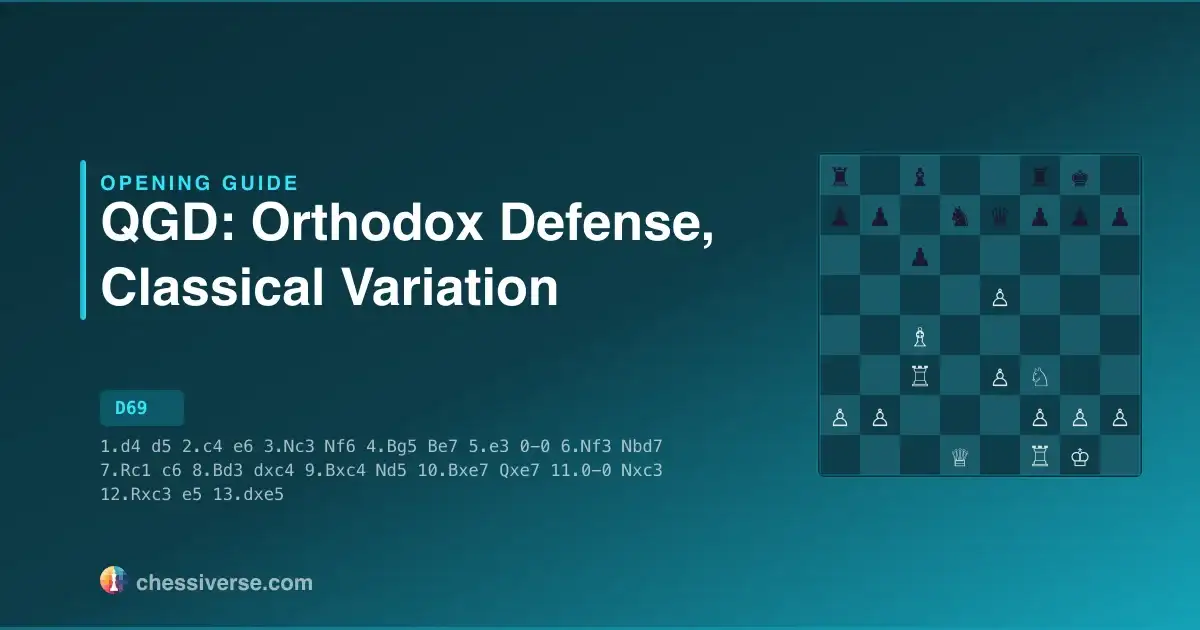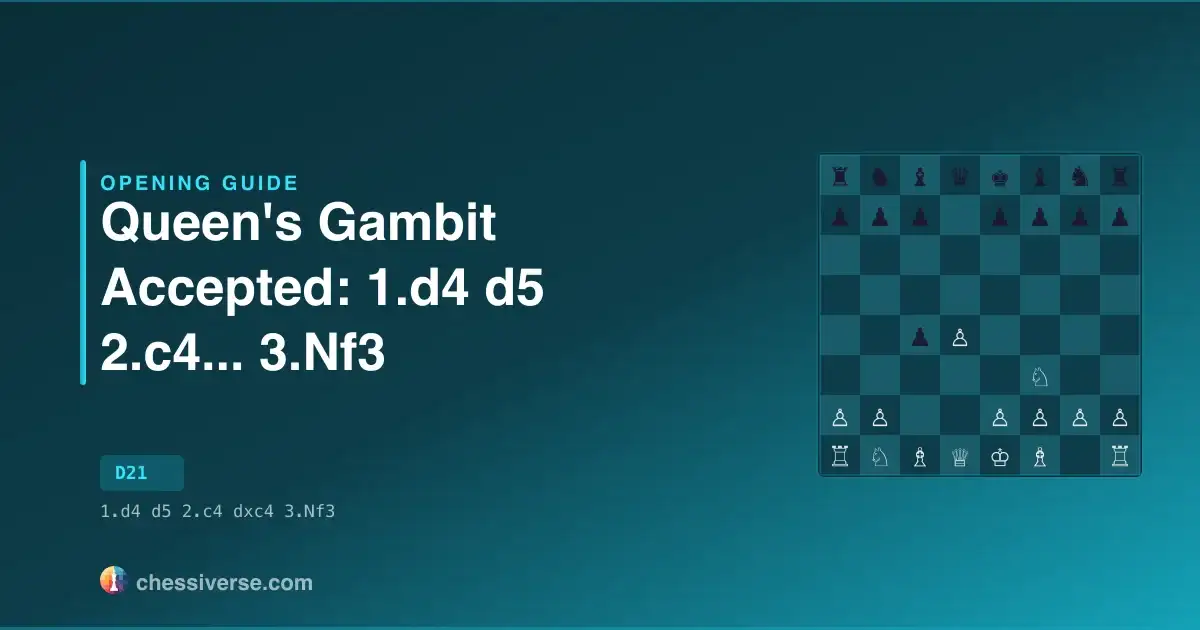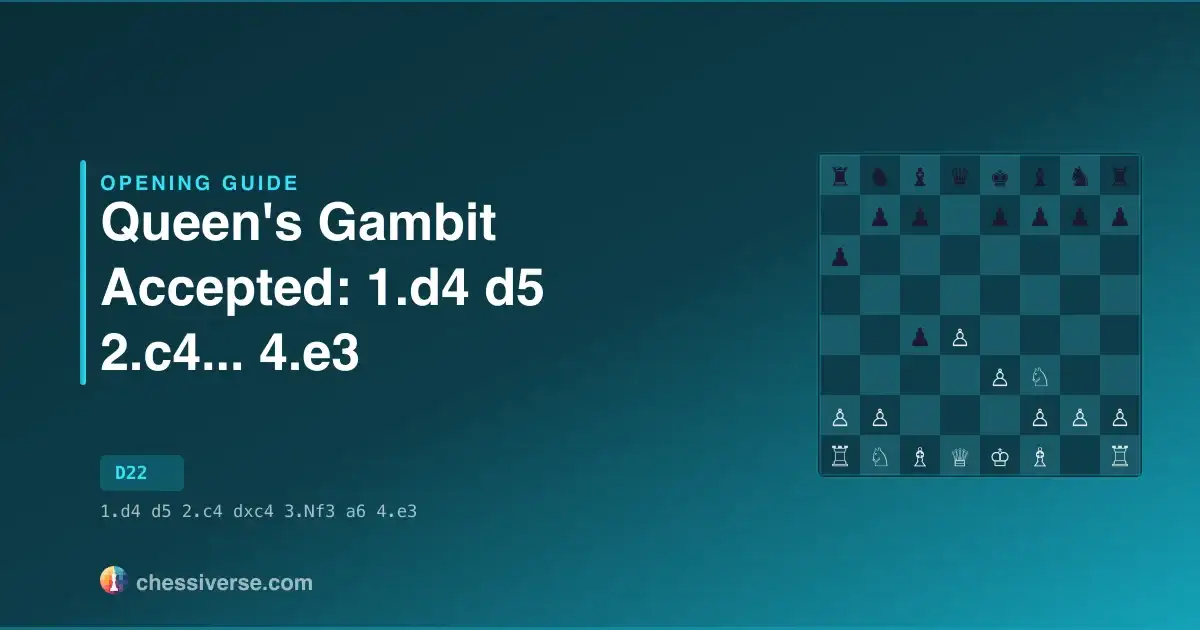


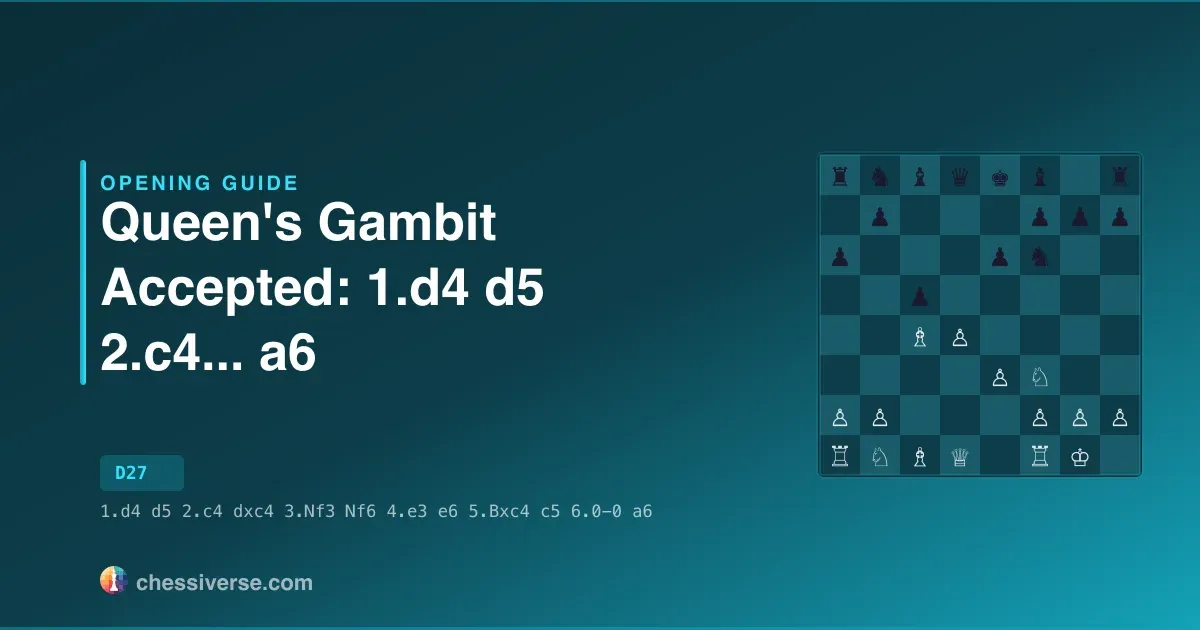
Starting from 1.d4 d5 2.c4 dxc4 3.Nf3 Nf6 4.e3 e6 5.Bxc4 c5 6.0-0 a6, players enter the Queen's Gambit Accepted: Classical Defense, Main Line — ECO D27. Across rating levels it shows up in 179,352 recorded games — enough data to map exactly where it succeeds and where it stalls.
History and Notable Players
It arises from the Queen's Gambit Accepted: Normal Variation, Traditional System. Among the most prolific White practitioners are Zdenko Kozul (41 games), Vladimir Kramnik (38 games), Ognjen Cvitan (30 games). Black-side regulars include Hrvoje Stevic (80 games), Sergei Rublevsky (61 games), Yuri Yakovich (54 games).
Performance Across Rating Levels
Popularity and results vary sharply by rating level. At 1200 Elo, the opening shows up in 0.00% of games (855 samples). White scores 38.4%, Black 56.8%, draws 4.8%. Move up to 1800 Elo and the share shifts to 0.00%, with White winning 44.5% versus Black's 47.2%. At the top end (2500+ Elo), popularity is 0.15% with 16.1% draws — a clear sign of how much theory rules the line at master level. White's score improves by 6.1pp from the 1200 bracket to the 2500 bracket — the line rewards preparation.
Move Diversity and Theory Depth
Move choice is far from uniform in the Queen's Gambit Accepted: Classical Defense, Main Line. At 1200 Elo (853 games), the top reply is Nc3, played 37.8% of the time. Three other moves each take at least 5% of games, and the top three moves account for 73.4% of games. Entropy: 2.71. By 2500 (20,434 games), dxc5 takes over as the top reply at 26.4%; five other moves reach 5% and the top three moves account for 52.5% of games. Entropy rises to 3.17. Even elite players don't fully agree on the best continuation here, which keeps the position dynamic.
Main Lines and Variations
From the position after 1.d4 d5 2.c4 dxc4 3.Nf3 Nf6 4.e3 e6 5.Bxc4 c5 6.0-0 a6, the recognised continuations are:
Each branch leads to a different middlegame character — the resulting pawn structure decides what kind of game you get.
Common Mistakes
- Neglecting development — It can feel productive to make extra pawn moves early, but falling behind in piece development is what loses most amateur games — especially in open positions where active pieces find squares fast.
- Overextending the attack — Gambits look like permission to throw everything forward. They aren't — every attacking move should improve a piece. Random checks and threats burn the initiative once they fail to coordinate.
Practice on Chessiverse
Ready to try the Queen's Gambit Accepted: Classical Defense, Main Line against a bot? Pick an opponent at your level and play a game.