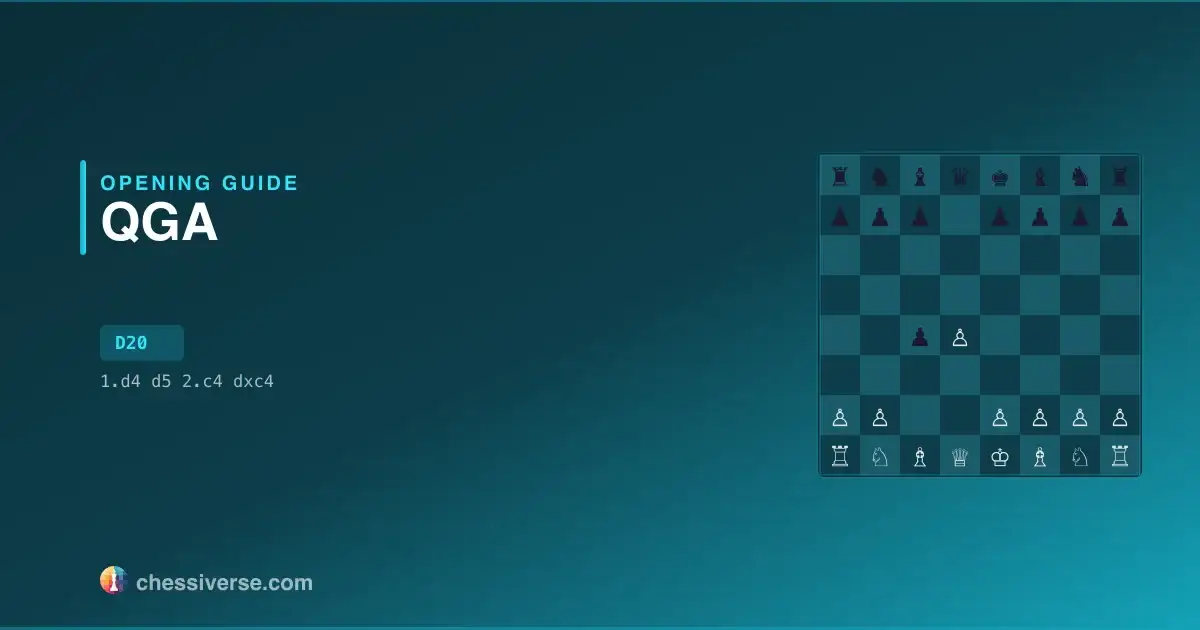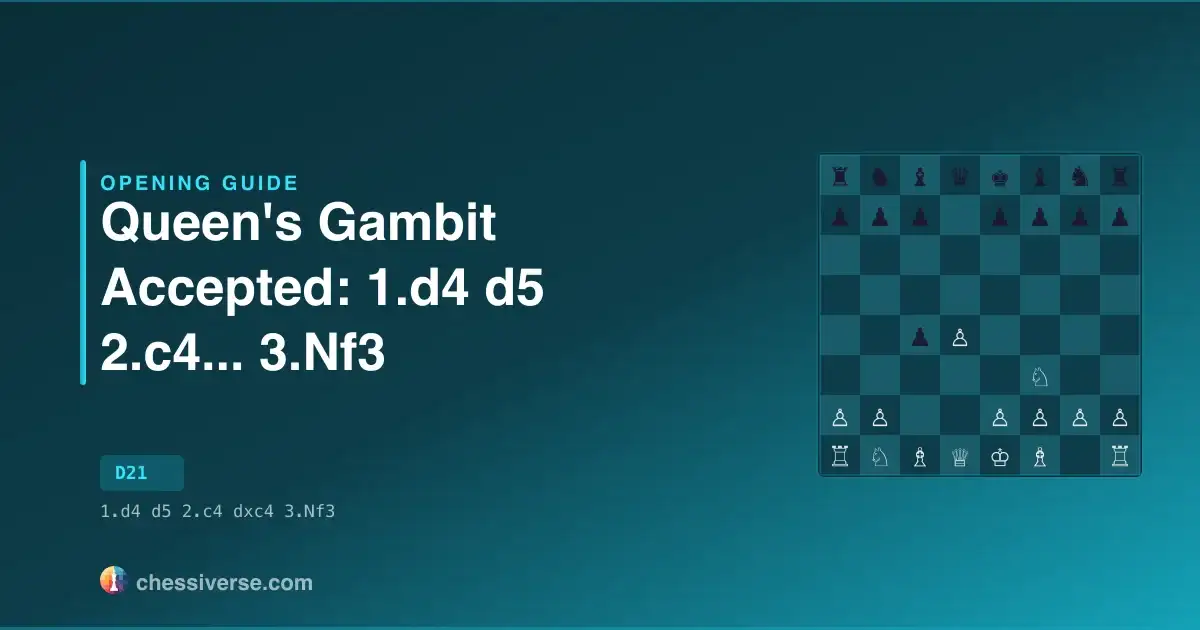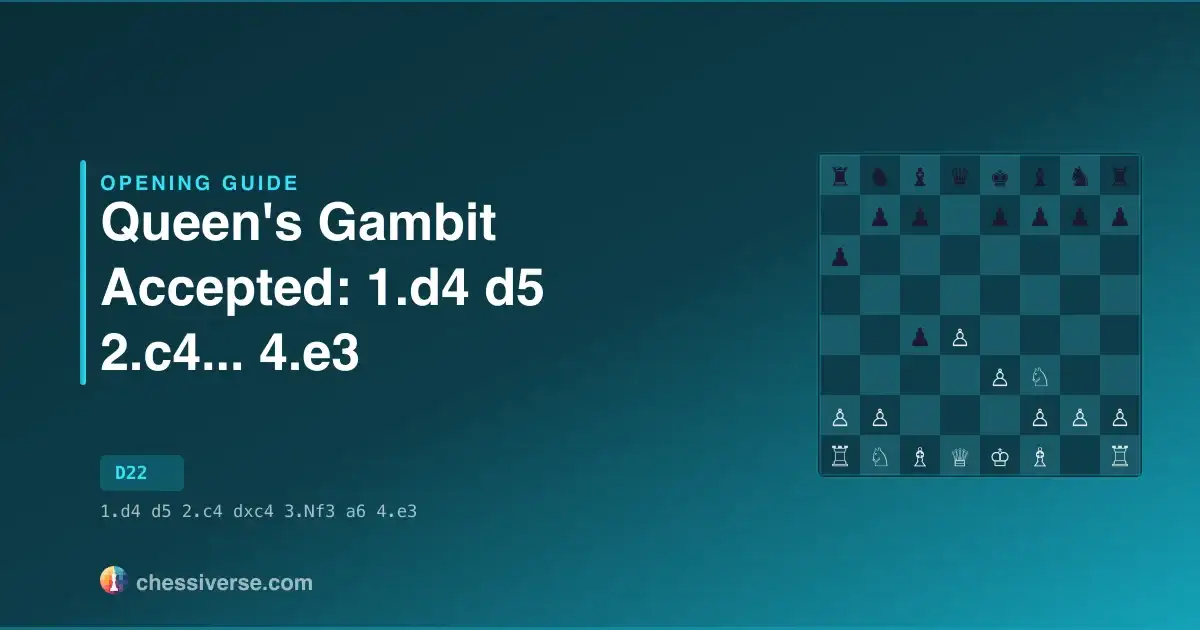




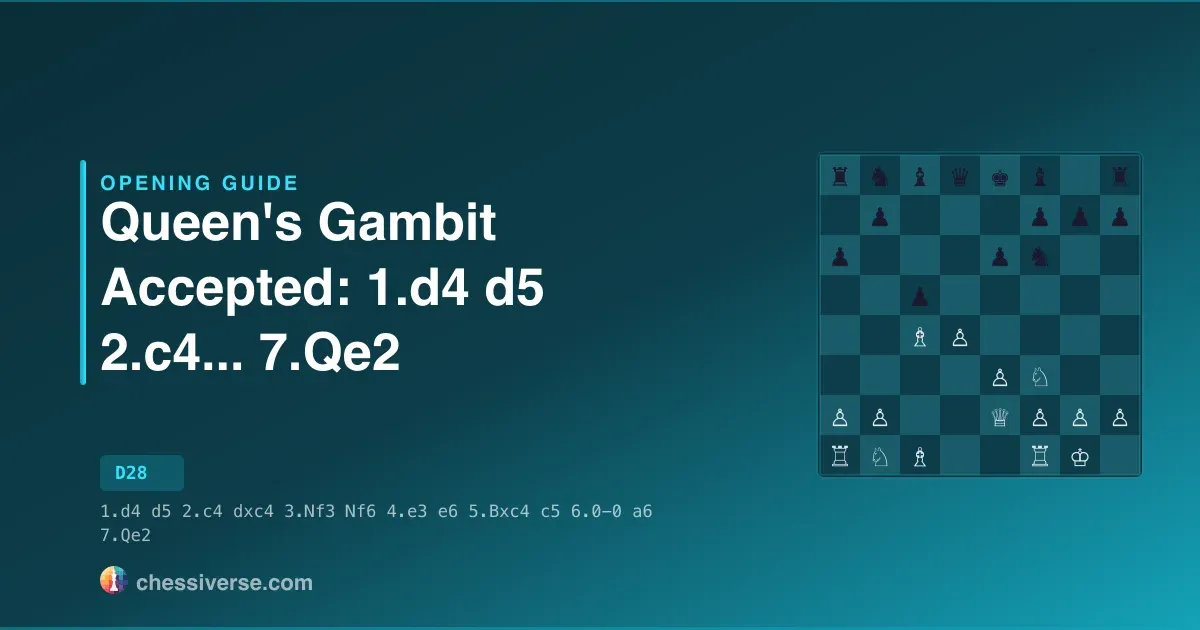
The Queen's Gambit Accepted: Classical Defense, Alekhine System begins with 1.d4 d5 2.c4 dxc4 3.Nf3 Nf6 4.e3 e6 5.Bxc4 c5 6.0-0 a6 7.Qe2 (ECO D28). With 24,533 games on record, the patterns below come from the largest practical sample available.
History and Notable Players
It arises from the Queen's Gambit Accepted: Classical Defense, Main Line. On the White side, Artur Jussupow (9 games), Nukhim N Rashkovsky (8 games), Krishnan Sasikiran (8 games) top the database. Notable Black exponents: Milan Drasko (12 games), Herman Pilnik (10 games), Carlos Garcia Palermo (10 games).
Performance Across Rating Levels
The picture changes a lot as you climb the rating ladder. At 1200 Elo, the opening shows up in 0.00% of games (15 samples). White scores 46.7%, Black 46.7%, draws 6.7%. By 1800, popularity is 0.00% and White's score is 50.3% to Black's 45%. At 2500, 0.02% of games go into this opening; draws sit at 10.5% — the line is well-mapped at this level. White's edge erodes by 3.8pp from 1200 to 2500 Elo, suggesting Black's counterplay is easier to find with experience.
Move Diversity and Theory Depth
Looking at move selection shows how forcing — or not — the position really is. Below 1600 the samples are small (15 games at 1200, 65 at 1400), so the comparison starts at 1600, with 254 games. There, the top reply is b5, played 72% of the time. Two other moves each take at least 5% of games, and the top three moves account for 92.5% of games. Entropy: 1.40. By 2500 (2,889 games), b5 dominates at 59.5% of replies; two other moves reach 5% and the top three moves account for 94% of games. Entropy rises to 1.54. Even elite players don't fully agree on the best continuation here, which keeps the position dynamic.
Main Lines and Variations
After 1.d4 d5 2.c4 dxc4 3.Nf3 Nf6 4.e3 e6 5.Bxc4 c5 6.0-0 a6 7.Qe2, the established follow-ups are:
Each branch leads to a different middlegame character — the resulting pawn structure decides what kind of game you get.
Common Mistakes
- Neglecting development — Extra pawn moves in the opening are tempting, especially when you "know the moves". Developing a piece each turn is the simple correction.
- Overextending the attack — Gambits look like permission to throw everything forward. They aren't — every attacking move should improve a piece. Random checks and threats burn the initiative once they fail to coordinate.
Practice on Chessiverse
Ready to try the Queen's Gambit Accepted: Classical Defense, Alekhine System against a bot? Pick an opponent at your level and play a game.