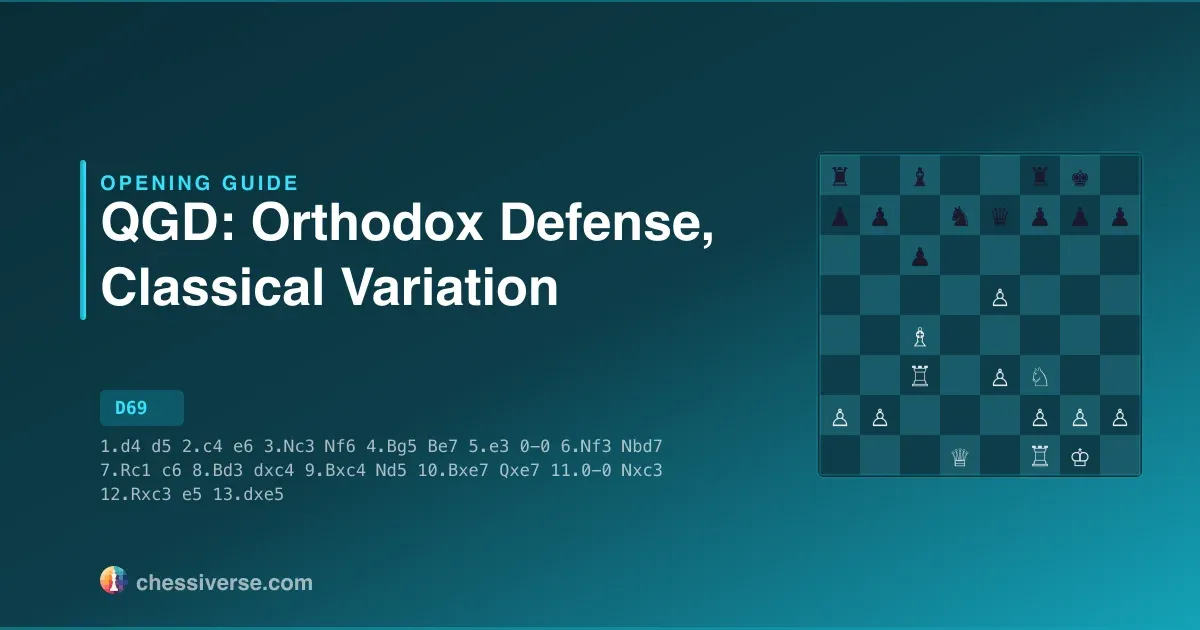
Starting from 1.d4 d5 2.c4 e6 3.Nc3 Nf6 4.Bg5 Be7 5.e3 0-0 6.Nf3 Nbd7 7.Rc1 c6 8.Bd3 dxc4 9.Bxc4 Nd5 10.Bxe7 Qxe7 11.0-0 Nxc3 12.Rxc3 e5 13.dxe5, players enter the QGD: Orthodox Defense, Classical Variation — ECO D69. The Capablanca freeing manoeuvre carried to its logical conclusion. Pieces have been exchanged on a grand scale, the centre is half-open, and the position is nearly symmetrical — but White still holds a small edge.
Strategic Overview
This is one of the most thoroughly analysed positions in classical chess theory. The Orthodox Defense Classical Variation follows the famous freeing manoeuvre: Black plays ...dxc4 to clear the central tension, then ...Nd5 to trade off pieces, including the dark-squared bishops, and finally ...e5 to free the position. By move thirteen, after dxe5, most of the pieces are off the board or about to be, and the resulting middlegame is almost symmetrical. But "almost" is the operative word. White has a half-tempo of development, a marginally better-placed rook on c3, and the typical slight initiative of the first move. Black has reached one of the soundest equalising lines available against 1.d4, but the position is not yet drawn — endgame technique matters, and the slight initiative can persist deep into the middlegame and beyond. This line was the safe choice of generations of world champions for a reason: it minimises risk, neutralises White's most ambitious plans, and forces White to find genuinely good moves to extract any chances. At club level it can be a snooze; at top level it remains a thoroughly modern weapon.
Key Ideas
When players succeed in this line, they usually do so by leaning on the following themes:
- Massive piece exchanges by move thirteen — The classical Capablanca freeing manoeuvre trades down aggressively, taking the dark-squared bishops off the board and resolving central tension. The result is a simplified middlegame where positional precision matters more than tactics.
- White retains a slight initiative — Even after extensive simplification, White holds a small edge — better piece coordination, a useful rook on c3, the lingering first-move advantage. Black aims for activity, not symmetry, to neutralise it.
- Endgame technique often decides — Because the middlegame is so simplified, many of these positions transition into rook or minor-piece endgames where small structural advantages matter. Both sides need to know endgame theory cold.
- A reliable equalising weapon at top level — Generations of world champions have used this line as a safe answer to 1.d4. Modern theory still considers it one of Black's most dependable paths to a playable middlegame.
History and Notable Players
It arises from the Queen's Gambit Declined: Orthodox Defense, Capablanca System (10...Qxe7).
The Queen's Gambit Declined was especially common in the early 20th century: in the 1927 Alekhine-Capablanca title match, every game but two of thirty-four opened with it. Capablanca introduced the freeing manoeuvre beginning 9...Nd5, and the resulting simplifying line was once played so often it earned its own ECO code.
Named after: "Orthodox" is the label for declining the gambit with 2...e6; this Classical Variation of that defence is also called the Orthodox Defense.
Notable players: José Raúl Capablanca, Alexander Alekhine
This exact sequence of central exchanges was once so routine that the Encyclopaedia of Chess Openings gave it a code of its own, D69 - though it has since faded from modern practice.
Move Diversity and Theory Depth
Move choice is far from uniform in the QGD: Orthodox Defense, Classical Variation. Below 1600 the samples are small (6 games at 1200, 37 at 1400), so the comparison starts at 1600, with 417 games. There, the top reply is Nxe5, played 99.5% of the time. No other move reaches 5% of games, and the top three moves account for 100% of games. Entropy: 0.05. By 2200 (1,397 games), Nxe5 dominates at 100% of replies; no other move reaches 5%. Entropy drops to 0.00.
Common Mistakes
- Neglecting development — Extra pawn moves in the opening are tempting, especially when you "know the moves". Developing a piece each turn is the simple correction.
- Releasing tension too early — The c4/d5 tension is the heart of these openings. Capturing or pushing prematurely usually surrenders the initiative.
Practice on Chessiverse
Ready to try the QGD: Orthodox Defense, Classical Variation against a bot? Pick an opponent at your level and play a game.