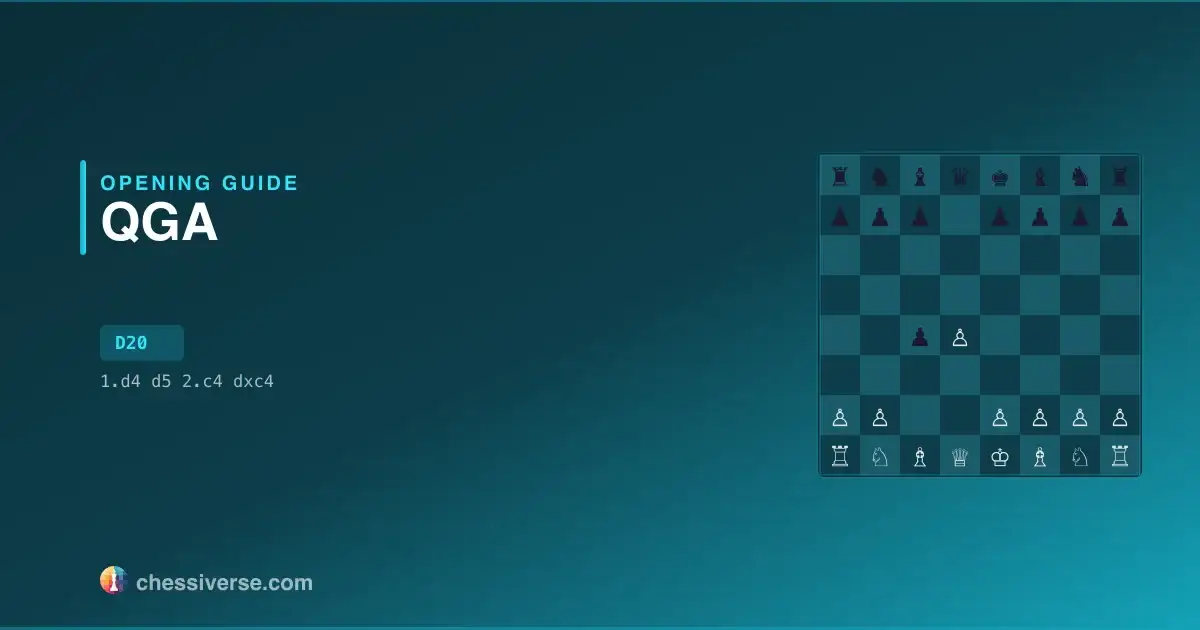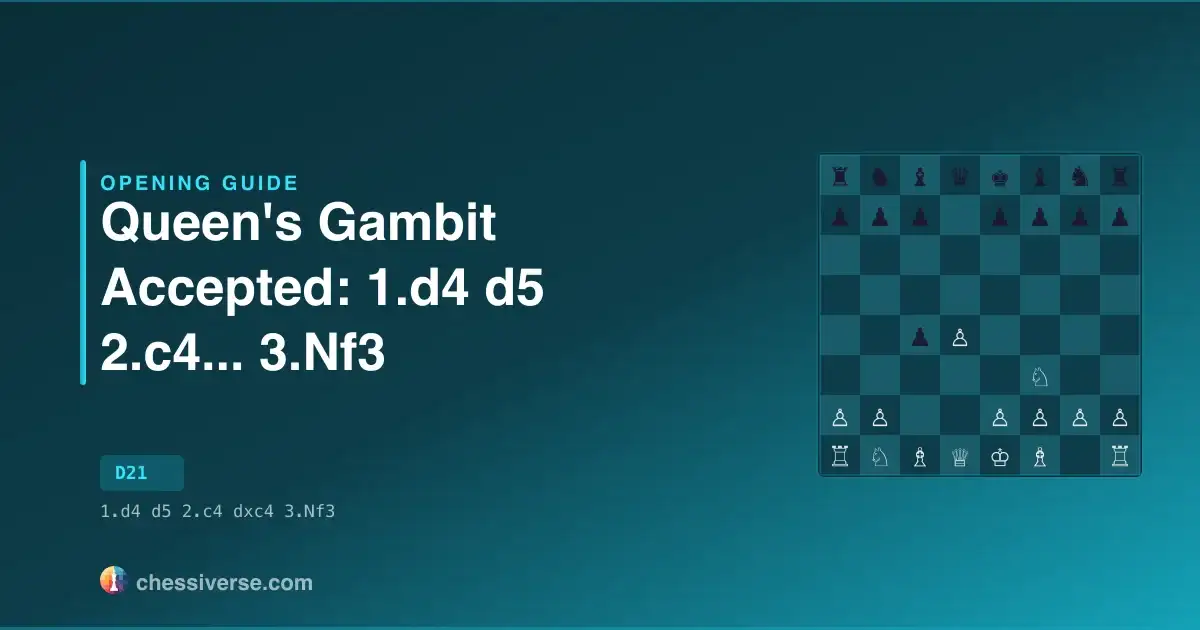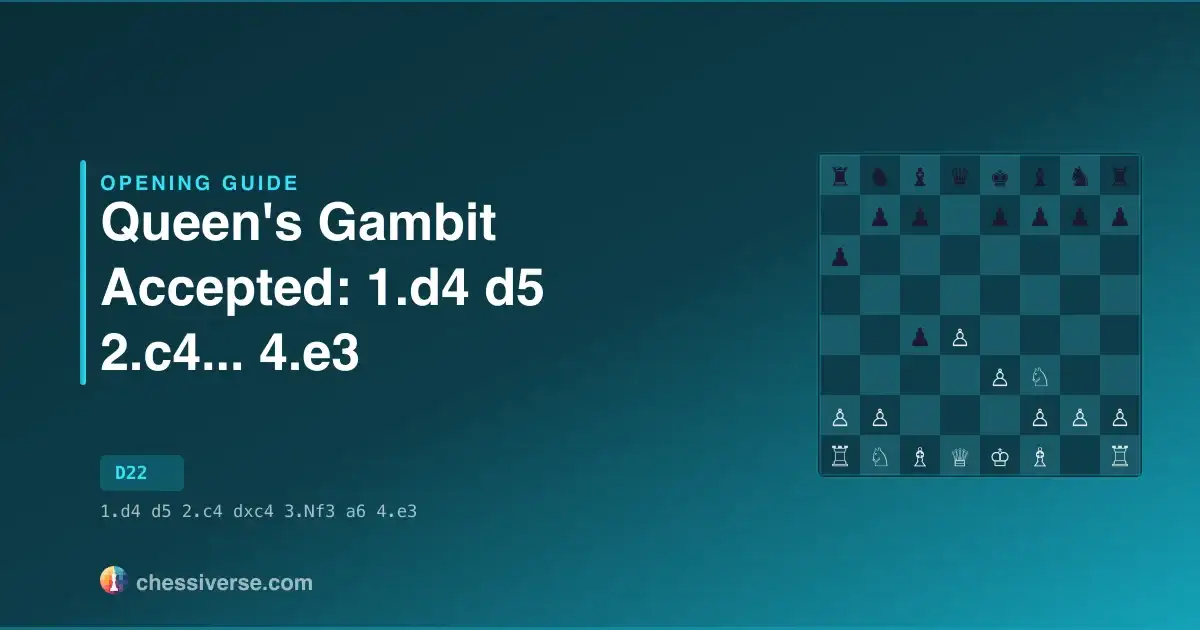
Queen's Gambit Declined: 1.d4 d5 2.c4...... Qxe7

-43%
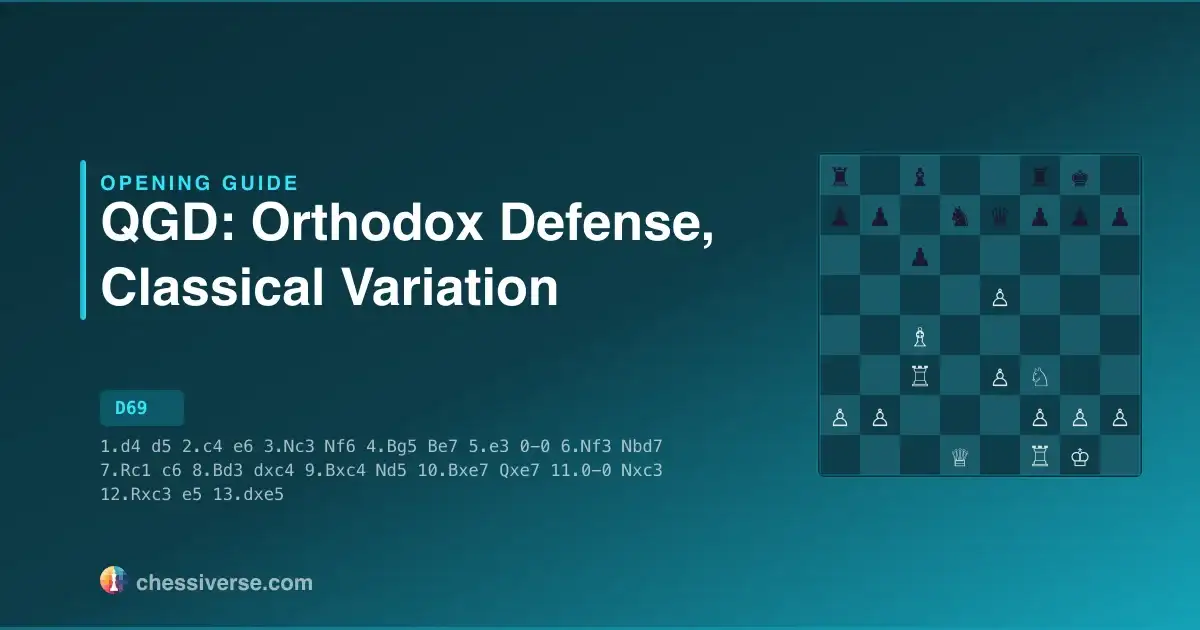
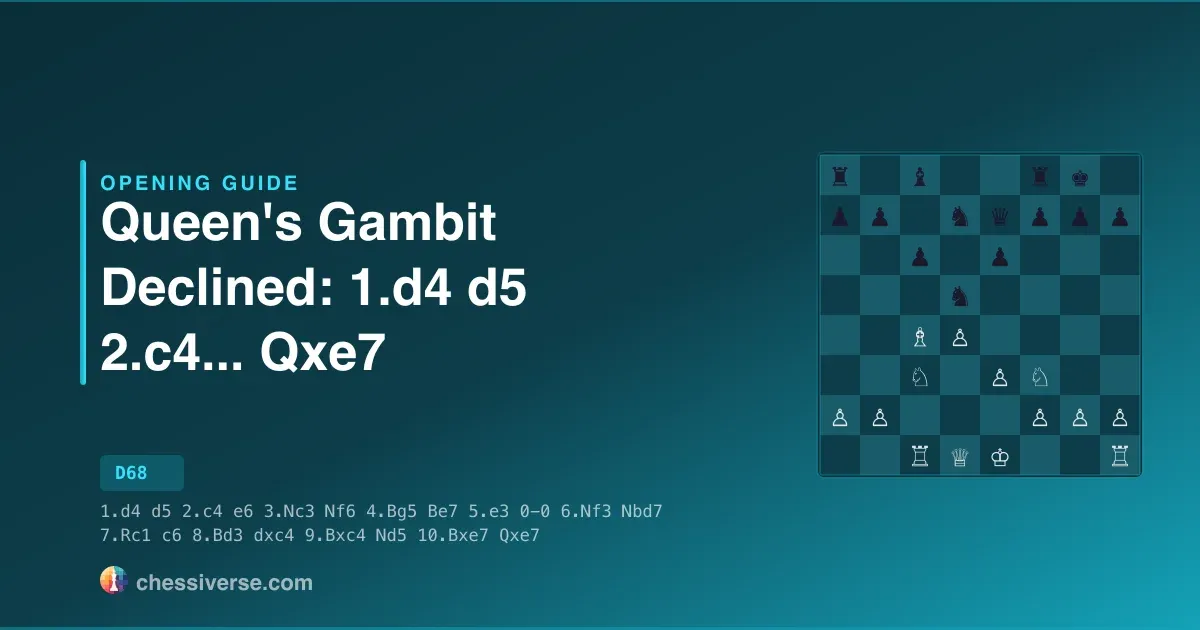
D681.d4 d5 2.c4 e6 3.Nc3 Nf6 4.Bg5 Be7 5.e3 0-0 6.Nf3 Nbd7 7.Rc1 c6 8.Bd3 dxc4 9.Bxc4 Nd5 10.Bxe7 Qxe7
Jun 14, 2028
TL;DR

Classical Orthodox endgame line: minor pieces traded, queens still on, Black's solid ...e6/...c6 structure absorbing the pressure. A theoretical drawing recipe rediscovered every generation since Capablanca first proved it sound.

Reviewed by

IM John Bartholomew
IM John BartholomewCo-Founder & Chess Educator

International Master and chess educator. Co-founded Chessable and joined Chessiverse as co-founder. Best known for his "Climbing the Rating Ladder" YouTube series and structured opening courses.

Queen's Gambit Declined: 1.d4 d5 2.c4...... Qxe7: A Complete Guide
Queen's Gambit Declined: 1.d4 d5 2.c4...... Qxe7 - Opening Moves
Summary

The Queen's Gambit Declined: 1.d4 d5 2.c4... Qxe7 begins with 1.d4 d5 2.c4 e6 3.Nc3 Nf6 4.Bg5 Be7 5.e3 0-0 6.Nf3 Nbd7 7.Rc1 c6 8.Bd3 dxc4 9.Bxc4 Nd5 10.Bxe7 Qxe7 (ECO D68). Across rating levels it shows up in 22,142 recorded games — enough data to map exactly where it succeeds and where it stalls.

History and Notable Players

It arises from the Queen's Gambit Declined: 1.d4 d5 2.c4... Nd5. Among the most prolific White practitioners are Gideon Stahlberg (9 games), Milan Sr Vidmar (9 games), Vasja Pirc (7 games). Black-side regulars include Milan Sr Vidmar (8 games), Gideon Stahlberg (8 games), Petar Trifunovic (7 games).

Move Diversity and Theory Depth

Move choice is far from uniform in the Queen's Gambit Declined: 1.d4 d5 2.c4... Qxe7. At 1200 Elo, the top reply is O-O, played 68.8% of the time. There are 2 other moves seeing meaningful share, and 84.4% of games stick to established theory. Entropy: 1.68. By 2500, O-O dominates at 80.3% of replies; only 2 viable alternatives remain and 97.6% of moves are theory. Entropy drops to 0.96. That entropy collapse is the signature of a line where preparation pays off: at the top, players know the best move and play it.

Main Lines and Variations

From the position after 1.d4 d5 2.c4 e6 3.Nc3 Nf6 4.Bg5 Be7 5.e3 0-0 6.Nf3 Nbd7 7.Rc1 c6 8.Bd3 dxc4 9.Bxc4 Nd5 10.Bxe7 Qxe7, the recognised continuations are:

Each branch leads to a different middlegame character — the resulting pawn structure decides what kind of game you get.

Common Mistakes

  • Neglecting development — It can feel productive to make extra pawn moves early, but falling behind in piece development is what loses most amateur games — especially in open positions where active pieces find squares fast.
  • Overextending the attack — Gambits look like permission to throw everything forward. They aren't — every attacking move should improve a piece. Random checks and threats burn the initiative once they fail to coordinate.

Practice on Chessiverse

Ready to try the Queen's Gambit Declined: 1.d4 d5 2.c4... Qxe7 against a bot? Pick an opponent at your level and play a game.

Quick Facts

Main Line1.d4 d5 2.c4 e6 3.Nc3 Nf6 4.Bg5 Be7 5.e3 0-0 6.Nf3 Nbd7 7.Rc1 c6 8.Bd3 dxc4 9.Bxc4 Nd5 10.Bxe7 Qxe7
DifficultyExpert
Style

Theoretician openings have deep, well-studied lines where knowledge of specific variations gives a significant advantage. Preparation and memorization of key lines are essential.

22,142games on Lichess
48.9%
9.2%
41.9%
White wins Draws Black wins

Top Players

Data from Lichess opening explorer (blitz & rapid)

Most Popular At2200
SharpnessCalm

Popularity by Rating

Percentage of all games at each rating bracket that feature this opening.

Data from Lichess opening explorer (blitz & rapid games)

Theory Adherence by Rating

How often players choose the single most popular move at this position. Higher = more predictable play.

White to move after the opening line

Popularity Over Time

Share of all Lichess blitz + rapid games featuring this opening, by year.

Top Moves by Rating

White to move after the opening line

RatingMost Popular2nd3rd
400O-O88.9%Ne411.1%
1000O-O100%
1200O-O68.8%Nxd512.5%Qe23.1%
1400O-O65.5%Nxd510.2%Bd35.5%
1600O-O73.2%Nxd56.5%e46.5%
1800O-O78.1%e47.2%Nxd53.9%
2000O-O84.2%e46.4%Ne43.4%
2200O-O82.5%Ne410.4%e44.2%
2500O-O80.3%Ne414.9%Bxd52.4%

Popularity by Time Control

Bullet
<0.01%6K
Blitz
<0.01%19K
Rapid
<0.01%3K
5% more decisive in bullet
Raw data tables (Lichess blitz + rapid)
Queen's Gambit Declined: 1.d4 d5 2.c4...... Qxe7: popularity and win rates by player rating
Rating (Elo)Share %GamesWhite win %Black win %Draw %Sharpness
4000.00966.733.30.01.000
10000.001540.046.713.30.867
12000.003250.040.69.40.906
14000.0025551.441.67.10.929
16000.001,98850.443.06.60.934
18000.006,39848.943.57.60.924
20000.008,05149.341.29.50.905
22000.005,09947.640.911.40.886
25000.0029549.835.614.60.854
Queen's Gambit Declined: 1.d4 d5 2.c4...... Qxe7: move-choice theory adherence by rating
Rating (Elo)Top moveTop move %Viable movesTheory %Entropy
400O-O88.92100.00.503
1000O-O100.01100.00.000
1200O-O68.8284.41.684
1400O-O65.5481.21.929
1600O-O73.2486.11.558
1800O-O78.1289.21.334
2000O-O84.2294.01.025
2200O-O82.5297.10.995
2500O-O80.3297.60.963
Queen's Gambit Declined: 1.d4 d5 2.c4...... Qxe7: popularity over time
YearShare %GamesWhite win %Black win %Draw %
20130.002147.647.64.8
20140.0010350.540.88.7
20150.0021257.535.86.6
20160.0054044.847.47.8
20170.0089949.242.88.0
20180.001,27251.840.37.9
20190.001,60747.943.98.2
20200.003,40747.942.69.4
20210.003,54348.341.110.5
20220.003,08847.942.89.4
20230.003,13949.341.59.2
20240.003,03949.841.29.0
20250.002,83050.140.89.0
Queen's Gambit Declined: 1.d4 d5 2.c4...... Qxe7: popularity by time control
FormatShare %GamesWhite win %Black win %Draw %Sharpness
bullet0.005,84448.446.25.40.946
blitz0.0019,43148.842.19.00.910
rapid0.002,66849.540.310.20.898
Queen's Gambit Declined: 1.d4 d5 2.c4...... Qxe7: top candidate moves by rating bracket
Rating (Elo)1st move1st %2nd move2nd %3rd move3rd %
400O-O88.9Ne411.1
1000O-O100.0
1200O-O68.8Nxd512.5Qe23.1
1400O-O65.5Nxd510.2Bd35.5
1600O-O73.2Nxd56.5e46.5
1800O-O78.1e47.2Nxd53.9
2000O-O84.2e46.4Ne43.4
2200O-O82.5Ne410.4e44.2
2500O-O80.3Ne414.9Bxd52.4
Queen's Gambit Declined: 1.d4 d5 2.c4...... Qxe7: top practitioners by side
SidePlayerGames
WhiteGideon Stahlberg9
WhiteMilan Sr Vidmar9
WhiteVasja Pirc7
BlackMilan Sr Vidmar8
BlackGideon Stahlberg8
BlackPetar Trifunovic7

Frequently Asked Questions

What is the Queen's Gambit Declined: 1.d4 d5 2.c4... Qxe7?

The Queen's Gambit Declined: 1.d4 d5 2.c4... Qxe7 begins with 1.d4 d5 2.c4 e6 3.Nc3 Nf6 4.Bg5 Be7 5.e3 0-0 6.Nf3 Nbd7 7.Rc1 c6 8.Bd3 dxc4 9.Bxc4 Nd5 10.Bxe7 Qxe7 and is classified under ECO code D68.

Is the Queen's Gambit Declined: 1.d4 d5 2.c4... Qxe7 good for beginners?

The Queen's Gambit Declined: 1.d4 d5 2.c4... Qxe7 can be played at any level. Beginners should focus on understanding the key strategic ideas rather than memorizing long theoretical lines. Our AI bots at various rating levels provide a great way to practice the opening concepts.

What are the main variations of the Queen's Gambit Declined: 1.d4 d5 2.c4... Qxe7?

The main continuations include: QGD: Orthodox Defense, Classical Variation. Each variation leads to distinct types of positions with their own strategic themes.

What are the win rates for the Queen's Gambit Declined: 1.d4 d5 2.c4... Qxe7?

In a database of 22,142 master games, White wins 48.9% of the time, Black wins 41.9%, and 9.2% are drawn. Notable players on the White side include Gideon Stahlberg and Milan Sr Vidmar. On the Black side, Milan Sr Vidmar and Gideon Stahlberg are among the most frequent practitioners.

Reviewed by

IM John Bartholomew
IM John BartholomewCo-Founder & Chess Educator

International Master and chess educator. Co-founded Chessable and joined Chessiverse as co-founder. Best known for his "Climbing the Rating Ladder" YouTube series and structured opening courses.

Practice This Opening on Chessiverse

Play against 1000+ AI bots with unique personalities and opening repertoires. From beginner-friendly to grandmaster-level opponents, find the perfect sparring partner for any opening.

Play Now

Not sure which opening fits you? Take the free chess personality test — your style determines which openings will work with you.

Back to Articles