


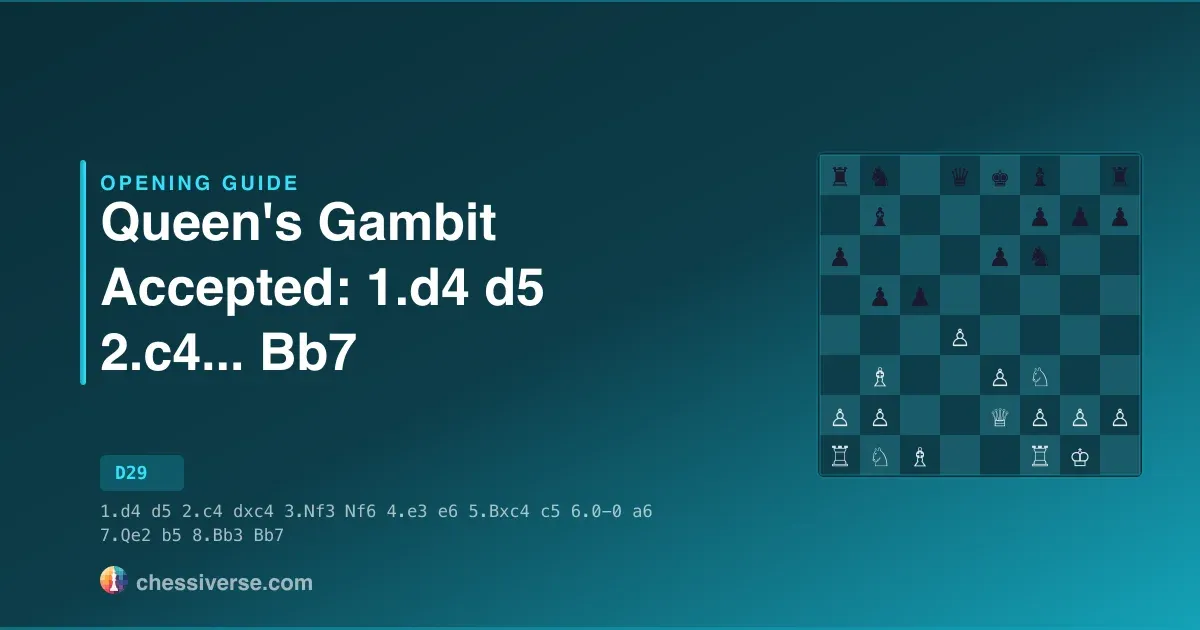
1.d4 d5 2.c4 dxc4 3.Nf3 Nf6 4.e3 e6 5.Bxc4 c5 6.0-0 a6 7.Qe2 b5 8.Bb3 Bb7 opens the Queen's Gambit Accepted: Classical Defense, Alekhine System, Main Line, ECO D29. Lichess records 10,241 games in this line, which gives us a reliable view of how it actually performs in practice.
History and Notable Players
It arises from the Queen's Gambit Accepted: Classical Defense, Alekhine System. Among the most prolific White practitioners are Boris Chatalbashev (8 games), Wolfgang Uhlmann (7 games), Vladimir Burmakin (7 games). Black-side regulars include Milan Drasko (9 games), Herman Pilnik (8 games), Matthias Krallmann (8 games).
Move Diversity and Theory Depth
What players actually play after the opening moves depends heavily on rating. Below 1600 the samples are small (12 games at 1200, 26 at 1400), so the comparison starts at 1600, with 128 games. There, the top reply is Rd1, played 58.6% of the time. Three other moves each take at least 5% of games, and the top three moves account for 89.1% of games. Entropy: 1.78. By 2500 (834 games), Rd1 dominates at 74.6% of replies; three other moves reach 5% and the top three moves account for 94.2% of games. Entropy drops to 1.24. That entropy collapse is the signature of a line where preparation pays off: at the top, players know the best move and play it.
Common Mistakes
- Neglecting development — It can feel productive to make extra pawn moves early, but falling behind in piece development is what loses most amateur games — especially in open positions where active pieces find squares fast.
- Overextending the attack — Gambits look like permission to throw everything forward. They aren't — every attacking move should improve a piece. Random checks and threats burn the initiative once they fail to coordinate.
Practice on Chessiverse
Ready to try the Queen's Gambit Accepted: Classical Defense, Alekhine System, Main Line against a bot? Pick an opponent at your level and play a game.