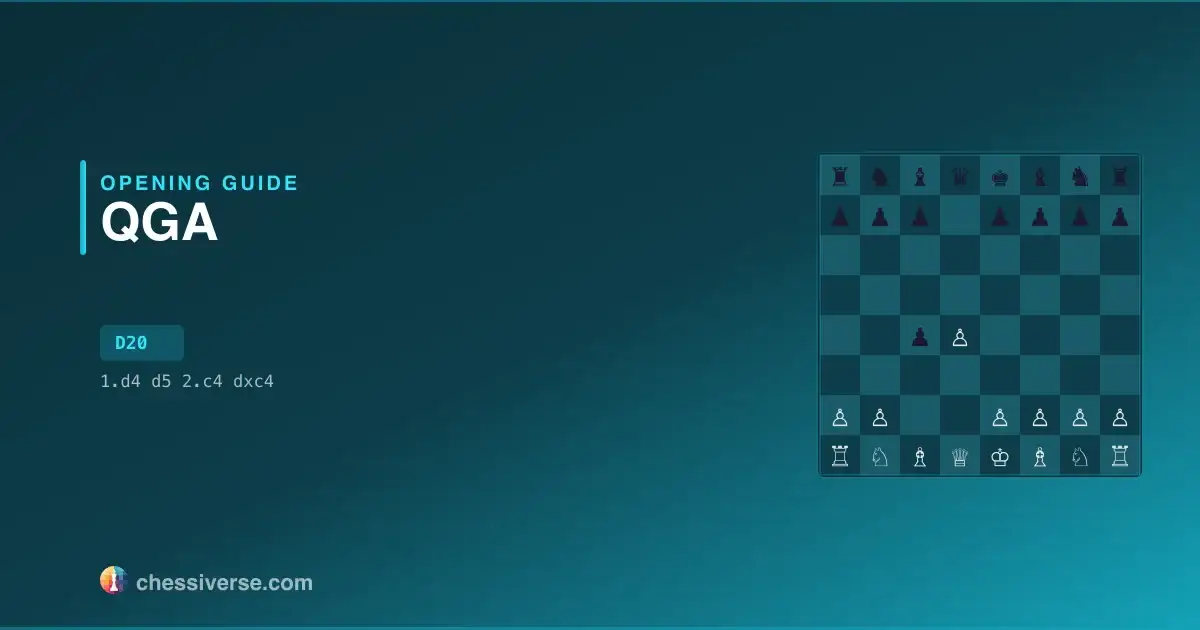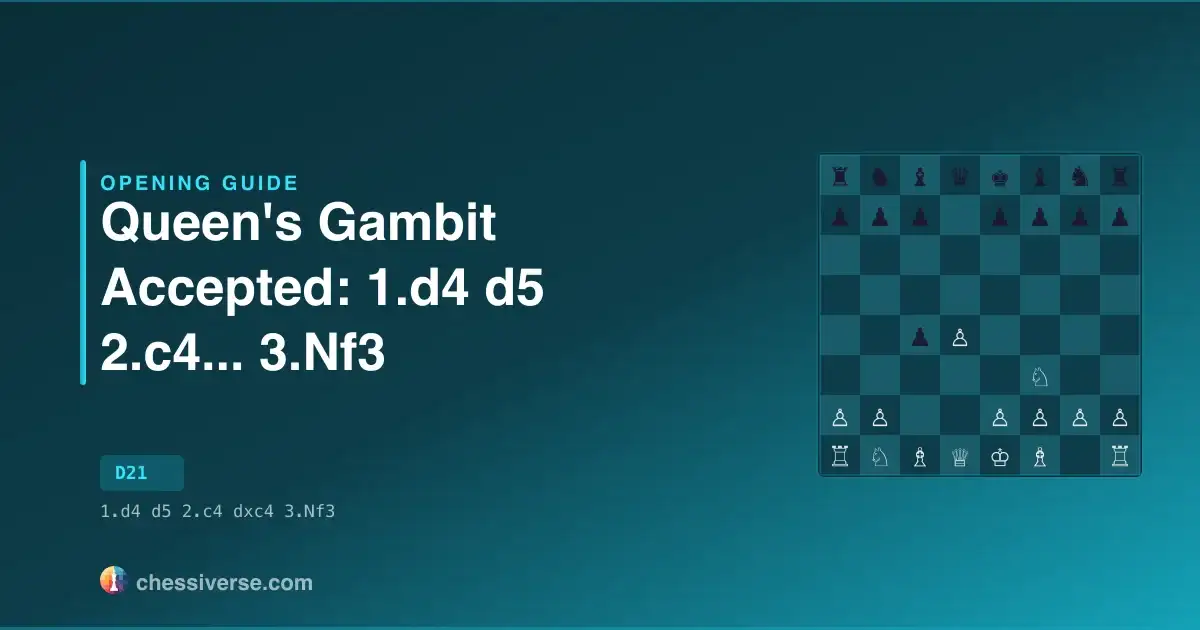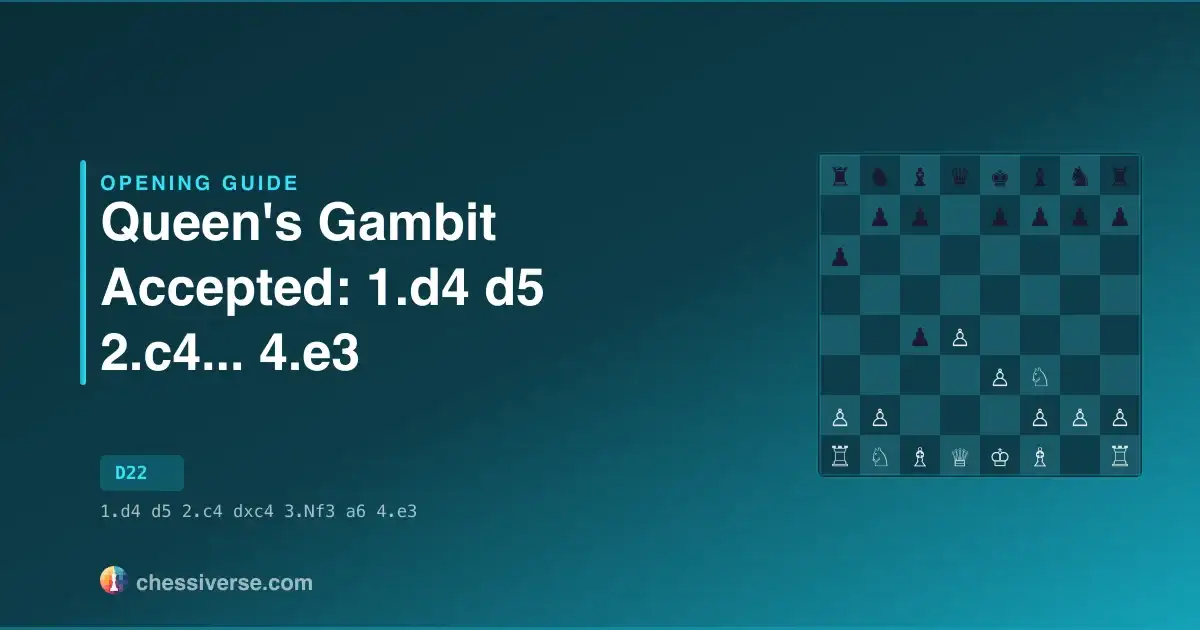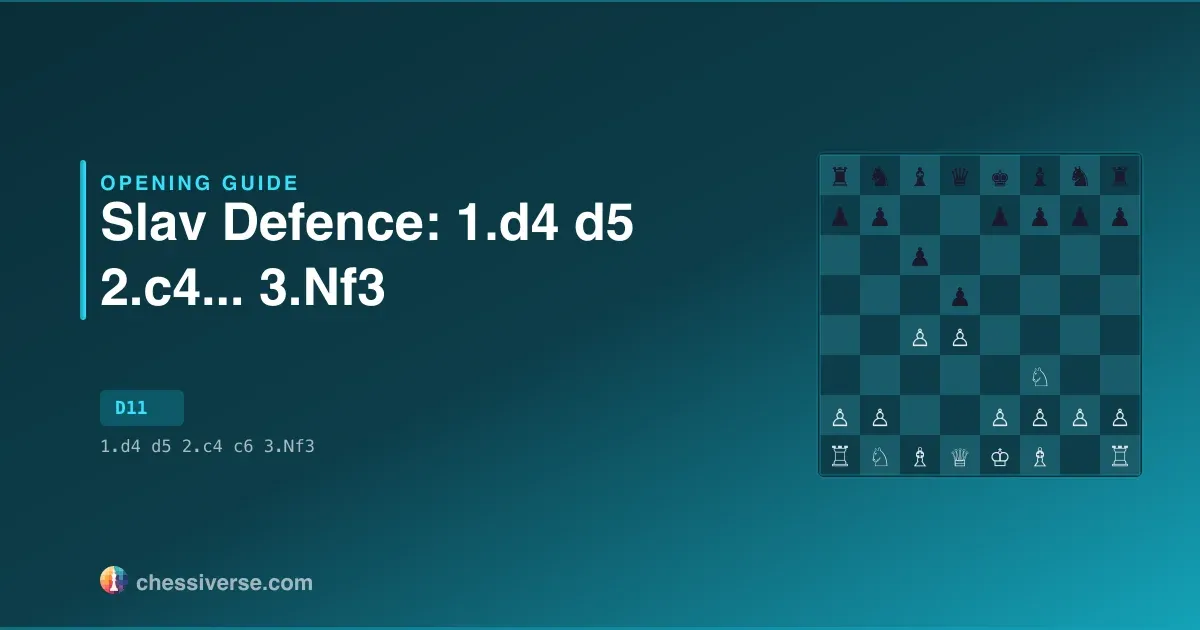
1.d4 d5 2.c4 c6 3.Nf3 opens the Slav Defense: Modern Line, ECO D11. White's most flexible third move in the Slav. Nf3 develops, controls e5, and sidesteps the ...dxc4 lines that work against 3.Nc3 — leaving Black with fewer concrete options and more positional choices.
Strategic Overview
3.Nf3 is the Slav's main highway. The move develops naturally and controls e5, but the key strategic point is what it does to Black's choices compared to 3.Nc3. Two specific Black tries no longer work cleanly. First, 3...Bf5 is still bad because 4.cxd5 cxd5 5.Qb3 wins a pawn. Second — and this is the difference — 3...dxc4 is now also dubious because White just replies 4.e3 and 5.a4, easily recovering the pawn. The knight on f3 isn't vulnerable to ...b5-b4 the way a knight on c3 would be, so the standard Slav-accepted pawn-grab fails here. That leaves Black with two main practical options. 3...Nf6 is by far the most common and usually transposes into Semi-Slav waters after 4.Nc3, though the Quiet Slav with 4.e3 is also a self-contained system. 3...a6 (the Chebanenko) is a fashionable modern alternative that emphasises queenside flexibility and tends to lead to Chebanenko Slav main lines. The whole point of 3.Nf3 for White is to keep options open and steer Black away from the most theoretical Slav-accepted lines, which is exactly why it's the move you see in most Slav games at every level.
Key Ideas
When players succeed in this line, they usually do so by leaning on the following themes:
- 3.Nf3 quietly closes the ...dxc4 escape — Compared to 3.Nc3, the knight on f3 isn't vulnerable to ...b5-b4 chasing tactics. That means 4.e3 and 5.a4 cleanly recover the c4-pawn, and Black can't just grab and run the way they can after 3.Nc3.
- 3...Bf5 still loses a pawn — The bishop-out approach fails to 4.cxd5 cxd5 5.Qb3 hitting both b7 and d5 — a tactic Black can't afford. Same as against 3.Nc3, this is the universal Slav trap to know.
- 3...Nf6 funnels into the Semi-Slav — The mainline reply usually leads to standard Semi-Slav positions after 4.Nc3. White has the 4.e3 Quiet Slav as an alternative that delays or skips Nc3 entirely, sidestepping the deepest theory.
- 3...a6 is the Chebanenko approach — Black plays ...a6 early to support ...b5 and stake claim on the queenside. The line is solid and fashionable, with White often choosing between the standard mainline Chebanenko or a Catalan-style 4.g3 setup.
History and Notable Players
It arises from the Slav Defense. Among the most prolific White practitioners are Aleksey Dreev (142 games), Alexander G Beliavsky (135 games), Pavel V Tregubov (122 games). Black-side regulars include Aleksey Dreev (312 games), Alexei Shirov (210 games), Sergey Volkov (208 games).
Performance Across Rating Levels
Popularity and results vary sharply by rating level. At 1200 Elo, the opening shows up in 0.11% of games (751,787 samples). White scores 52.1%, Black 44.1%, draws 3.8%. Move up to 1800 Elo and the share shifts to 0.36%, with White winning 51.8% versus Black's 42.9%. Among 2500-rated players the line appears in 1.18% of games and draws spike to 10.5%, indicating tight preparation. Positions also become less sharp as level rises (sharpness 0.96 → 0.90).
Time Control Patterns
Time control matters here: bullet players reach for this opening more than others. In bullet, it appears in 0.31% of games (8,234,647); White wins 51.9%. Blitz shows 0.29% adoption across 10,512,210 games, White scoring 51.5%. In rapid, the share rises to 0.19% — 2,066,114 games, White 52.6%.
Move Diversity and Theory Depth
Looking at move selection shows how forcing — or not — the position really is. At 1200 Elo (751,787 games), the top reply is Nf6, played 38.2% of the time. Four other moves each take at least 5% of games, and the top three moves account for 69.3% of games. Entropy: 2.60. By 2500 (160,742 games), Nf6 dominates at 88% of replies; only one other move still reaches 5% and the top three moves account for 97.6% of games. Entropy drops to 0.74. That entropy collapse is the signature of a line where preparation pays off: at the top, players know the best move and play it.
Historical Trends
Tracking the Slav Defense: Modern Line year over year shows a clear story. Adoption peaked in 2015 at 0.37% (81,988 games). By 2025 it sits at 0.26%, 31% below the peak but still 13% above its 2013 level, so the line is up over the full period despite easing from the high.
Main Lines and Variations
The main branches off 1.d4 d5 2.c4 c6 3.Nf3 include:
- Slav Defense: Three Knights Variation
- Slav Defense: Quiet Variation, Schallopp Defense
- Slav Defense: Exchange Variation
Each branch leads to a different middlegame character — the resulting pawn structure decides what kind of game you get.
Common Mistakes
- Drifting away from main theory — At 400 Elo, the three most-played moves cover 64% of games, against 88.8% at 2000. The most popular deviation is dxc4 (played 19.6% of the time at 400, much less so up top). It looks fine but quietly hands the better-prepared side an edge.
- Neglecting development — It can feel productive to make extra pawn moves early, but falling behind in piece development is what loses most amateur games — especially in open positions where active pieces find squares fast.
- Releasing tension too early — The c4/d5 tension is the heart of these openings. Capturing or pushing prematurely usually surrenders the initiative.
Practice on Chessiverse
Ready to try the Slav Defense: Modern Line against a bot? Pick an opponent at your level and play a game.