



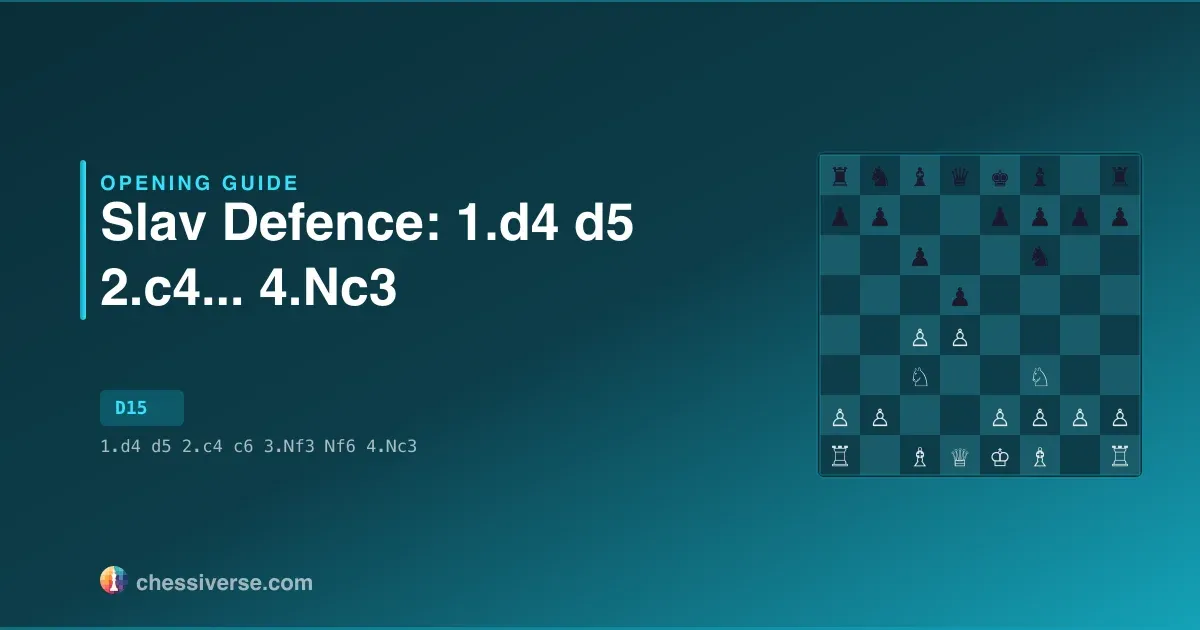
1.d4 d5 2.c4 c6 3.Nf3 Nf6 4.Nc3 opens the Slav Defense: Three Knights Variation, ECO D15. Four moves in and the Slav reaches its decisive branching point. The next Black move chooses between four wildly different opening systems — Semi-Slav, Pure Slav, Chebanenko, or Schlechter — and each of them is its own world.
Strategic Overview
4.Nc3 is the principled main move: it develops the knight to its best square, adds pressure on d5, and controls e4 while keeping the c1-bishop's diagonal open. The whole structural debate of the Slav opens up here, and Black's reply determines the character of the entire game. The Semi-Slav with 4...e6 is the heavyweight choice: Black keeps the queen's bishop temporarily locked in but plans to free it later with a ...c5 or ...e5 break, and the resulting positions are some of the richest in modern theory. The Slav Accepted (or "Pure Slav") with 4...dxc4 takes the pawn and intends to develop the queen's bishop while White is busy recovering material — White typically plays 5.a4 to prevent ...b5, and the main strategic battle is over who controls the c-file and the central squares. The Chebanenko 4...a6 is the modern flexible try, preparing ...b5 and an eventual ...c5 break with maximum queenside freedom. The Schlechter 4...g6 is the rare fianchetto choice that transposes to Grünfeld-like structures. Each of these is a serious opening in its own right and they have almost nothing in common beyond the first four moves — choosing one is choosing a whole repertoire.
Key Ideas
When players succeed in this line, they usually do so by leaning on the following themes:
- Nc3 hits d5 and prepares everything — The knight goes to its most active square, adds pressure on d5, and controls e4. It also leaves the c1-bishop unblocked, which matters in lines where Black plays an early ...Bf5 and White wants to challenge the centre.
- 4...e6 enters Semi-Slav territory — The Semi-Slav is the deepest, most theoretical option. Black locks the queen's bishop in for now and plans to free it later with ...c5 or ...e5 breaks. The arising positions can be wildly tactical or deeply positional depending on White's choice.
- 4...dxc4 grabs the pawn — The Pure Slav Accepted. Black takes the gambit pawn, develops the queen's bishop while White recovers material with a4 and Bxc4, and the strategic battle becomes about piece activity, the c-file, and central squares.
- 4...a6 is the modern Chebanenko — Preparing ...b5 and keeping options open, the Chebanenko has become the choice of many top players because it offers flexibility without committing to specific structures. White has to know multiple set-ups to challenge it seriously.
- 4...g6 transposes to Grünfeld waters — The Schlechter is rare but legitimate. Black fianchettoes and aims for hypermodern-style play, often transposing into positions reminiscent of the Grünfeld with a c6 pawn included as a small bonus.
History and Notable Players
It arises from the Slav Defense: Modern Line. On the White side, Loek Van Wely (177 games), Alexander G Beliavsky (143 games), Ivan Sokolov (129 games) top the database. Notable Black exponents: Aleksey Dreev (325 games), Sergey Volkov (199 games), Alexei Shirov (197 games).
Performance Across Rating Levels
Popularity and results vary sharply by rating level. Among 1200-rated players, it appears in 0.09% of games — 606,245 of them on record — with White winning 51.6% and Black 44.7%. At 1800 the opening surfaces in 0.43% of games; White wins 50.7%, Black 43.9%, draws 5.4%. At the top end (2500+ Elo), popularity is 1.02% with 9.9% draws — a clear sign of how much theory rules the line at master level. Positions also become less sharp as level rises (sharpness 0.96 → 0.90).
Time Control Patterns
The Slav Defense: Three Knights Variation skews toward blitz chess. In bullet, it appears in 0.31% of games (8,148,620); White wins 51.1%. Blitz shows 0.32% adoption across 11,532,929 games, White scoring 50.6%. In rapid, the share rises to 0.18% — 1,984,152 games, White 51.2%.
Move Diversity and Theory Depth
Move choice is far from uniform in the Slav Defense: Three Knights Variation. At 1200 Elo (606,245 games), the top reply is Bg4, played 25.9% of the time. Four other moves each take at least 5% of games, and the top three moves account for 74.9% of games. Entropy: 2.65. By 2500 (138,914 games), e6 takes over as the top reply at 36.7%; only three other moves still reach 5% and the top three moves account for 87.9% of games. Entropy drops to 2.11. The narrowing is significant — strong players consolidate around a small set of best moves, while amateurs scatter across many plausible-looking options.
Historical Trends
Tracking the Slav Defense: Three Knights Variation year over year shows a clear story. Adoption peaked in 2015 at 0.38% (84,331 games). By 2025 it sits at 0.26%, 31% below the peak but still 16% above its 2013 level, so the line is up over the full period despite easing from the high.
Main Lines and Variations
From the position after 1.d4 d5 2.c4 c6 3.Nf3 Nf6 4.Nc3, the recognised continuations are:
Each branch leads to a different middlegame character — the resulting pawn structure decides what kind of game you get.
Common Mistakes
- Drifting away from main theory — At 400 Elo, the three most-played moves cover 63% of games, against 69.1% at 2000. The most popular deviation is Bf5 (played 21.3% of the time at 400, less so up top). It looks fine but quietly hands the better-prepared side an edge.
- Neglecting development — Extra pawn moves in the opening are tempting, especially when you "know the moves". Developing a piece each turn is the simple correction.
- Releasing tension too early — The c4/d5 tension is the heart of these openings. Capturing or pushing prematurely usually surrenders the initiative.
Practice on Chessiverse
Ready to try the Slav Defense: Three Knights Variation against a bot? Pick an opponent at your level and play a game.