



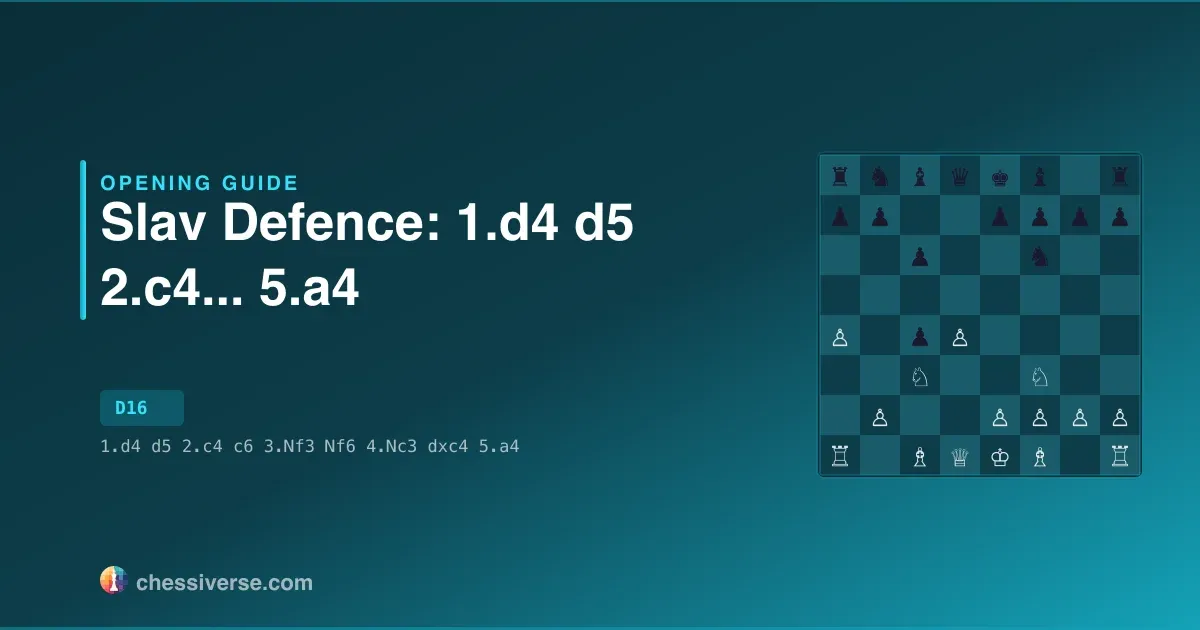
Starting from 1.d4 d5 2.c4 c6 3.Nf3 Nf6 4.Nc3 dxc4 5.a4, players enter the Slav Defense: Alapin Variation — ECO D16. Black grabs the pawn, White pushes a4 to stop it from staying gone. The Slav Accepted is the chess version of taking a loan you intend to repay — and the interest rate is whatever the bishop on f5 charges you.
Strategic Overview
5.a4 is the principled main line of the Slav Accepted. By advancing the a-pawn, White prevents ...b5, which would otherwise lock in the extra pawn and turn the whole opening into a sad gambit for White. The cost of 5.a4 is structural: the b4-square becomes a permanent outpost for Black, and the a-pawn is committed to the third rank. In exchange White gets to recover the c4-pawn at leisure and play for the small but stable edge that comes from having a slightly better central pawn presence. Black's four main fifth moves each address the position differently. 5...Bf5 is the Czech variation and by far the most testing — the bishop reaches its ideal diagonal and the move scores well in practice and theory. 5...Bg4 is the Steiner, a popular club-level choice that pins the knight but allows tactical motifs based on Ne5 hitting the bishop with tempo. 5...e6 is the Soultanbeieff, a quieter set-up that often transposes into Meran-like positions. 5...Na6 is the Smyslov, where the knight heads for b4 to grab a permanent outpost. The Czech is the modern mainline at top level, but all four are viable at amateur level — the choice depends on whether you want fast bishop development or a queenside-pawn-structure battle.
Key Ideas
The recurring motifs below distinguish a confident handler of this opening from a beginner:
- a4 stops ...b5 cold — Without a4, Black plays ...b5 and holds the extra pawn while finishing development — a complete disaster for White. The a-pawn push is the only way to keep the gambit theoretically sound and recover material.
- 5...Bf5 is the modern main line — The Czech variation is the most theoretically tested response. Black gets the bishop out to its best diagonal immediately and forces White to find a concrete plan to demonstrate compensation for the pawn.
- 5...Bg4 is fine but requires accuracy — The Steiner pins the knight and is popular in amateur play, but White's Ne5 ideas hit the bishop with tempo and create concrete problems. Black needs to know the lines or risks ending up cramped.
- 5...Na6 heads for the b4 outpost — The Smyslov variation looks bizarre but is principled — the knight goes to b4 where it can't be chased by pawns thanks to the a4 push. The b4-square is a permanent feature of the position and Black plans to exploit it.
- b4 is a hole White can't fill — The cost of 5.a4 is permanent. The b4-square is weak forever and Black's plans frequently exploit it — either by parking a knight there or using it as a transit square for queenside operations.
History and Notable Players
It arises from the Slav Defense: Three Knights Variation. On the White side, Loek Van Wely (66 games), Miso Cebalo (50 games), Wolfgang Uhlmann (48 games) top the database. Notable Black exponents: Jonny Hector (114 games), Eduard Meduna (79 games), Evgeny Bareev (69 games).
Performance Across Rating Levels
The picture changes a lot as you climb the rating ladder. Among 1200-rated players, it appears in 0.00% of games — 5,417 of them on record — with White winning 60.3% and Black 36.3%. Move up to 1800 Elo and the share shifts to 0.02%, with White winning 51% versus Black's 43.8%. Among 2500-rated players the line appears in 0.23% of games and draws spike to 10.5%, indicating tight preparation. White's edge erodes by 14.0pp from 1200 to 2500 Elo, suggesting Black's counterplay is easier to find with experience.
Time Control Patterns
Time control matters here: blitz players reach for this opening more than others. In bullet, it appears in 0.02% of games (444,917); White wins 50%. Blitz shows 0.02% adoption across 842,590 games, White scoring 48.5%. In rapid, the share rises to 0.01% — 94,556 games, White 50.9%. White's score swings 2.4pp across formats, so time control isn't just a stylistic choice here — it shifts the actual results.
Move Diversity and Theory Depth
Move choice is far from uniform in the Slav Defense: Alapin Variation. At 1200 Elo (5,417 games), the top reply is e6, played 27.1% of the time. Four other moves each take at least 5% of games, and the top three moves account for 59% of games. Entropy: 3.14. By 2500 (31,054 games), Bf5 takes over as the top reply at 83.3%; only one other move still reaches 5% and the top three moves account for 92.8% of games. Entropy drops to 1.08. The narrowing is significant — strong players consolidate around a small set of best moves, while amateurs scatter across many plausible-looking options.
Historical Trends
Long-term, the trajectory of this opening is informative. Adoption peaked in 2015 at 0.03% (6,779 games). By 2025 it sits at 0.02%, 42% below the peak but still 27% above its 2013 level, so the line is up over the full period despite easing from the high.
Main Lines and Variations
The main branches off 1.d4 d5 2.c4 c6 3.Nf3 Nf6 4.Nc3 dxc4 5.a4 include:
Each branch leads to a different middlegame character — the resulting pawn structure decides what kind of game you get.
Common Mistakes
- Drifting away from main theory — At 400 Elo, the three most-played moves cover 55% of games, against 83.4% at 2000. The most popular deviation is b5 (played 11% of the time at 400, much less so up top). It looks fine but quietly hands the better-prepared side an edge.
- Neglecting development — Extra pawn moves in the opening are tempting, especially when you "know the moves". Developing a piece each turn is the simple correction.
- Releasing tension too early — The c4/d5 tension is the heart of these openings. Capturing or pushing prematurely usually surrenders the initiative.
Practice on Chessiverse
Ready to try the Slav Defense: Alapin Variation against a bot? Pick an opponent at your level and play a game.