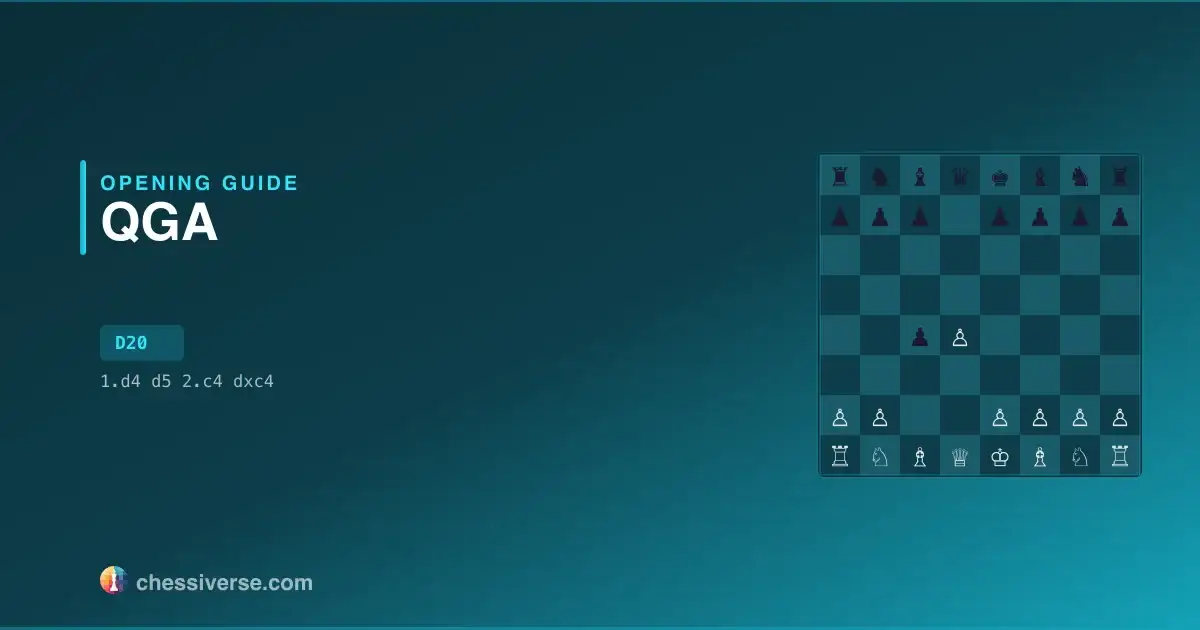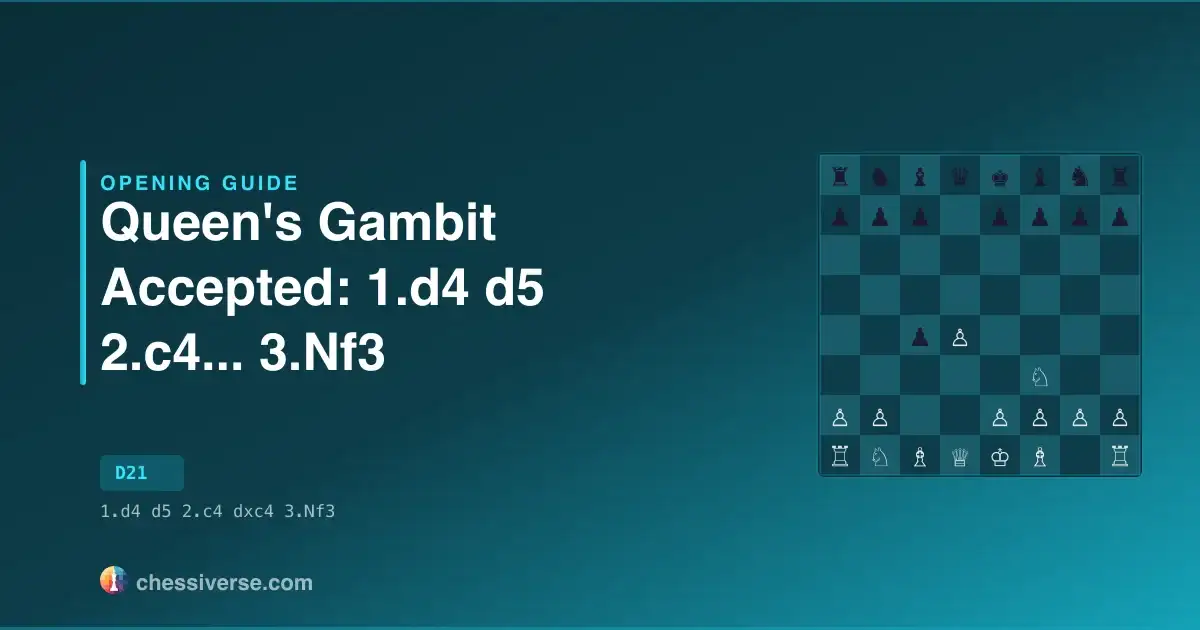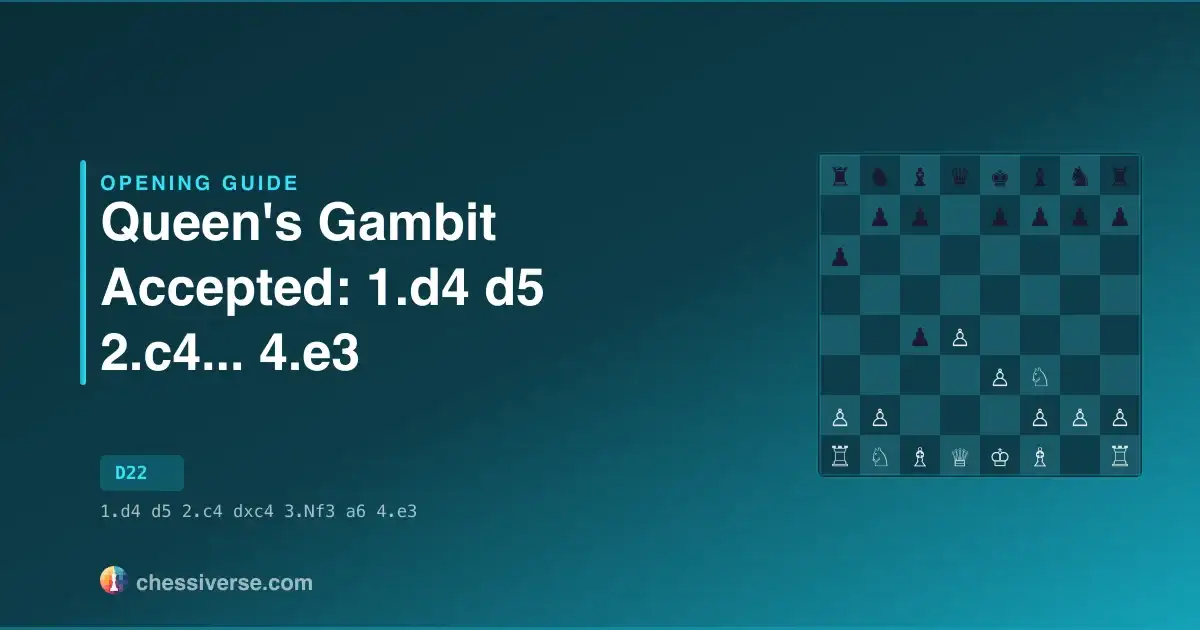




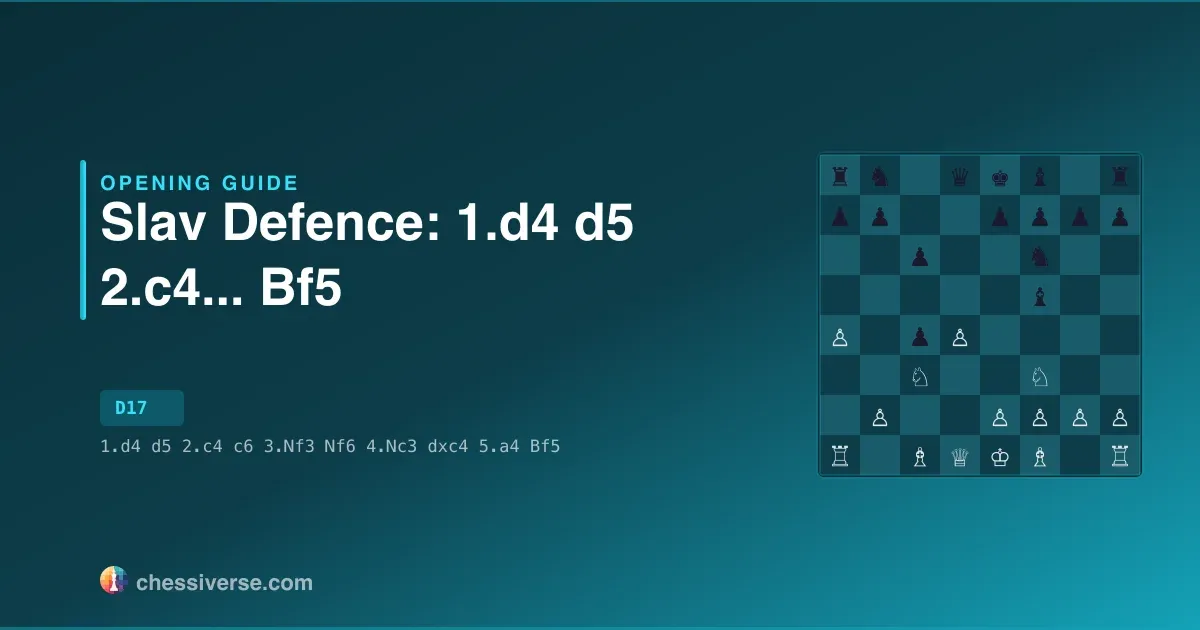
Starting from 1.d4 d5 2.c4 c6 3.Nf3 Nf6 4.Nc3 dxc4 5.a4 Bf5, players enter the Slav Defense: Czech Variation — ECO D17. The Slav's signature move: bishop to f5 before the door closes. With the c4-pawn on Black's side of the board, the Qb3-fork tactic is dead and the bishop can finally come out to its best square.
Strategic Overview
5...Bf5 is the Czech variation, the theoretical mainline of the Slav Accepted and one of the most-studied positions in chess. The whole point of the Slav was getting the queen's bishop out actively before locking it behind ...e6, and here Black finally does it. White's standard ...Qb3-fork trick (used in other Slav move-orders to win a pawn) is off the table because the c4-pawn now belongs to Black — there's no light-squared pressure for White to exploit. That leaves White with two serious tries to recover the gambit pawn. 6.e3 is the Dutch variation, the classical main line: White prepares Bxc4 calmly and aims for the typical Slav middlegame with e4 ambitions. 6.Ne5 is the Central variation, the sharper modern try — White uses the knight to recapture and immediately puts pressure on Black's centre. 6.Nh4 (the Bled Attack) directly challenges the f5-bishop. The arising positions tend to be rich middlegames where Black's bishop pair (after typical exchanges) and well-placed pieces balance White's slight central edge. This is one of the most respected ways for Black to handle 1.d4 at every level — solid, principled, and full of fighting chances.
Key Ideas
The recurring motifs below distinguish a confident handler of this opening from a beginner:
- The bishop reaches f5 with no downside — The whole point of the Slav move-order is making ...Bf5 safe. With ...dxc4 already played, the Qb3 fork that punishes ...Bf5 in other lines doesn't work — Black gets active bishop development without paying the structural price.
- 6.e3 is the classical Dutch variation — The Dutch is the calm recovery: e3 prepares Bxc4 and the rest of normal development. White aims for the typical Slav structures with an eventual e4 break, while Black sets up solid piece play and bishop pair potential.
- 6.Ne5 is the sharp modern try — The Central variation skips the standard recovery and uses the knight to recapture. The arising positions are sharper and more concrete, with White trying to demonstrate that Black's bishop on f5 is a target rather than a strength.
- 6.Nh4 hits the bishop directly — The Bled Attack challenges f5 immediately. Black usually retreats to g6 or trades on h4, but either way White has spent time on the knight maneuver and the structural debate becomes the central question.
History and Notable Players
It arises from the Slav Defense: Alapin Variation. On the White side, Loek Van Wely (52 games), Wolfgang Uhlmann (38 games), Alexander G Beliavsky (37 games) top the database. Notable Black exponents: Jonny Hector (115 games), Eduard Meduna (79 games), Evgeny Bareev (66 games).
Performance Across Rating Levels
How well the Slav Defense: Czech Variation works depends on what level you're playing at. Among 1200-rated players, it appears in 0.00% of games — 1,115 of them on record — with White winning 54% and Black 42.7%. At 1800 the opening surfaces in 0.01% of games; White wins 48%, Black 46.3%, draws 5.7%. Among 2500-rated players the line appears in 0.19% of games and draws spike to 10.7%, indicating tight preparation. White's edge erodes by 7.6pp from 1200 to 2500 Elo, suggesting Black's counterplay is easier to find with experience.
Time Control Patterns
Look at the same opening across time controls and blitz stands out. In bullet, it appears in 0.01% of games (220,487); White wins 47.7%. Blitz shows 0.02% adoption across 545,070 games, White scoring 46.6%. In rapid, the share rises to 0.00% — 54,566 games, White 46.6%.
Move Diversity and Theory Depth
Move choice is far from uniform in the Slav Defense: Czech Variation. At 1200 Elo (1,111 games), the top reply is e3, played 59% of the time. Three other moves each take at least 5% of games, and the top three moves account for 86.5% of games. Entropy: 1.88. By 2500 (25,838 games), Ne5 takes over as the top reply at 44.4%; only two other moves still reach 5% and the top three moves account for 95.9% of games. Entropy drops to 1.60.
Historical Trends
Year-over-year data tells you whether this opening is a contemporary fixture or a fading one. Adoption peaked in 2015 at 0.02% (4,601 games). By 2025 it sits at 0.01%, 45% below the peak but still 55% above its 2013 level, so the line is up over the full period despite easing from the high.
Main Lines and Variations
From the position after 1.d4 d5 2.c4 c6 3.Nf3 Nf6 4.Nc3 dxc4 5.a4 Bf5, the recognised continuations are:
Each branch leads to a different middlegame character — the resulting pawn structure decides what kind of game you get.
Common Mistakes
- Drifting away from main theory — At 1000 Elo, the three most-played moves cover 79.8% of games, against 88.4% at 2000. The most popular deviation is Bg5 (played 15.5% of the time at 1000, less so up top). It looks fine but quietly hands the better-prepared side an edge.
- Neglecting development — Extra pawn moves in the opening are tempting, especially when you "know the moves". Developing a piece each turn is the simple correction.
- Releasing tension too early — The c4/d5 tension is the heart of these openings. Capturing or pushing prematurely usually surrenders the initiative.
Practice on Chessiverse
Ready to try the Slav Defense: Czech Variation against a bot? Pick an opponent at your level and play a game.