



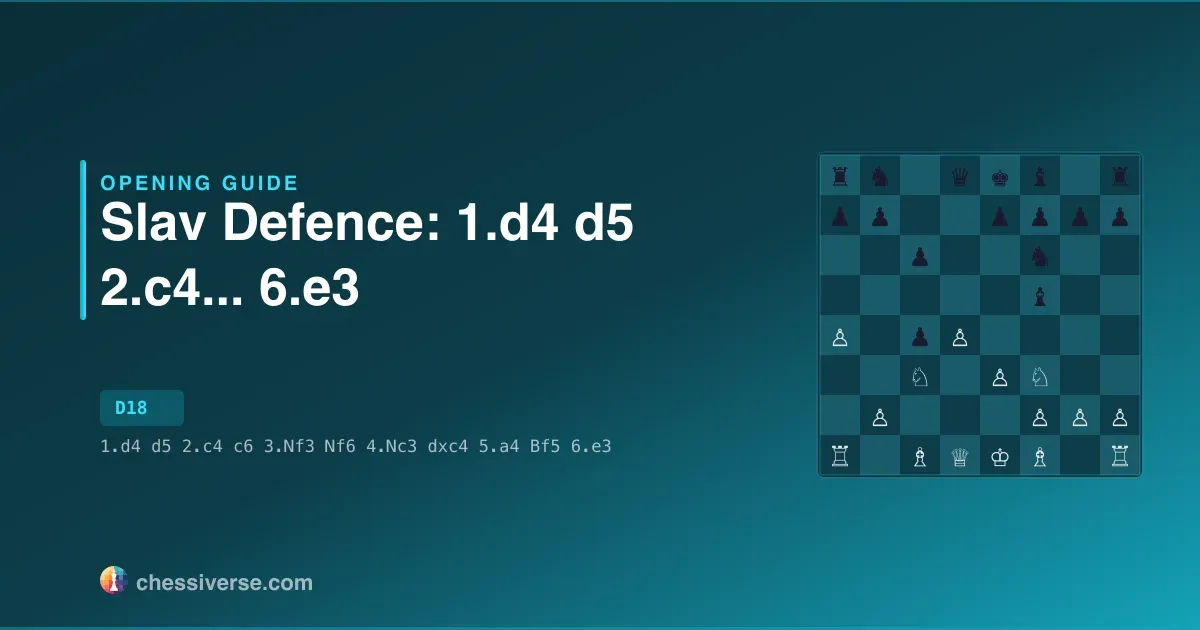
Starting from 1.d4 d5 2.c4 c6 3.Nf3 Nf6 4.Nc3 dxc4 5.a4 Bf5 6.e3, players enter the Slav Defense: Czech Variation, Classical System — ECO D18. The classical main line of the Slav Accepted. White opens the bishop diagonal, plans Bxc4, and accepts that the dark-squared bishop sits behind pawns for a while — that's the price of getting the material back cleanly.
Strategic Overview
6.e3 is the Dutch variation, the most theoretically tested response to the Czech Slav. White's plan is calm and clear: free the light-squared bishop, capture on c4, finish development, and aim for the classical e4 break that opens lines for the whole army. The trade-off is that the c1-bishop is stuck behind its own pawns for several moves and only comes to life after the eventual e3-e4 push. Black's near-automatic reply is 6...e6, preparing to develop the dark-squared bishop. Crucially, the bishop typically goes to b4 — not because it likes the square inherently, but because the b4-square is the structural weakness White inherited from playing 5.a4. Black exploits that weakness directly, often combining ...Bb4 with ...O-O and ...Nbd7 to build a balanced, harmonious set-up. The middlegames that arise are some of the richest in classical chess: White looks for the central break and minority attack possibilities, Black plays for piece activity, the b4-outpost, and counterplay along the c-file. At every level this is a serious mainline with thousands of games — knowing the typical plans matters more than memorising specific moves.
Key Ideas
When players succeed in this line, they usually do so by leaning on the following themes:
- e3 frees the light-squared bishop — The point of e3 is one move: Bxc4. White recovers the pawn cleanly and the bishop reaches an active diagonal. The cost is that the dark-squared bishop stays passive behind pawns until the eventual e4 break opens its lines.
- 6...e6 prepares ...Bb4 against the weak square — The dark-squared bishop almost always heads for b4, exploiting the permanent hole White created with 5.a4. Combined with ...O-O and ...Nbd7, Black gets a harmonious set-up with concrete strategic targets.
- The e3-e4 break defines White's ambitions — White's whole long-term plan revolves around getting the e4 push in under good conditions. Once it lands, the dark-squared bishop activates and the position opens up. Black's job is to prevent or neutralise that break.
History and Notable Players
It arises from the Slav Defense: Czech Variation. On the White side, Wolfgang Uhlmann (36 games), Loek Van Wely (36 games), Evgeny Gleizerov (27 games) top the database. Notable Black exponents: Jonny Hector (59 games), Eduard Meduna (38 games), Vassily Smyslov (37 games).
Performance Across Rating Levels
How well the Slav Defense: Czech Variation, Classical System works depends on what level you're playing at. Among 1200-rated players, it appears in 0.00% of games — 719 of them on record — with White winning 52.3% and Black 44.1%. Move up to 1800 Elo and the share shifts to 0.01%, with White winning 47.3% versus Black's 46.5%. Among 2500-rated players the line appears in 0.08% of games and draws spike to 11.5%, indicating tight preparation. White's edge erodes by 7.4pp from 1200 to 2500 Elo, suggesting Black's counterplay is easier to find with experience.
Move Diversity and Theory Depth
What players actually play after the opening moves depends heavily on rating. At 1200 Elo (717 games), the top reply is e6, played 73.1% of the time. Two other moves each take at least 5% of games, and the top three moves account for 84.1% of games. Entropy: 1.68. By 2500 (11,175 games), e6 dominates at 93.1% of replies; no other move reaches 5% and the top three moves account for 98.5% of games. Entropy drops to 0.48. The narrowing is significant — strong players consolidate around a small set of best moves, while amateurs scatter across many plausible-looking options.
Historical Trends
Year-over-year data tells you whether this opening is a contemporary fixture or a fading one. Adoption peaked in 2015 at 0.011% (2,473 games). By 2025 it sits at 0.006%, 48% below the peak but still 35% above its 2013 level, so the line is up over the full period despite easing from the high.
Main Lines and Variations
After 1.d4 d5 2.c4 c6 3.Nf3 Nf6 4.Nc3 dxc4 5.a4 Bf5 6.e3, the established follow-ups are:
Each branch leads to a different middlegame character — the resulting pawn structure decides what kind of game you get.
Common Mistakes
- Drifting away from main theory — At 1000 Elo, the three most-played moves cover 80.2% of games, against 98.1% at 2000. The most popular deviation is Nbd7 (played 12% of the time at 1000, much less so up top). It looks fine but quietly hands the better-prepared side an edge.
- Neglecting development — Extra pawn moves in the opening are tempting, especially when you "know the moves". Developing a piece each turn is the simple correction.
- Releasing tension too early — The c4/d5 tension is the heart of these openings. Capturing or pushing prematurely usually surrenders the initiative.
Practice on Chessiverse
Ready to try the Slav Defense: Czech Variation, Classical System against a bot? Pick an opponent at your level and play a game.