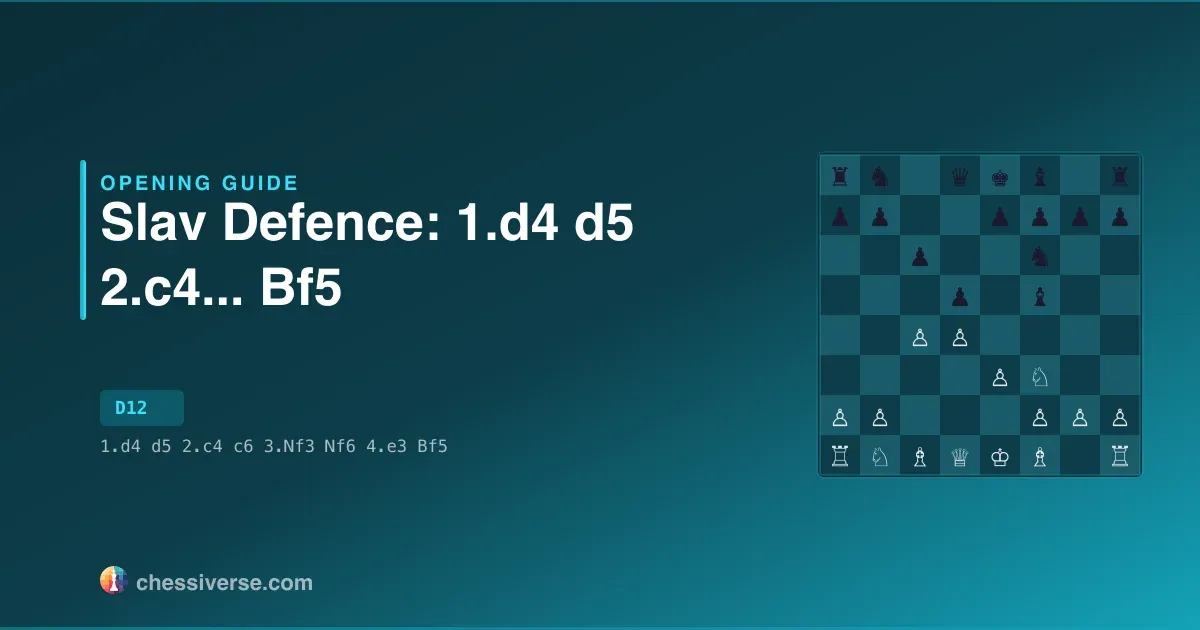
The Slav Defense: Quiet Variation, Schallopp Defense begins with 1.d4 d5 2.c4 c6 3.Nf3 Nf6 4.e3 Bf5 (ECO D12). The whole point of the Slav was solving the bad-bishop problem before locking the centre. With 4...Bf5 Black does exactly that — the queen's bishop is out before the door closes, and the position is already comfortable.
Strategic Overview
4...Bf5 is the Slav at its most efficient. The standard Slav problem — how to develop the queen's bishop before ...e6 locks it in — is solved on move four. The bishop reaches its natural active diagonal, Black has solid development, and the central pawn structure is intact. The reason White's 5.cxd5 cxd5 6.Qb3 trick doesn't work here is the f6-knight: after 6...Qc7 the queen sortie isn't a real fork because the b7 and d5 pawns are both adequately covered. That means White has to find a different approach. The principled main line is 5.Nc3, developing actively and pressuring d5 with another piece. The exchange variation with 5.cxd5 is fine for Black because it leaves White with a queen's bishop trapped behind its own pawns and no easy way to challenge Black's solid structure. The third option, 5.Bd3, offers the trade of light-squared bishops — exchanging Black's good bishop for White's potentially active one. Compared to other Slav variations where Black has to spend tempi solving the bishop problem, here the position is simple and Black's pieces all have natural homes. The downside is that the game tends to be less ambitious for both sides — this is the comfortable equality variation, not the play-for-a-win one.
Key Ideas
When players succeed in this line, they usually do so by leaning on the following themes:
- The bishop escapes before ...e6 — The defining problem of the Slav is the queen's bishop. 4...Bf5 solves it immediately — the bishop is out on an active diagonal before any pawn moves can shut it in. That's the entire opening's strategic identity.
- Qb3 is no longer a fork — The usual Slav trap 4.cxd5 cxd5 5.Qb3 hitting b7 and d5 doesn't work after ...Nf6 is on the board. Black can play ...Qc7 and the queen sortie achieves nothing — both attacked pawns are adequately defended.
- 5.Nc3 is the principled main line — White develops actively and adds pressure on d5. The position remains in the strategic Slav family with both sides having natural plans — Black plans ...e6 and ...Be7, White plans Bd3 and possibly an e4 break.
- 5.Bd3 fights for the light-squared bishop — Trading bishops with 5.Bd3 simplifies the position and removes one of Black's strongest pieces. It's a slight ambition concession by White but creates a position where neither side has much to fear.
History and Notable Players
It arises from the Slav Defense: Modern Line. On the White side, Zlatko Ilincic (50 games), Aleksey Dreev (43 games), Mark L Hebden (30 games) top the database. Notable Black exponents: Aleksey Dreev (53 games), Jonny Hector (47 games), Alexei Shirov (38 games).
Performance Across Rating Levels
How well the Slav Defense: Quiet Variation, Schallopp Defense works depends on what level you're playing at. The 1200 bracket has 76,562 games (0.01% of all games at that level); White wins 47.7%, Black 48.4%, 3.9% are drawn. Move up to 1800 Elo and the share shifts to 0.03%, with White winning 47% versus Black's 47%. Among 2500-rated players the line appears in 0.14% of games and draws spike to 11.5%, indicating tight preparation. Positions also become less sharp as level rises (sharpness 0.96 → 0.89).
Time Control Patterns
The Slav Defense: Quiet Variation, Schallopp Defense skews toward bullet chess. In bullet, it appears in 0.03% of games (675,486); White wins 49.2%. Blitz shows 0.03% adoption across 898,865 games, White scoring 47.4%. In rapid, the share rises to 0.02% — 184,860 games, White 47.1%. White's score swings 2.1pp across formats, so time control isn't just a stylistic choice here — it shifts the actual results.
Move Diversity and Theory Depth
What players actually play after the opening moves depends heavily on rating. At 1200 Elo (76,562 games), the top reply is Nc3, played 50.3% of the time. Four other moves each take at least 5% of games, and the top three moves account for 73.6% of games. Entropy: 2.48. By 2500 (19,702 games), Nc3 dominates at 76.6% of replies; only two other moves still reach 5% and the top three moves account for 92.7% of games. Entropy drops to 1.30. The narrowing is significant — strong players consolidate around a small set of best moves, while amateurs scatter across many plausible-looking options.
Historical Trends
Year-over-year data tells you whether this opening is a contemporary fixture or a fading one. Adoption peaked in 2015 at 0.03% (6,586 games). By 2025 it sits at 0.02%, 26% below the peak but still 21% above its 2013 level, so the line is up over the full period despite easing from the high.
Common Mistakes
- Drifting away from main theory — At 400 Elo, the three most-played moves cover 73.1% of games, against 79% at 2000. The most popular deviation is Bd3 (played 17.5% of the time at 400, less so up top). It looks fine but quietly hands the better-prepared side an edge.
- Neglecting development — Extra pawn moves in the opening are tempting, especially when you "know the moves". Developing a piece each turn is the simple correction.
- Releasing tension too early — The c4/d5 tension is the heart of these openings. Capturing or pushing prematurely usually surrenders the initiative.
Practice on Chessiverse
Ready to try the Slav Defense: Quiet Variation, Schallopp Defense against a bot? Pick an opponent at your level and play a game.