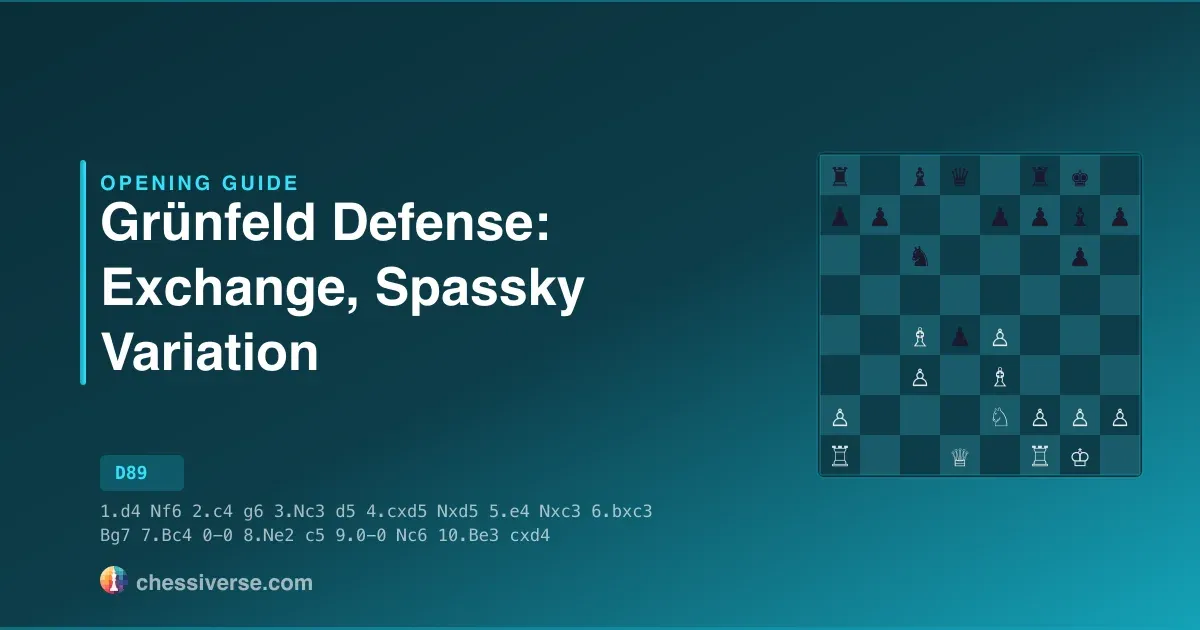
The Grünfeld Defense: Exchange Variation, Spassky Variation (13...Be6) begins with 1.d4 Nf6 2.c4 g6 3.Nc3 d5 4.cxd5 Nxd5 5.e4 Nxc3 6.bxc3 Bg7 7.Bc4 0-0 8.Ne2 c5 9.0-0 Nc6 10.Be3 Bg4 11.f3 Na5 12.Bd3 cxd4 13.cxd4 Be6 (ECO D89). Black has provoked 11.f3 with 10...Bg4, driven White's bishop from c4 to d3 with 11...Na5 and swapped c-pawns. The bishop on e6 now eyes c4 and a2, and White's main answer, 14.d5, offers the a1 rook for the g7 bishop.
Strategic Overview
White uses the Bc4 and Ne2 setup of the Exchange Grünfeld: with the bishop on c4, a knight on f3 would allow ...Bg4 and heavy pressure on d4. Black plays ...Bg4 anyway. 10...Bg4 pins the e2 knight, which guards d4, against the queen, and 11.f3 breaks the pin. 11...Na5 then hits the c4 bishop, and after 12.Bd3 cxd4 13.cxd4 Be6 Black's bishop takes over the a2-g8 diagonal that White's bishop has left. The pawn structure is the classic Exchange Grünfeld imbalance: White has the d4 and e4 pawns in the centre, Black has two queenside pawns against one. White's main reply is 14.d5, which attacks the e6 bishop and opens the long diagonal for the g7 bishop. After 14...Bxa1 15.Qxa1 f6, Black is up the exchange, and White plays for the dark squares around Black's king, where the g7 bishop is gone. 14.Qa4 and 14.Rc1 are the main ways to avoid the exchange sacrifice.
Key Ideas
The recurring motifs below distinguish a confident handler of this opening from a beginner:
- 10...Bg4 and 11...Na5 come first — The bishop pins the e2 knight, which guards d4, against the queen and provokes 11.f3. The knight jump to a5 then drives White's bishop from c4 to d3, off the a2-g8 diagonal, before Black releases the tension with 12...cxd4.
- The e6 bishop targets c4 and a2 — From e6 the bishop and the a5 knight both cover c4, so ...Bc4 can trade off White's light-squared bishop. The bishop also looks down the diagonal at a2, which only the a1 rook defends.
- 14.d5 offers the exchange — The main reply attacks the e6 bishop and opens the long diagonal, so Black can take the rook: 14...Bxa1 15.Qxa1 f6. Black is up the exchange and ...f6 blocks the queen's diagonal; White's compensation is the dark squares around Black's king, with Bh6 against the f8 rook a typical follow-up.
- Quieter tries keep the d4 pawn in place — 14.Qa4 guards a2 and attacks the a5 knight, and 14.Rc1 takes the open c-file but leaves a2 to the e6 bishop. With the pawn still on d4, the g7 bishop's diagonal stays closed and no exchange sacrifice is on offer.
- Centre against queenside majority — White has the d- and e-pawns in the centre, Black has two queenside pawns against one. White wants to use the centre in the middlegame; Black's majority can produce a passed pawn if the game reaches an endgame.
History and Notable Players
It arises from the Grünfeld Defense: Exchange Variation, Spassky Variation (8...c5).
Move Diversity and Theory Depth
What players actually play after the opening moves depends heavily on rating. Below 1600 the samples are small (3 games at 1200, 68 at 1400), so the comparison starts at 1600, with 858 games. There, the top reply is 14.d5, played 41.4% of the time; four other moves each take at least 5% of games (14.Qa4 18.4%, 14.Qd2 17.5%, 14.Rc1 9.2%, 14.Rb1 5.2%), and entropy is 2.45. By 2500 (978 games), 14.d5 rises to 58.8%, followed by 14.Rc1 at 20.4% and 14.Qa4 at 9.5%; three moves besides 14.d5 still reach 5%, and entropy falls to 1.71. Stronger players settle on 14.d5 more often, but about 30% of games at 2500 still go 14.Rc1 or 14.Qa4.
Common Mistakes
- Playing outside main lines — At 1400 Elo (68 games), 80.9% of moves are one of the three most-played replies — at 2000 that climbs to 85.5%. Most of the gap is players who pick a reasonable-looking move over the best one, and the position quietly drifts.
- Neglecting development — Extra pawn moves in the opening are tempting, especially when you "know the moves". Developing a piece each turn is the simple correction.
- Playing without a plan — Each Grünfeld Defense: Exchange Variation, Spassky Variation (13...Be6) middlegame demands a specific approach. Decide whether the position calls for attack, manoeuvre, or simplification before reaching for a move.
Practice on Chessiverse
Ready to try the Grünfeld Defense: Exchange Variation, Spassky Variation (13...Be6) against a bot? Pick an opponent at your level and play a game.