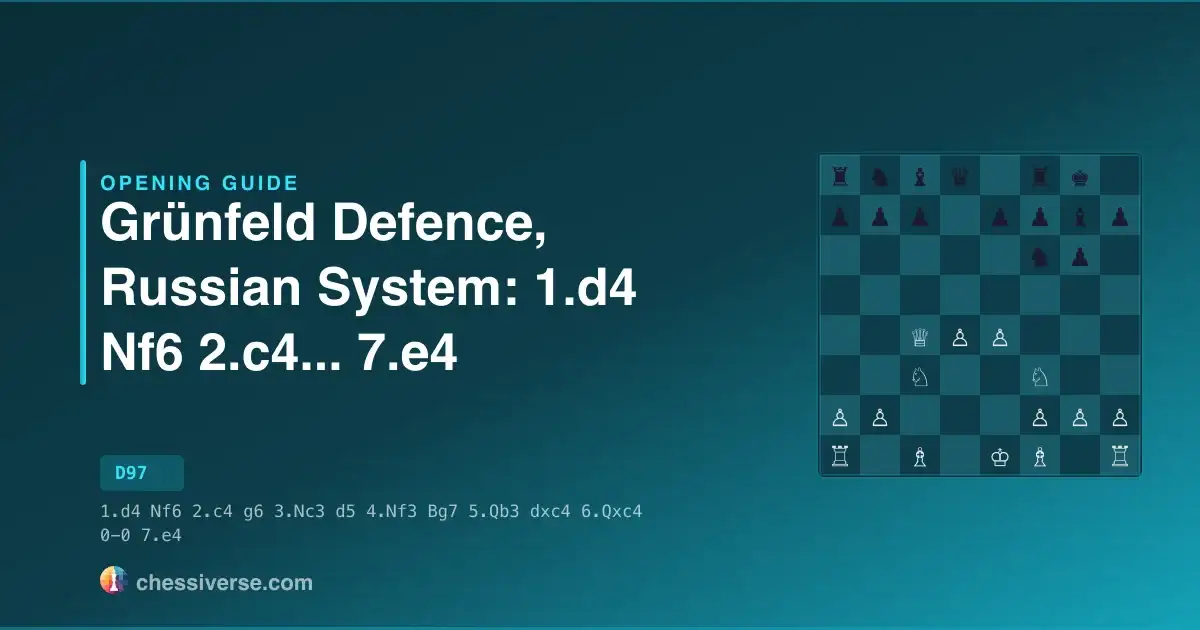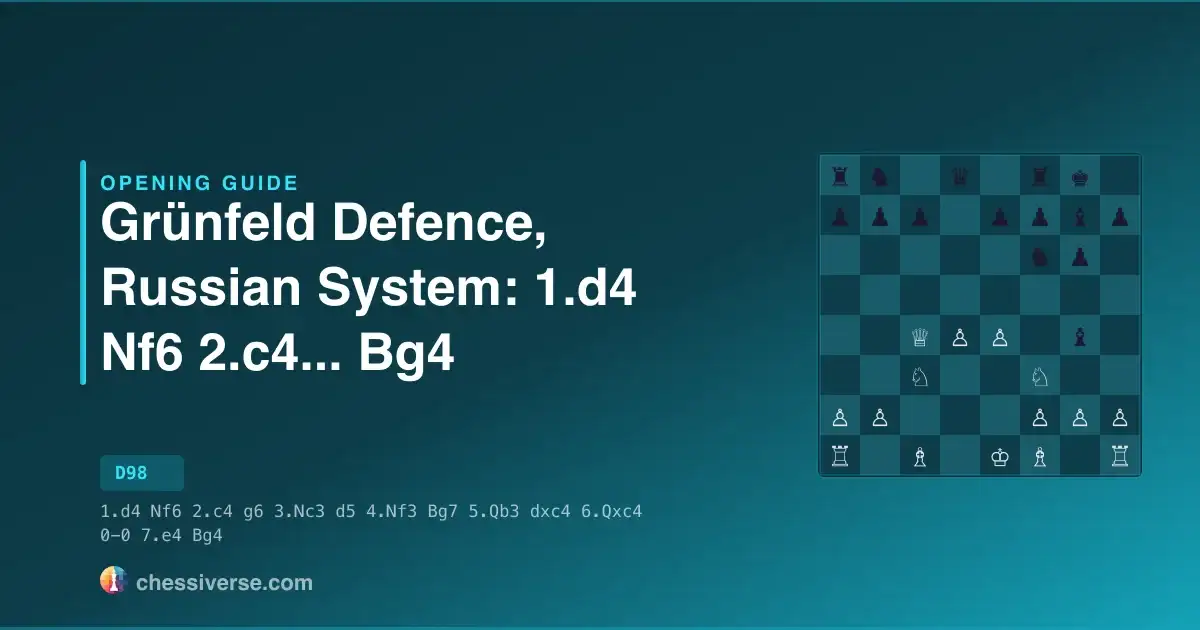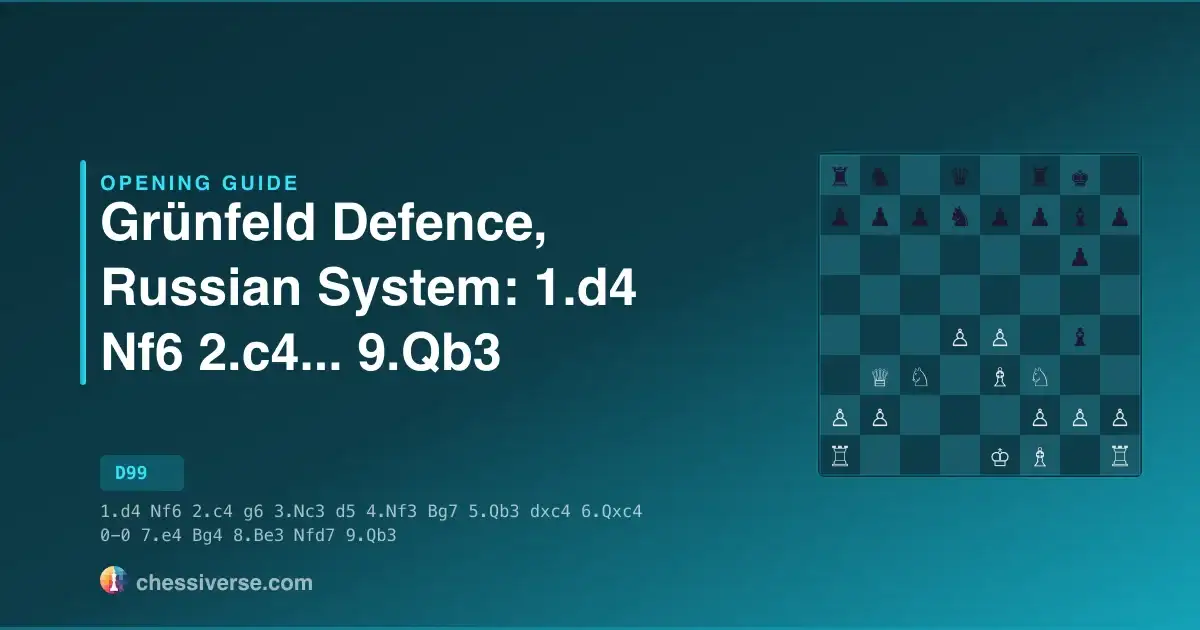





The Grünfeld Defense arises after 1.d4 Nf6 2.c4 g6 3.Nc3 d5 and falls under ECO code D80. This represents the standard and most frequent starting position of the Grünfeld Defense, though the ...d5 push can be deferred when White delays e4, as often happens when Nf3 is played early. Bobby Fischer's celebrated Game of the Century famously emerged from this defence. The Grünfeld tends to produce sharp, tactical play because Black immediately strikes at White's centre rather than simply fianchettoing as in the King's Indian. By playing 3...d5, Black at least temporarily prevents e4 and directly contests White's central control. White's main strategy is to exchange on d5 and follow up with e4, pushing Black's pieces back. The opening has deep historical roots in the 1920s chess revolution: while the Nimzo-Indian was establishing what masters called the "Modern style," Ernst Grünfeld introduced this system in 1922 and used it to defeat leading players of the era, including Kostic, Samisch, Colle, and Alekhine. This demonstrated a core hypermodern principle: that a pawn centre is not merely a source of strength but also a potential target. The critical test of these competing philosophies occurs in the Exchange Variation, 4. cxd5 Nxd5 5. e4 Nxc3 6. bxc3, where White gains an imposing pawn centre but Black obtains powerful counterplay along the long a1-h8 diagonal and can pressure d4 with moves like ...Bg7, ...Rd8, ...c5, ...Nc6, and sometimes ...Qa5, potentially fianchettoing on the other diagonal as well to target e4. With 6.6 million Lichess games across all rating levels, it is a specialized opening choice.
- A flagship hypermodern opening: Black invites White to build a broad pawn centre, betting that it will become a target rather than a strength.
- Black chips at the centre with ...c5 and the g7 bishop on the long diagonal, often adding ...Qa5, ...Bg4 and ...Nc6 to pile pressure on d4.
- In the Exchange Variation White gets pawns on e4, d4 and c3 and can push for a central breakthrough or kingside attack while Black counterattacks.
History and Notable Players
It arises from the King's Indian Defense. Among the most prolific practitioners on the White side are Evgeny Postny (16 games), Chris G Ward (14 games), Zoltan Varga (12 games). On the Black side, notable exponents include Artyom Timofeev (11 games), Valeri Yandemirov (11 games), Andras Flumbort (8 games).
The earliest known example is an 1855 game in Calcutta between Moheschunder Bannerjee and John Cochrane. Ernst Grünfeld debuted it internationally at Bad Pistyan 1922 and beat future world champion Alekhine with it in Vienna later that year. Kasparov leaned on it in world-title matches against Karpov (1986-1990) and Kramnik (2000).
Named after: Ernst Grünfeld, who introduced the defence into international play at the Bad Pistyan tournament in April 1922.
Notable players: Garry Kasparov, Bobby Fischer, Vasily Smyslov, Magnus Carlsen
The 1956 Game of the Century between Donald Byrne and 13-year-old Bobby Fischer reached a Grünfeld by transposition — and after Kramnik's new idea in game 2 of their 2000 match, Kasparov gave the opening up for the rest of his career.
Statistics
Based on 6.6 million Lichess games across all rating levels:
- White wins: 46.2%
- Black wins: 47.5%
- Draws: 6.3%
The statistics show a roughly balanced opening where both sides have equal chances.
Main Lines and Variations
After 1.d4 Nf6 2.c4 g6 3.Nc3 d5, the main continuations include:
- Grünfeld Defense: Stockholm Variation
- Grünfeld Defense: Russian Variation, Accelerated Variation
- Grünfeld Defense: Brinckmann Attack
- Grünfeld Defense: Three Knights Variation
- Grünfeld Defense: Exchange Variation
Each of these lines leads to distinct types of positions and requires its own understanding of the resulting pawn structures and piece placements.
Practice on Chessiverse
The best way to learn the Grünfeld Defense is through practice. On Chessiverse, you can play chess against computer opponents that specialize in this opening. Our AI bots range from beginner to grandmaster level, each with unique playing styles — from aggressive attackers to solid defenders. Choose a bot that matches your rating and work your way up as you master the opening's key ideas.
Performance Across Rating Levels
Popularity and results vary sharply by rating level. At 1200 Elo, the opening shows up in 0.02% of games (142,706 samples). White scores 48.1%, Black 48.3%, draws 3.6%. By 1800, popularity is 0.23% and White's score is 45.5% to Black's 48.7%. Among 2500-rated players the line appears in 0.77% of games and draws spike to 11.6%, indicating tight preparation.
Time Control Patterns
Time control matters here: blitz players reach for this opening more than others. In bullet, it appears in 0.11% of games (2,984,546); White wins 47.4%. Blitz shows 0.16% adoption across 5,684,493 games, White scoring 46.5%. In rapid, the share rises to 0.08% — 939,415 games, White 44.5%. White's score swings 2.9pp across formats, so time control isn't just a stylistic choice here — it shifts the actual results.
Move Diversity and Theory Depth
What players actually play after the opening moves depends heavily on rating. At 1200 Elo (142,706 games), the top reply is Nf3, played 26.3% of the time. Four other moves each take at least 5% of games, and the top three moves account for 65.8% of games. Entropy: 2.73. By 2500 (104,452 games), cxd5 takes over as the top reply at 50.6%; only three other moves still reach 5% and the top three moves account for 88.1% of games. Entropy drops to 1.90. The narrowing is significant — strong players consolidate around a small set of best moves, while amateurs scatter across many plausible-looking options.
Historical Trends
Year-over-year data tells you whether this opening is a contemporary fixture or a fading one. Adoption peaked in 2015 at 0.20% (44,667 games). By 2025 it sits at 0.12%, 41% below the peak and 29% under its 2013 level, leaving the line in decline.