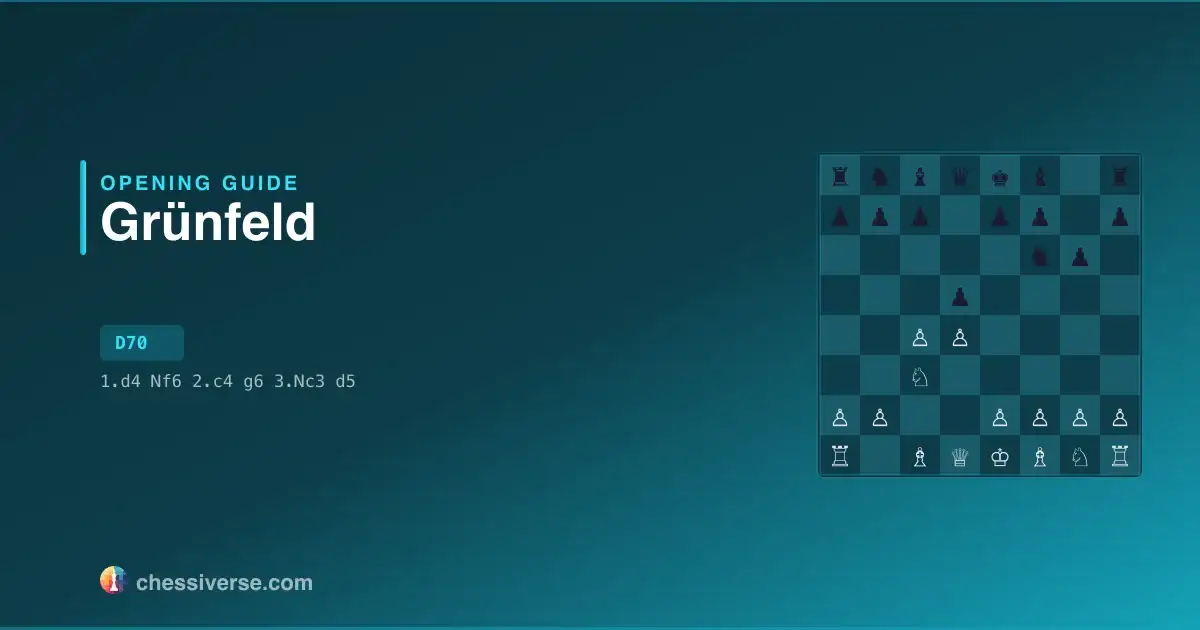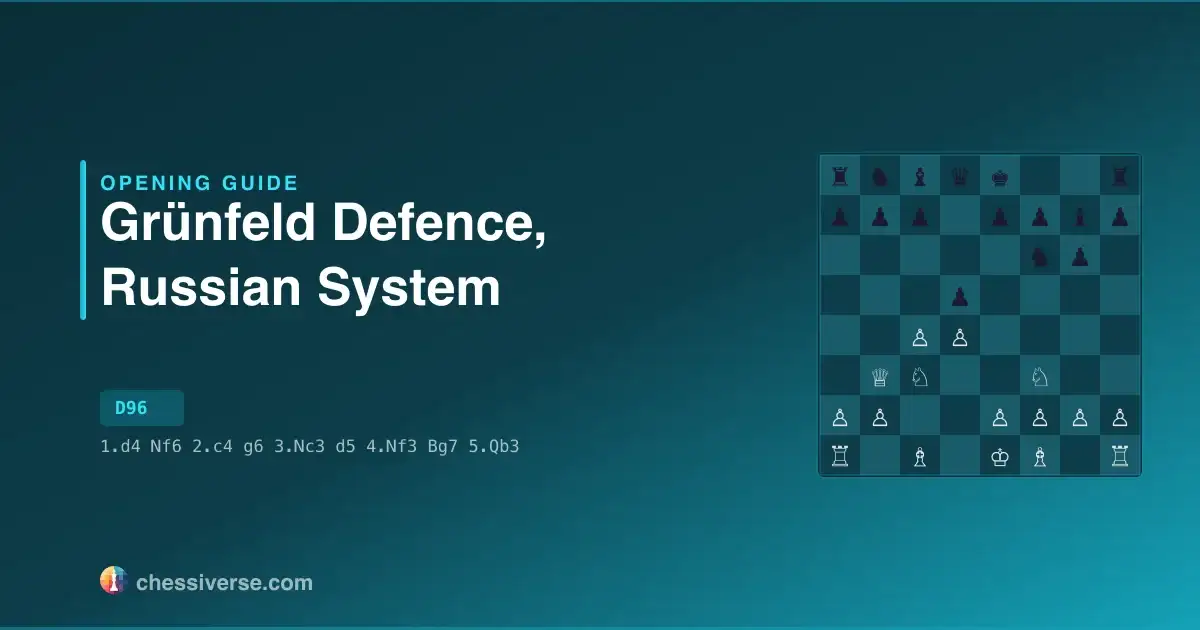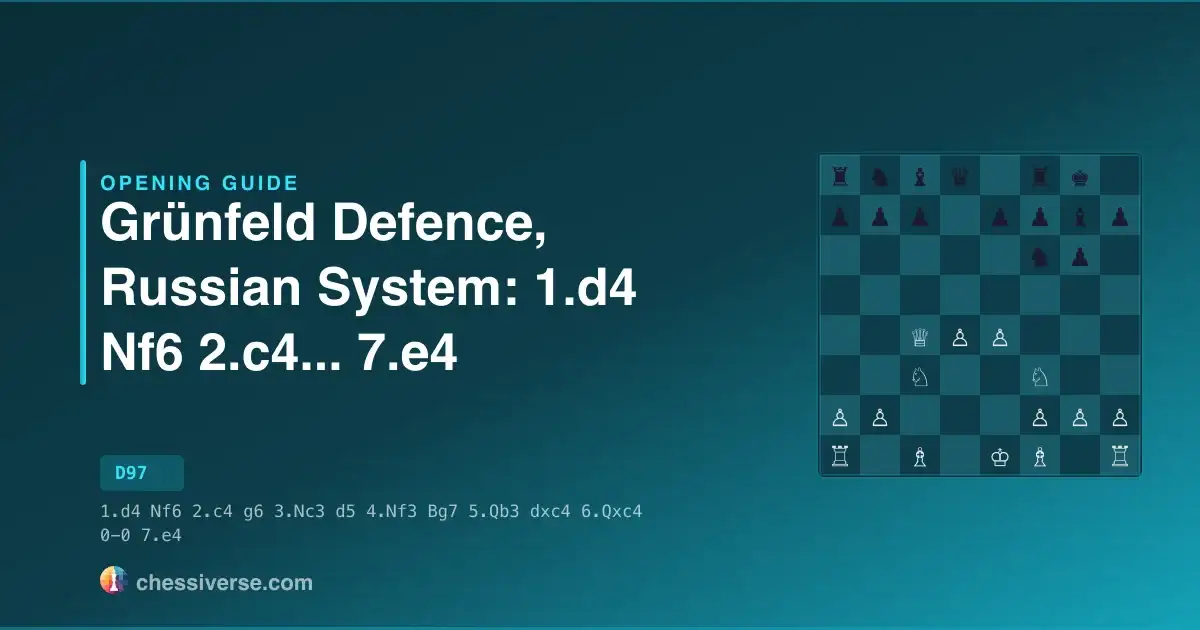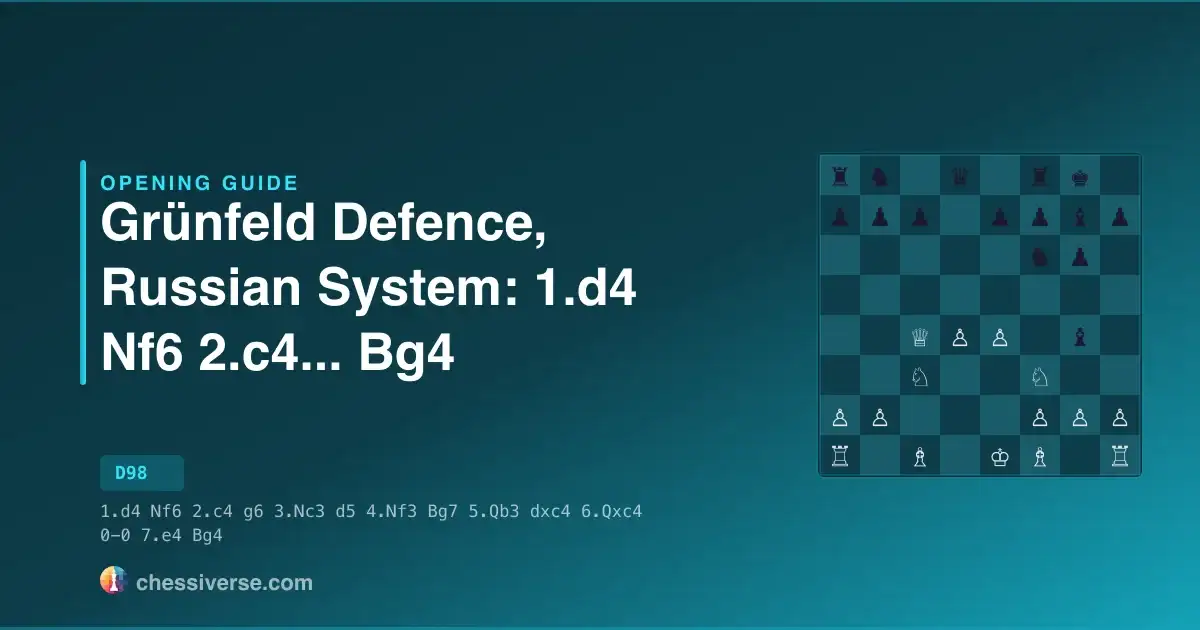


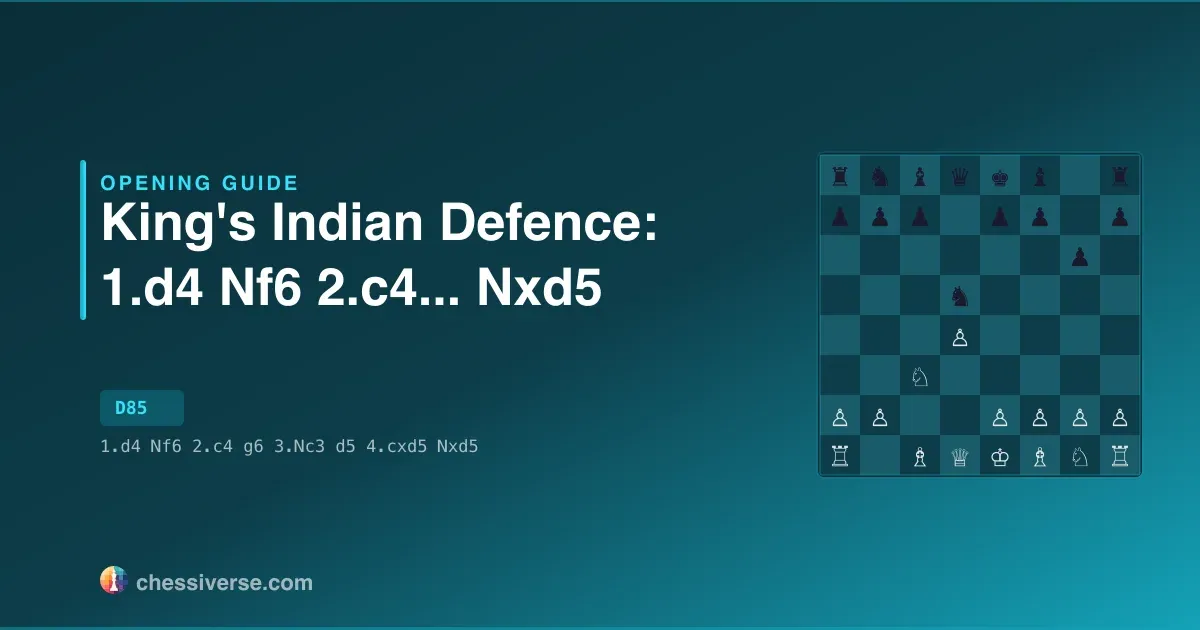
Starting from 1.d4 Nf6 2.c4 g6 3.Nc3 d5 4.cxd5 Nxd5, players enter the Grünfeld Defense: Exchange Variation — ECO D85. The Grünfeld's exchange variation in its starting position. Black has invited White to grab the centre — now the real fight begins over whether that centre is a strength or a target.
Strategic Overview
After 4.cxd5 Nxd5 the entire Grünfeld philosophy crystallises in one position. White has the option to drive the knight back and build a giant pawn centre with e4, and Black is betting that this centre will become more of a liability than an asset. The fianchettoed bishop on g7 will rake the long diagonal aimed at d4 and beyond, and the natural break ...c5 (sometimes prepared with ...Nc6 or supported by ...b6 and ...Bb7) will hammer at White's centre from the first opportunity. White's choices fan out from here. 5.e4 Nxc3 6.bxc3 is the absolute main line, after which White can develop the bishop to c4 for the classical setup, choose Be2 with Nf3 for a more positional approach, or opt for the modern exchange with Nf3 and Rb1. Each path leads to its own type of middlegame, but the strategic poles are constant: White wants to convert the central pawns into a passed d-pawn or a kingside attack; Black aims to trade pieces, exploit the weakened c3 pawn, and turn the queenside into the active front. The Grünfeld Exchange has been a top-level battleground since the 1930s and remains one of the most reliable answers to 1.d4.
Key Ideas
The recurring motifs below distinguish a confident handler of this opening from a beginner:
- Black invites a big centre as a target — Hypermodern thinking in action: rather than blockade White's pawns, Black lets them advance and aims to undermine them with ...c5 and piece pressure along the long diagonal.
- The g7 bishop is the heart of Black's setup — Once the centre opens, the fianchettoed bishop becomes one of the strongest pieces on the board, aimed straight at d4 and the queenside. Trading it off is rarely a good idea for Black.
- c3 becomes the structural pivot — After 5.e4 Nxc3 6.bxc3, the doubled c-pawns define the middlegame. Black targets them with ...c5 and piece pressure while White hopes to use the extra centre and half-open b-file as compensation.
- The ...c5 break is non-negotiable — Almost every Black plan involves the move ...c5 sooner or later. It opens the long diagonal, attacks d4, and converts the latent fianchetto pressure into concrete play.
History and Notable Players
It arises from the Grünfeld Defense. Among the most prolific White practitioners are Anatoly Vaisser (62 games), Svetozar Gligoric (59 games), Ivan Sokolov (57 games). Black-side regulars include Peter Svidler (114 games), Lubomir Ftacnik (93 games), Semen I Dvoirys (77 games).
Performance Across Rating Levels
How well the Grünfeld Defense: Exchange Variation works depends on what level you're playing at. Among 1200-rated players, it appears in 0.00% of games — 31,422 of them on record — with White winning 46.9% and Black 49.3%. By 1800, popularity is 0.09% and White's score is 44.9% to Black's 48.6%. At the top end (2500+ Elo), popularity is 0.39% with 12.1% draws — a clear sign of how much theory rules the line at master level. Positions also become less sharp as level rises (sharpness 0.96 → 0.88).
Time Control Patterns
Time control matters here: blitz players reach for this opening more than others. In bullet, it appears in 0.04% of games (1,024,480); White wins 46.5%. Blitz shows 0.07% adoption across 2,371,385 games, White scoring 46%. In rapid, the share rises to 0.03% — 375,699 games, White 43.8%. White's score swings 2.7pp across formats, so time control isn't just a stylistic choice here — it shifts the actual results.
Move Diversity and Theory Depth
Looking at move selection shows how forcing — or not — the position really is. At 1200 Elo (31,325 games), the top reply is e4, played 59.3% of the time. Two other moves each take at least 5% of games, and the top three moves account for 91.7% of games. Entropy: 1.77. By 2500 (53,144 games), e4 dominates at 76.3% of replies; only one other move still reaches 5% and the top three moves account for 94.6% of games. Entropy drops to 1.22. That entropy collapse is the signature of a line where preparation pays off: at the top, players know the best move and play it.
Historical Trends
Tracking the Grünfeld Defense: Exchange Variation year over year shows a clear story. Adoption peaked in 2015 at 0.08% (16,872 games). By 2025 it sits at 0.05%, 33% below the peak and 25% under its 2013 level, leaving the line in decline.
Main Lines and Variations
From the position after 1.d4 Nf6 2.c4 g6 3.Nc3 d5 4.cxd5 Nxd5, the recognised continuations are:
Each branch leads to a different middlegame character — the resulting pawn structure decides what kind of game you get.
Common Mistakes
- Neglecting development — It can feel productive to make extra pawn moves early, but falling behind in piece development is what loses most amateur games — especially in open positions where active pieces find squares fast.
- Playing without a plan — Each Grünfeld Defense: Exchange Variation middlegame demands a specific approach. Decide whether the position calls for attack, manoeuvre, or simplification before reaching for a move.
Practice on Chessiverse
Ready to try the Grünfeld Defense: Exchange Variation against a bot? Pick an opponent at your level and play a game.