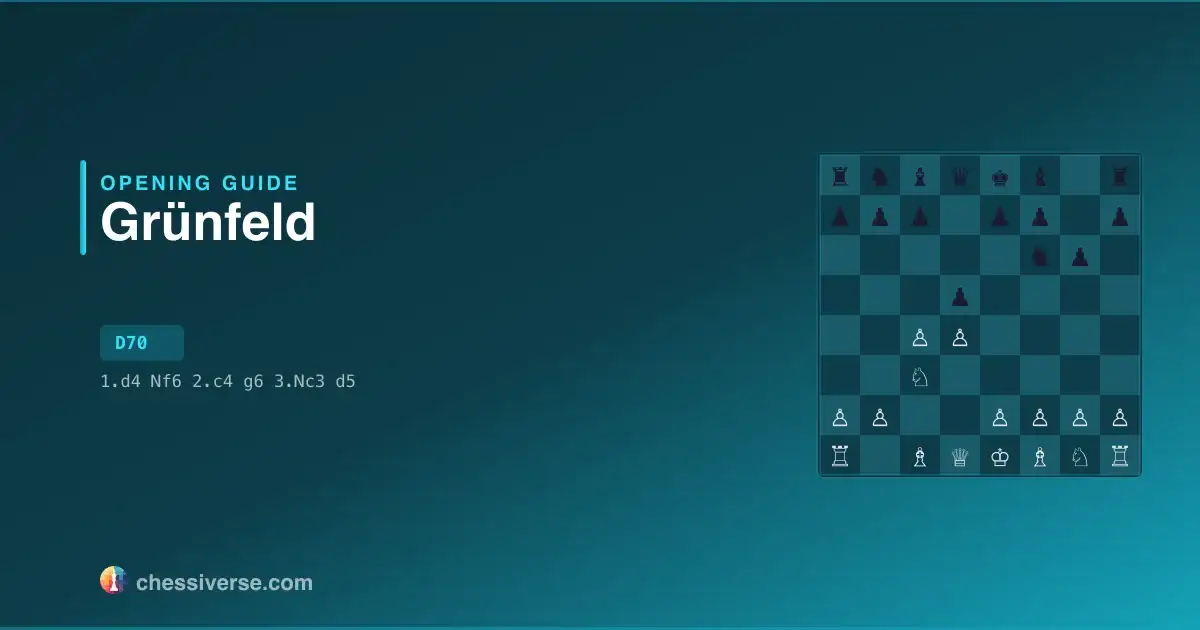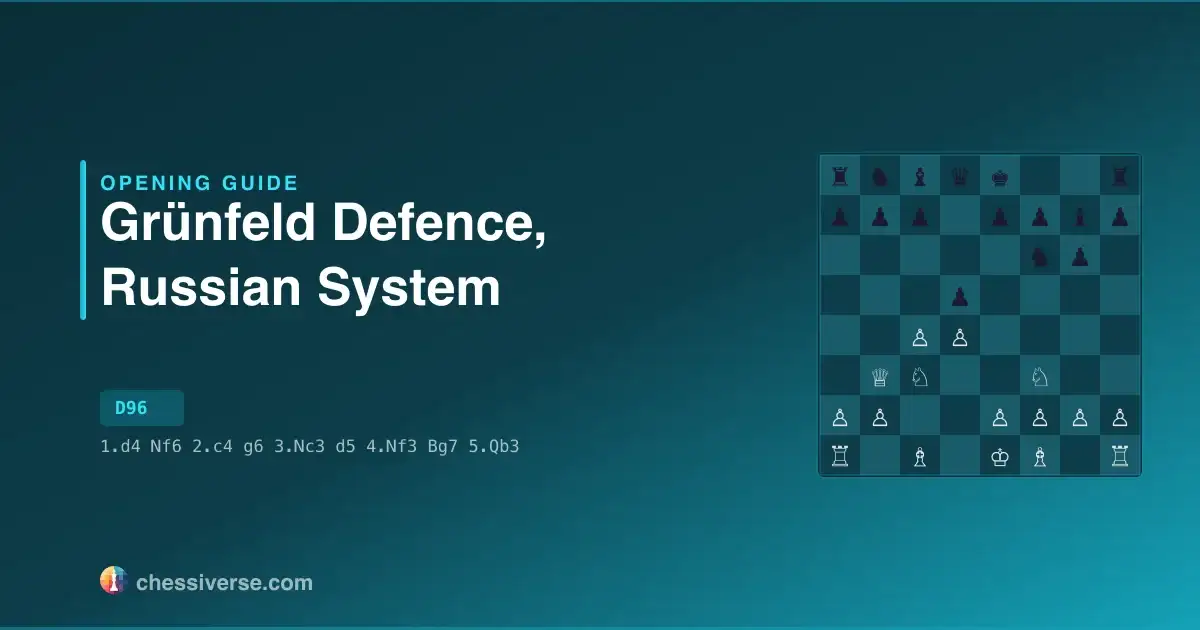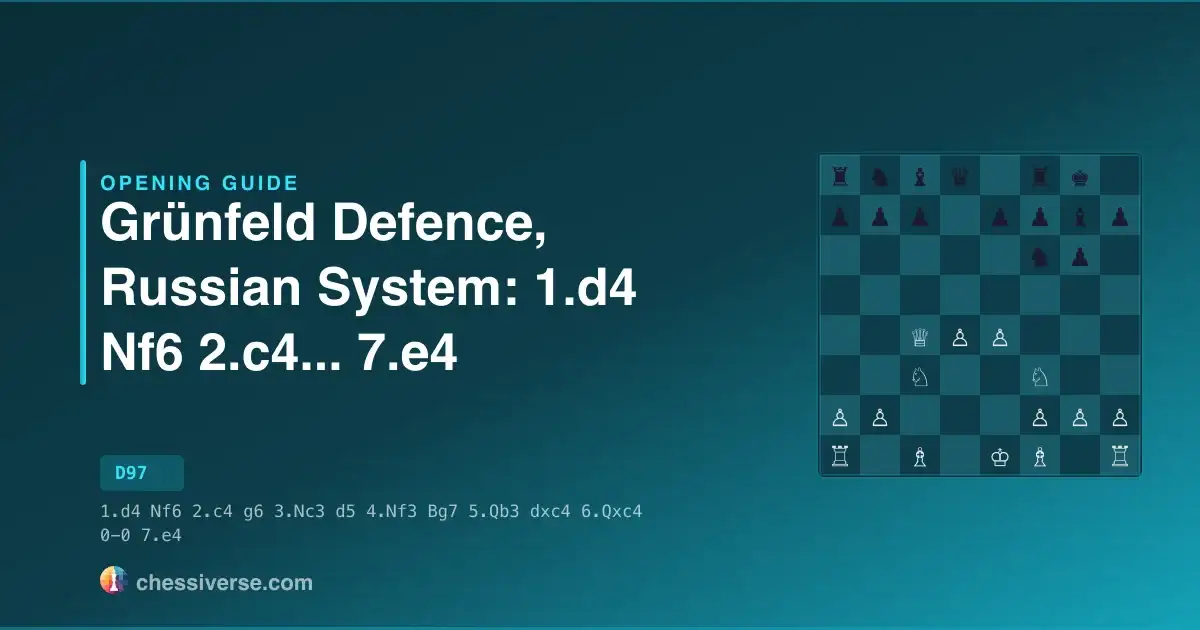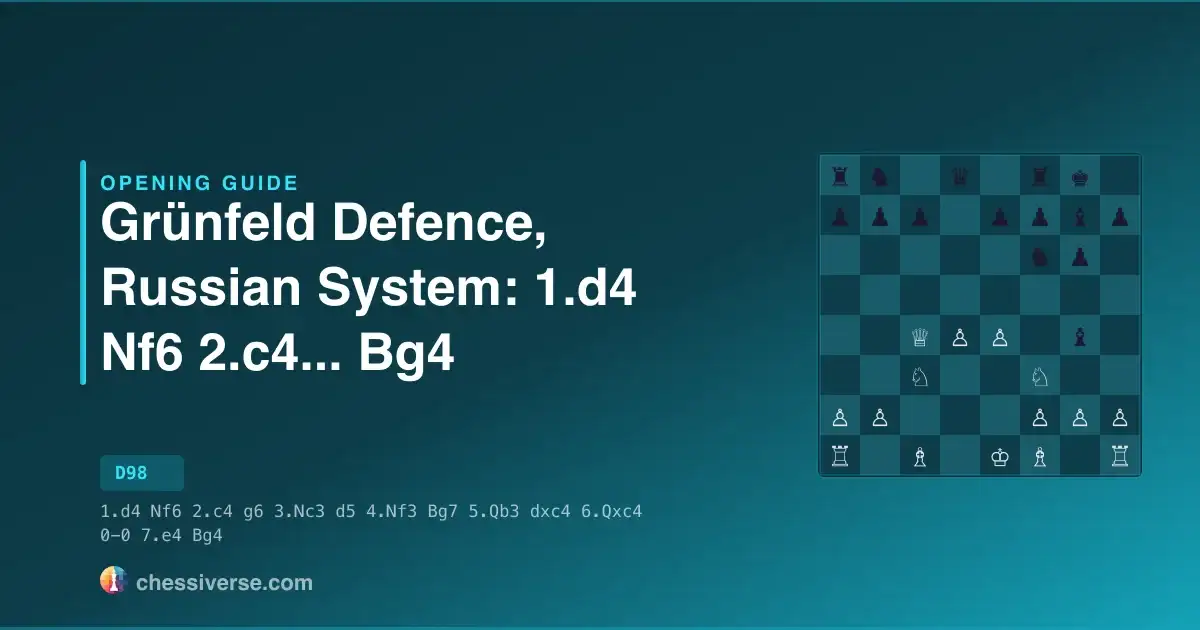




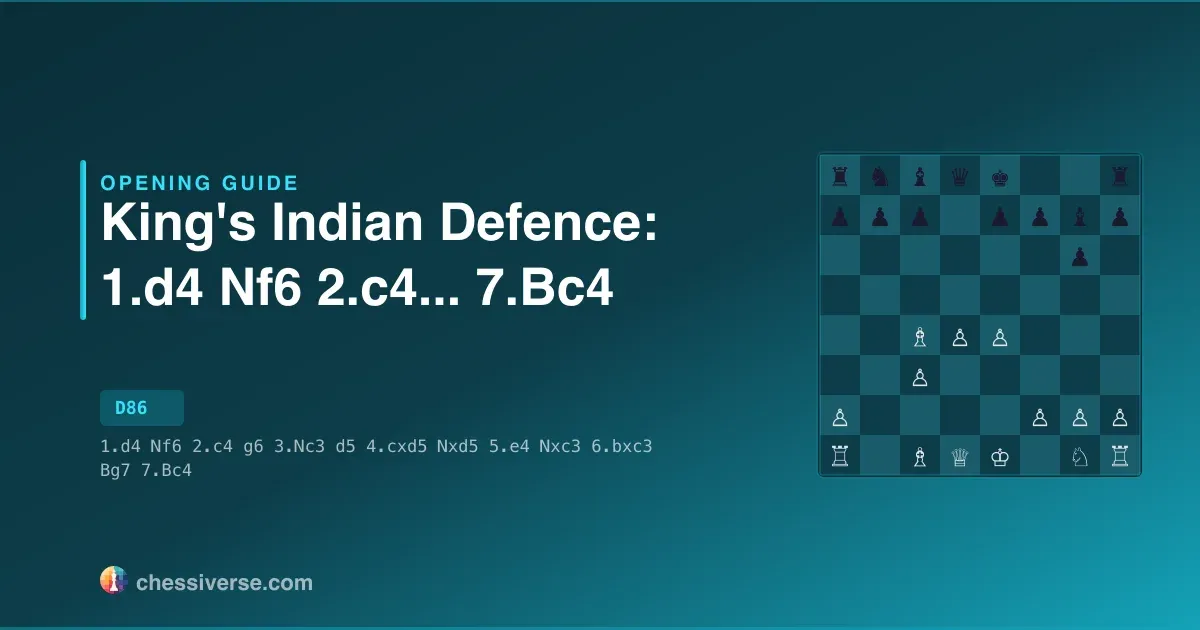
Starting from 1.d4 Nf6 2.c4 g6 3.Nc3 d5 4.cxd5 Nxd5 5.e4 Nxc3 6.bxc3 Bg7 7.Bc4, players enter the Grünfeld Defense: Exchange Variation, Classical Variation — ECO D86. The classical Grünfeld Exchange. The bishop steps out aggressively, eyeing f7, but it locks White into a knight development scheme that gives the position its specific character.
Strategic Overview
Placing the bishop on c4 is the most active development of White's king's bishop, hitting the sensitive f7 square and supporting the centre. The catch is that Nf3 now becomes problematic — after ...Bg4 Black's pressure on d4 grows uncomfortable to defend, so White is committed to one of a few specific schemes. Either the bishop goes to c4 with Ne2 supporting from behind, or White plays Nf3 with the prophylactic h3 to neutralise ...Bg4 before it shows up. Each setup defines the middlegame. The Be2/Nf3 system, which has become more fashionable since the 1980s, keeps the knight on its best square but accepts a more modest bishop placement. The Bc4/Ne2 setup gives the bishop its best diagonal at the cost of a less natural knight square. Both schemes lead to the same fundamental themes: White uses the central pawns to build a kingside attack or push d5 at the right moment; Black hits the centre with ...c5, exchanges to neutralise White's bishop pair where possible, and tries to convert the structural weaknesses on the queenside (the c3 pawns, the open b-file) into long-term targets. It's a position with deep theory and clear strategic plans for both sides.
Key Ideas
A few ideas come up again and again in this opening:
- Bc4 hits f7 but locks White out of Nf3 — The bishop is on its best diagonal, attacking the most sensitive square in Black's camp. The downside is that Nf3 walks into ...Bg4 with crushing pressure on d4, so the knight must go to e2 or be supported by h3.
- Two compatible setups: Bc4/Ne2 or Bc4/Nf3/h3 — Either the bishop is active and the knight modest on e2, or the knight stays on f3 but White spends a tempo on h3 to prevent ...Bg4. Picking between them is a long-running theoretical and stylistic question.
- Black's standard ...c5 break remains central — Just like in every Exchange Grünfeld, Black aims to crack open the centre with ...c5, opening the long diagonal for the g7 bishop and targeting the d4 and c3 weaknesses behind White's pawn front.
- The c3 pawn and open b-file are long-term weaknesses — White's compact-looking centre comes with structural damage. The c-pawns are doubled, c3 is a fixed weakness, and the half-open b-file can be a launching pad for either side's rook activity.
History and Notable Players
It arises from the Grünfeld Defense: Exchange Variation. Among the most prolific White practitioners are Igor Naumkin (51 games), Peter Lukacs (47 games), Rainer Knaak (47 games). Black-side regulars include Josef Pribyl (34 games), Wlodzimierz Schmidt (33 games), Lubomir Ftacnik (29 games).
Performance Across Rating Levels
How well the Grünfeld Defense: Exchange Variation, Classical Variation works depends on what level you're playing at. Among 1200-rated players, it appears in 0.00% of games — 1,853 of them on record — with White winning 49.8% and Black 46.7%. At 1800 the opening surfaces in 0.02% of games; White wins 47.6%, Black 46.2%, draws 6.2%. At 2500, 0.09% of games go into this opening; draws sit at 11.3% — the line is well-mapped at this level. White's edge erodes by 3.9pp from 1200 to 2500 Elo, suggesting Black's counterplay is easier to find with experience.
Time Control Patterns
Look at the same opening across time controls and blitz stands out. In bullet, it appears in 0.01% of games (219,621); White wins 46.9%. Blitz shows 0.02% adoption across 564,509 games, White scoring 46.9%. In rapid, the share rises to 0.01% — 78,667 games, White 46.1%.
Move Diversity and Theory Depth
What players actually play after the opening moves depends heavily on rating. At 1200 Elo (1,848 games), the top reply is O-O, played 47.1% of the time. One other move takes at least 5% of games, and the top three moves account for 91.3% of games. Entropy: 1.74. By 2500 (12,229 games), c5 takes over as the top reply at 76.6%; one other move reaches 5% and the top three moves account for 99.7% of games. Entropy drops to 0.88. That entropy collapse is the signature of a line where preparation pays off: at the top, players know the best move and play it.
Historical Trends
Year-over-year data tells you whether this opening is a contemporary fixture or a fading one. Adoption peaked in 2015 at 0.02% (4,439 games). By 2025 it sits at 0.01%, 43% below the peak and 42% under its 2013 level, leaving the line in decline.
Main Lines and Variations
The main branches off 1.d4 Nf6 2.c4 g6 3.Nc3 d5 4.cxd5 Nxd5 5.e4 Nxc3 6.bxc3 Bg7 7.Bc4 include:
Each branch leads to a different middlegame character — the resulting pawn structure decides what kind of game you get.
Common Mistakes
- Drifting away from main theory — At 1000 Elo, the three most-played moves cover 89.7% of games, against 99.6% at 2000. The most popular deviation is e6 (played 7.1% of the time at 1000, much less so up top). It looks fine but quietly hands the better-prepared side an edge.
- Neglecting development — It can feel productive to make extra pawn moves early, but falling behind in piece development is what loses most amateur games — especially in open positions where active pieces find squares fast.
- Playing without a plan — Each Grünfeld Defense: Exchange Variation, Classical Variation middlegame demands a specific approach. Decide whether the position calls for attack, manoeuvre, or simplification before reaching for a move.
Practice on Chessiverse
Ready to try the Grünfeld Defense: Exchange Variation, Classical Variation against a bot? Pick an opponent at your level and play a game.