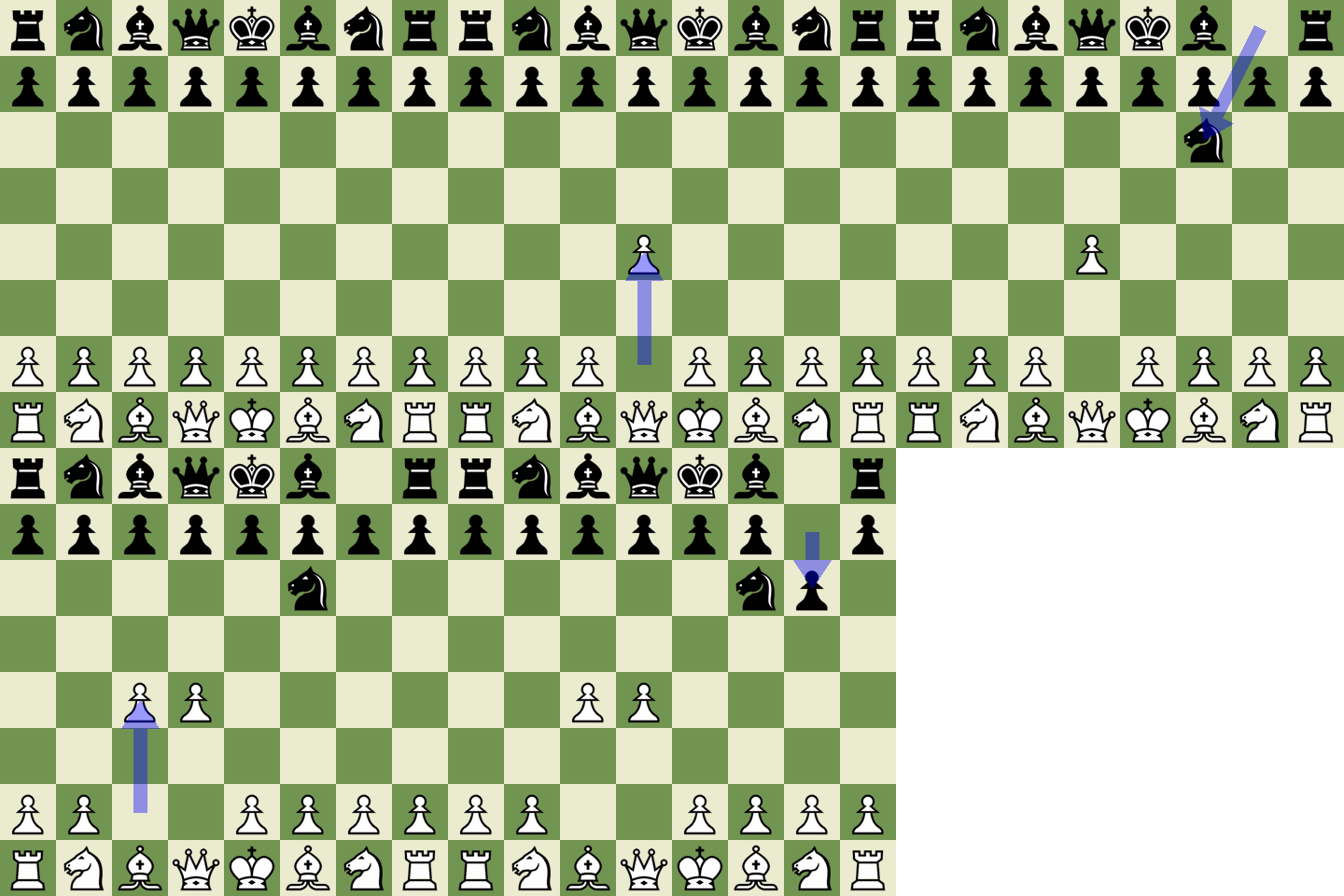
The King's Indian Defense arises after 1.d4 Nf6 2.c4 g6 and falls under ECO code E60. By playing 2...g6, Black signals a hypermodern development plan: the dark-squared bishop will be fianchettoed to g7, from where it exerts long-range pressure on White's centre alongside carefully timed pawn breaks. Several important themes are already in play at this early stage. Keeping the dark-squared bishop is essential for Black's kingside safety after castling, since 2...g6 weakens the dark squares around the king, and without the bishop covering f6 and h6, those weaknesses can prove fatal. At the same time, the g7 bishop carries significant offensive potential: if White opens the centre through pawn exchanges, the bishop can become a powerful attacking piece along the long diagonal toward White's queenside. This pawn structure almost always leads to one of two major systems. In the King's Indian Defense proper, Black castles quickly on the kingside, conceding White a substantial pawn centre but planning to chip away at it with pawn advances and reclaim territory. In the Grunfeld Defense, Black waits for White to play Nc3 before striking with ...d5, seeking counterplay along the long dark diagonal with the aid of ...c5, while White leans on the advantage of a broad central pawn mass. With 31.5 million Lichess games across all rating levels, it is one of the most popular openings.
- Black lets White build a broad pawn centre, then strikes back at it with ...e5 or ...c5
- If White closes the centre with d5, Black attacks the king with ...f5 and a pawn storm while White plays for a queenside breakthrough
- The resulting positions are sharply unbalanced, giving both sides real winning chances
History and Notable Players
It arises from the Indian Defense Systems. Among the most prolific practitioners on the White side are Ivan Farago (1106 games), Svetozar Gligoric (880 games), Loek Van Wely (778 games). On the Black side, notable exponents include Viktor Korchnoi (593 games), Jan H Timman (482 games), Svetozar Gligoric (479 games).
Long viewed with suspicion, the defence was rehabilitated from the 1930s onward by Soviet players Alexander Konstantinopolsky, Isaac Boleslavsky and David Bronstein. It became a main weapon of world champions, though Kasparov shelved it in the early 2000s after Vladimir Kramnik began beating it regularly.
Named after: The label Indian Defence dates to 1884; the specific name King's Indian arose in the mid-1900s and is attributed to Hans Kmoch.
Notable players: Garry Kasparov, Bobby Fischer, Mikhail Tal, Hikaru Nakamura
Eduard Gufeld considered his dazzling 1973 King's Indian win over Vladimir Bagirov his masterpiece, calling it his Mona Lisa.
Statistics
Based on 31.5 million Lichess games across all rating levels:
- White wins: 47.7%
- Black wins: 47.1%
- Draws: 5.3%
The statistics show a roughly balanced opening where both sides have equal chances.
Main Lines and Variations
After 1.d4 Nf6 2.c4 g6, the main continuations include:
- King's Indian Defense (3.Nc3)
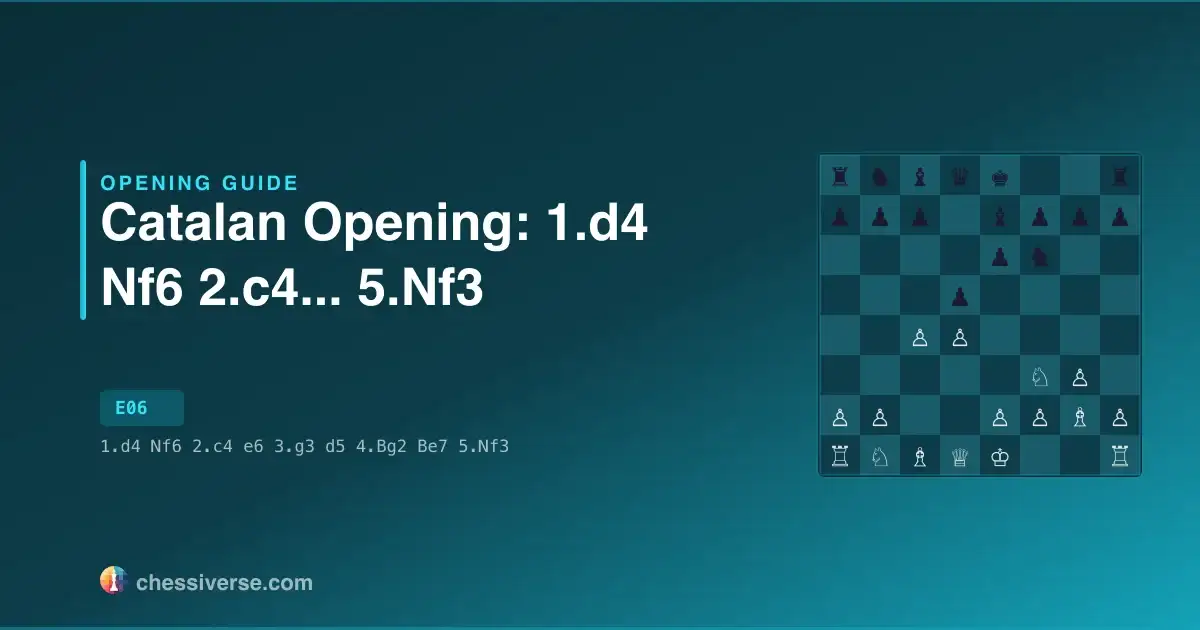
- Neo-Grünfeld Defense: with g3 (5.Nf3)
- Neo-Grünfeld Defense: Exchange Variation
Each of these lines leads to distinct types of positions and requires its own understanding of the resulting pawn structures and piece placements.
Common Mistakes to Avoid
- Allowing White to build an overwhelming center: Hypermodern openings allow White space in the center, but you need to strike back at the right moment. Delaying the counterattack too long can leave you without active play.
Practice on Chessiverse
The best way to learn the King's Indian Defense is through practice. On Chessiverse, you can play chess against computer opponents that specialize in this opening. Our AI bots range from beginner to grandmaster level, each with unique playing styles — from aggressive attackers to solid defenders. Choose a bot that matches your rating and work your way up as you master the opening's key ideas.
Performance Across Rating Levels
Popularity and results vary sharply by rating level. The 1200 bracket has 1,607,751 games (0.24% of all games at that level); White wins 47.9%, Black 48.4%, 3.8% are drawn. At 1800 the opening surfaces in 0.98% of games; White wins 47.3%, Black 47.6%, draws 5.1%. At the top end (2500+ Elo), popularity is 2.99% with 9.7% draws — a clear sign of how much theory rules the line at master level.
Time Control Patterns
Look at the same opening across time controls and blitz stands out. In bullet, it appears in 0.58% of games (15,511,890); White wins 48.4%. Blitz shows 0.73% adoption across 26,229,760 games, White scoring 47.9%. In rapid, the share rises to 0.48% — 5,298,418 games, White 46.7%.
Move Diversity and Theory Depth
Move choice is far from uniform in the King's Indian Defense. At 1200 Elo (1,607,751 games), the top reply is Nc3, played 64% of the time. Two other moves each take at least 5% of games, and the top three moves account for 86.8% of games. Entropy: 1.85. By 2500 (408,056 games), Nc3 dominates at 77.1% of replies; two other moves reach 5% and the top three moves account for 95.4% of games. Entropy drops to 1.17. The narrowing is significant — strong players consolidate around a small set of best moves, while amateurs scatter across many plausible-looking options.