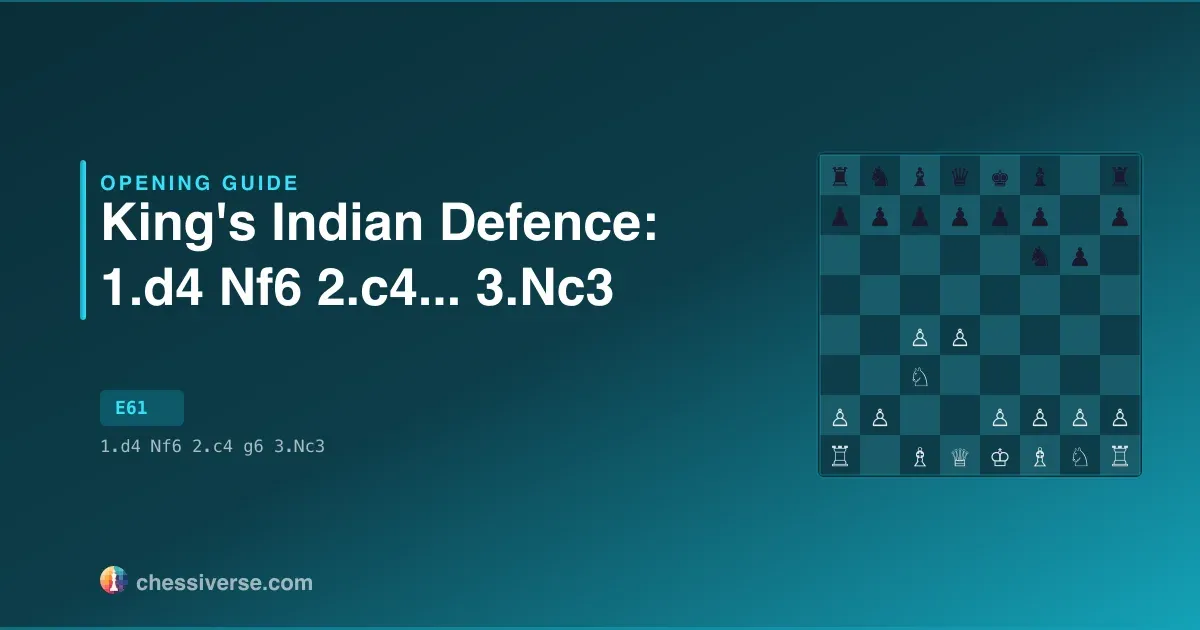
The King's Indian Defense arises after 1.d4 Nf6 2.c4 g6 3.Nc3 and falls under ECO code E61. By developing the knight to c3, White prepares the e4 advance while retaining flexibility to enter multiple systems against the King's Indian. One of Black's most potent options here is the Grunfeld Defense with 3...d5, where the main line 4.cxd5 Nxd5 5.e4 Nxc3 6.bxc3 Bg7 creates a classic hypermodern structure — White holds an imposing pawn center that Black attacks from a distance using the dark-squared bishop and a ...c5 pawn break. The alternatives 3...Bg7 and 3...d6 follow the traditional King's Indian approach, remaining among the most respected and widely played setups at all levels. With 25.5 million Lichess games across all rating levels, it is one of the most popular openings.
History and Notable Players
It arises from the King's Indian Defense. Among the most prolific practitioners on the White side are Ivan Farago (366 games), Aleksey Dreev (239 games), Viktor Korchnoi (228 games). On the Black side, notable exponents include Wolfgang Uhlmann (384 games), Peter Svidler (269 games), Svetozar Gligoric (247 games).
Statistics
Based on 25.5 million Lichess games across all rating levels:
- White wins: 48%
- Black wins: 46.8%
- Draws: 5.2%
The statistics show a roughly balanced opening where both sides have equal chances.
Main Lines and Variations
After 1.d4 Nf6 2.c4 g6 3.Nc3, the main continuations include:
- King's Indian Defense: Normal Variation
- King's Indian Defense: Fianchetto Variation, Delayed Fianchetto
Each of these lines leads to distinct types of positions and requires its own understanding of the resulting pawn structures and piece placements.
Common Mistakes to Avoid
- Allowing White to build an overwhelming center: Hypermodern openings allow White space in the center, but you need to strike back at the right moment. Delaying the counterattack too long can leave you without active play.
Practice on Chessiverse
The best way to learn the King's Indian Defense is through practice. On Chessiverse, you can play chess against computer opponents that specialize in this opening. Our AI bots range from beginner to grandmaster level, each with unique playing styles — from aggressive attackers to solid defenders. Choose a bot that matches your rating and work your way up as you master the opening's key ideas.
Performance Across Rating Levels
Popularity and results vary sharply by rating level. Among 1200-rated players, it appears in 0.16% of games — 1,055,556 of them on record — with White winning 48.8% and Black 47.5%. Move up to 1800 Elo and the share shifts to 0.84%, with White winning 47.5% versus Black's 47.4%. At 2500, 2.34% of games go into this opening; draws sit at 9.7% — the line is well-mapped at this level.
Time Control Patterns
Look at the same opening across time controls and blitz stands out. In bullet, it appears in 0.46% of games (12,119,119); White wins 48.6%. Blitz shows 0.59% adoption across 21,352,185 games, White scoring 48.1%. In rapid, the share rises to 0.37% — 4,112,677 games, White 47.1%.
Move Diversity and Theory Depth
Move choice is far from uniform in the King's Indian Defense (3.Nc3). At 1200 Elo (1,053,009 games), the top reply is Bg7, played 85.2% of the time. Two other moves each take at least 5% of games, and the top three moves account for 97.8% of games. Entropy: 0.87. By 2500 (318,979 games), Bg7 dominates at 64.8% of replies; only one other move still reaches 5% and the top three moves account for 99.5% of games. Entropy rises to 1.09.