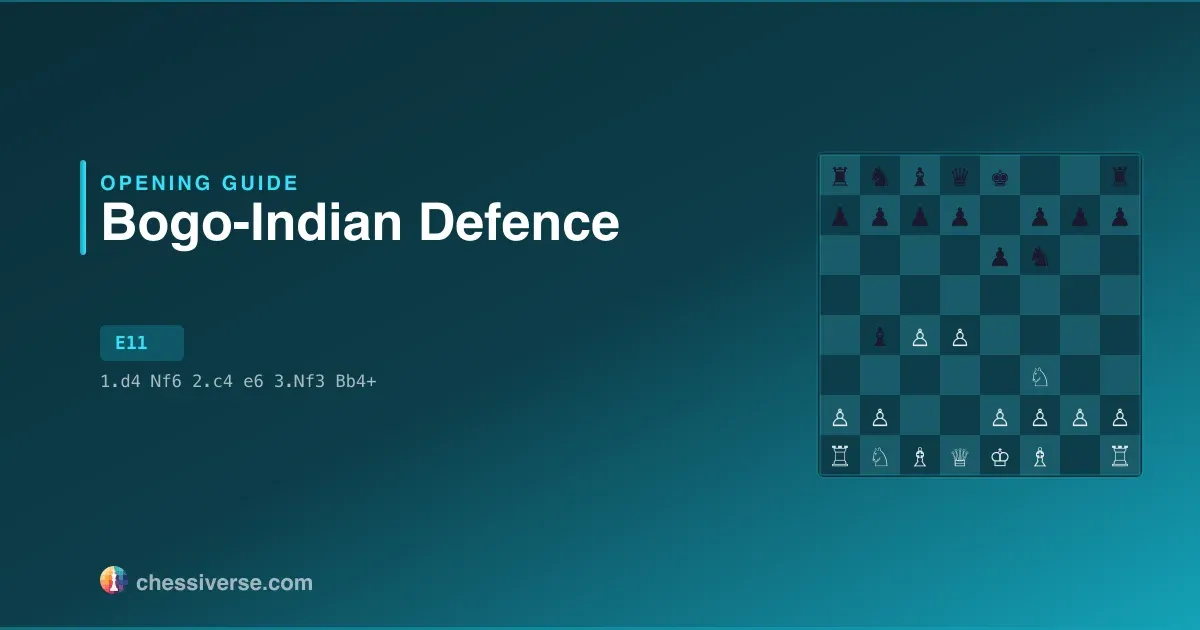
The Bogo-Indian Defense begins with 1.d4 Nf6 2.c4 e6 3.Nf3 Bb4+ (ECO E11). With 2,179,516 games on record, the patterns below come from the largest practical sample available.
- White must answer the check on b4; the main independent tries are 4.Bd2 and 4.Nbd2, since 4.Nc3 simply transposes to the Nimzo-Indian.
- It offers Black another option besides the Queen's Indian when White plays 3.Nf3 to avoid the Nimzo-Indian.
- Play often revolves around the fate of the b4-bishop, which comes under question after 4.Bd2.
History and Notable Players
It arises from the Indian Defense: Anti-Nimzo-Indian. On the White side, Ivan Farago (89 games), Zdenko Kozul (71 games), Loek Van Wely (57 games) top the database. Notable Black exponents: Ulf Andersson (130 games), Viktor Korchnoi (84 games), Milan Drasko (84 games).
The defense is credited to Efim Bogoljubow, its likely originator, who employed it frequently during the 1920s. It emerged as Black's answer when White plays 3.Nf3 to sidestep the Nimzo-Indian, and was later taken up by players such as Keres, Petrosian, Smyslov and Korchnoi.
Named after: Efim Bogoljubow, the Russian-born German grandmaster believed to have originated it; 'Bogo' abbreviates his surname.
Notable players: Efim Bogoljubow, Paul Keres, Tigran Petrosian, Ulf Andersson
The same position can arise from 1.d4 e6 2.c4 Bb4+, known as the Keres Defence, and Bogo-Indian move orders can lead into the Monticelli Trap.
Performance Across Rating Levels
Popularity and results vary sharply by rating level. The 1200 bracket has 73,188 games (0.01% of all games at that level); White wins 51.3%, Black 45%, 3.7% are drawn. At 1800 the opening surfaces in 0.05% of games; White wins 50%, Black 44.4%, draws 5.6%. At the top end (2500+ Elo), popularity is 0.52% with 10.8% draws — a clear sign of how much theory rules the line at master level. White's edge erodes by 3.8pp from 1200 to 2500 Elo, suggesting Black's counterplay is easier to find with experience.
Time Control Patterns
The Bogo-Indian Defense skews toward blitz chess. In bullet, it appears in 0.04% of games (981,689); White wins 50.5%. Blitz shows 0.05% adoption across 1,873,200 games, White scoring 49.3%. In rapid, the share rises to 0.03% — 302,087 games, White 49.7%.
Move Diversity and Theory Depth
Looking at move selection shows how forcing — or not — the position really is. At 1200 Elo (73,048 games), the top reply is Bd2, played 49.4% of the time. Two other moves each take at least 5% of games, and the top three moves account for 99.7% of games. Entropy: 1.31. By 2500 (71,061 games), Bd2 dominates at 57.3% of replies; two other moves reach 5% and the top three moves account for 99.9% of games. Entropy drops to 1.23.
Common Mistakes
- Neglecting development — Extra pawn moves in the opening are tempting, especially when you "know the moves". Developing a piece each turn is the simple correction.
- Letting White own the centre — Hypermodern openings concede central space on purpose, but only if you strike back in time. Delay the counter-blow and you end up squeezed.
Practice on Chessiverse
Ready to try the Bogo-Indian Defense against a bot? Pick an opponent at your level and play a game.