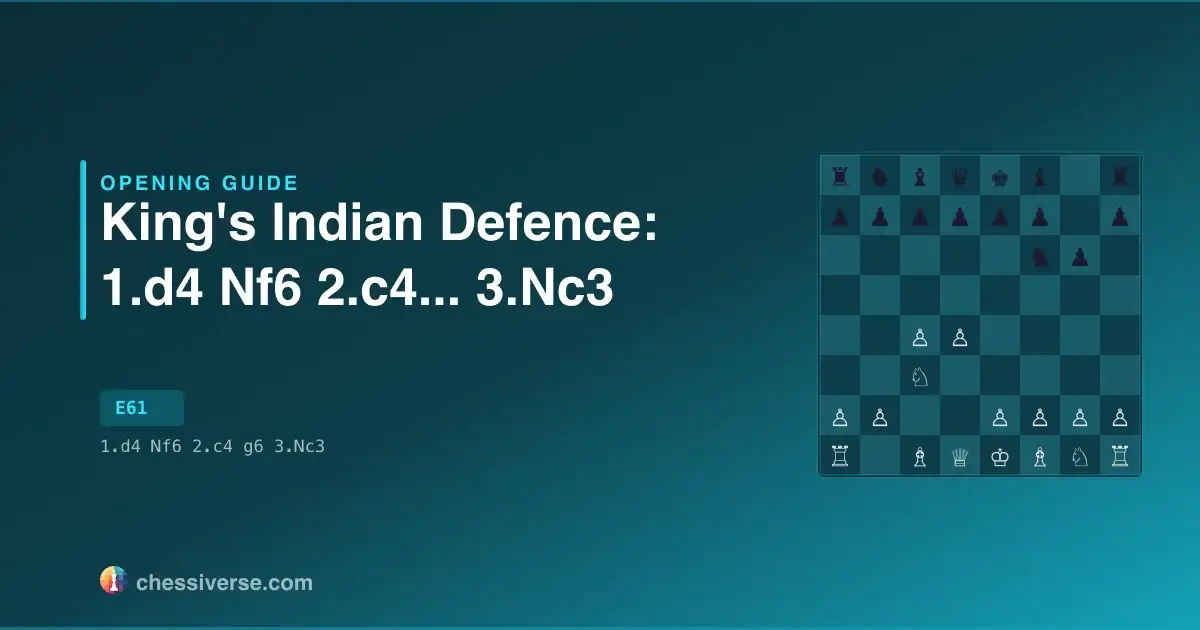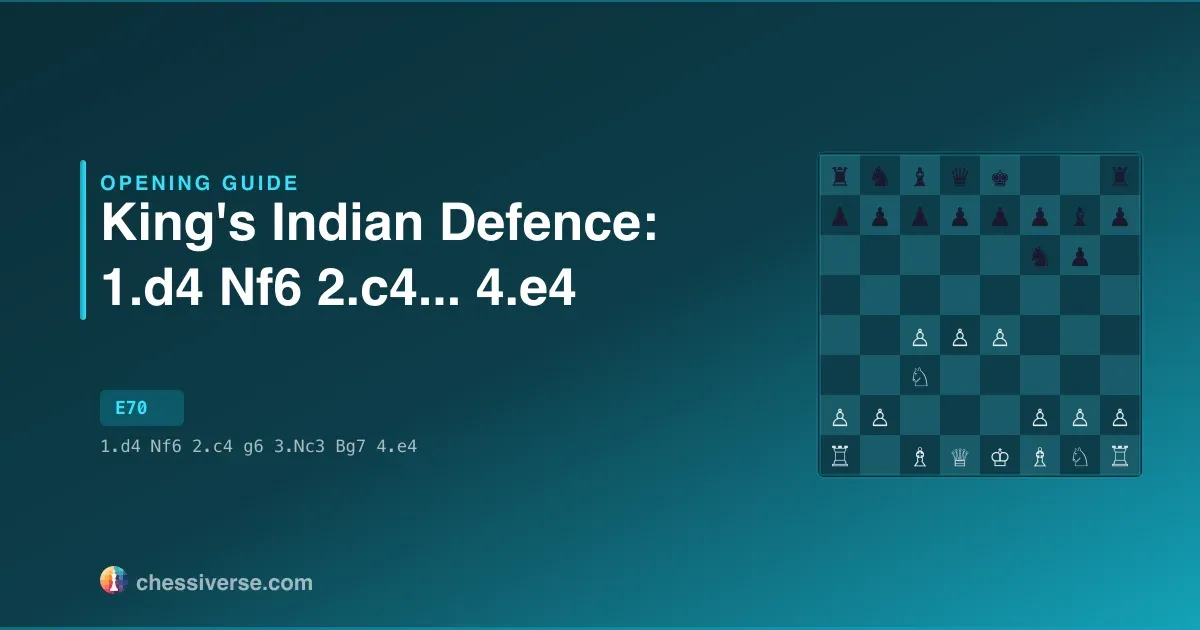
The King's Indian Defense: Normal Variation begins with 1.d4 Nf6 2.c4 g6 3.Nc3 Bg7 4.e4 (ECO E70). The principled answer. Black has invited White to take the centre, and 4.e4 accepts the invitation in full. From here, every classical King's Indian system branches out.
Strategic Overview
After 4.e4, White owns a textbook classical centre: pawns on c4, d4 and e4, with the natural development of pieces to follow. Black's main move is 4...d6, which is doing more than it looks. The pawn on d6 stops e4-e5 from kicking the knight, opens a diagonal for the queen's bishop, and sets the stage for one of the King's Indian's signature pawn breaks — either ...e5, leading to the locked centres of the Mar del Plata and Bayonet structures, or ...c5, transposing into Benoni-flavoured positions. The strategic battle is now fully drawn: White claims the centre and queenside space, Black accepts cramping in exchange for kingside attacking chances and central counter-breaks at the moment of their choosing. White's main line continues 5.Nf3 O-O 6.Be2 e5 7.O-O, the Classical Variation that has been the central battleground of the King's Indian for decades. 4...O-O is also playable since e4-e5 attacks an empty square; if White does push, Black tucks the knight away on e8 and the structure resembles a more committal Four Pawns Attack. A note of warning: 4...d5 is a mistake here because the c4 and e4 pawns clamp down on d5; if Black wanted a Grünfeld, they should have played ...d5 a move earlier.
Key Ideas
When players succeed in this line, they usually do so by leaning on the following themes:
- 4...d6 enables both ...e5 and ...c5 breaks — The little pawn move on d6 is the launchpad for the entire King's Indian. It prevents e4-e5, opens the c8-h3 diagonal, and prepares either ...e5 (Classical structures) or ...c5 (Benoni-like positions) depending on White's setup.
- Classical centre versus piece play — White accepts the invitation to seize the centre with c4, d4 and e4. The whole game becomes a question of whether that centre is durable or whether Black's piece pressure and counter-breaks can crack it.
- The Classical main line is 5.Nf3 O-O 6.Be2 e5 7.O-O — This is the road into the Mar del Plata, Bayonet, Petrosian, and other classical systems. The choice of when and how to resolve the central tension defines the middlegame.
- 4...d5 is a mistake — too late for a Grünfeld — Pushing ...d5 now drops the pawn since White's c4 and e4 pawns both hit d5. If Black wanted a Grünfeld, the time was move three, not move four.
History and Notable Players
It arises from the King's Indian Defense (3.Nc3). Among the most prolific White practitioners are Ivan Farago (192 games), Loek Van Wely (140 games), Viktor Korchnoi (136 games). Black-side regulars include Wolfgang Uhlmann (256 games), Ilia Smirin (207 games), Zdenko Kozul (204 games).
Performance Across Rating Levels
How well the King's Indian Defense: Normal Variation works depends on what level you're playing at. Among 1200-rated players, it appears in 0.07% of games — 497,674 of them on record — with White winning 50.1% and Black 46.4%. At 1800 the opening surfaces in 0.43% of games; White wins 49.8%, Black 45.7%, draws 4.5%. At 2500, 1.39% of games go into this opening; draws sit at 8.6% — the line is well-mapped at this level.
Time Control Patterns
The King's Indian Defense: Normal Variation skews toward blitz chess. In bullet, it appears in 0.21% of games (5,597,960); White wins 50.6%. Blitz shows 0.31% adoption across 11,033,755 games, White scoring 49.9%. In rapid, the share rises to 0.20% — 2,168,216 games, White 49.3%.
Move Diversity and Theory Depth
Move choice is far from uniform in the King's Indian Defense: Normal Variation. At 1200 Elo (496,509 games), the top reply is d6, played 68.4% of the time. One other move takes at least 5% of games, and the top three moves account for 94.5% of games. Entropy: 1.35. By 2500 (189,497 games), d6 dominates at 67.6% of replies; one other move reaches 5% and the top three moves account for 99.9% of games. Entropy drops to 0.94.
Historical Trends
Year-over-year data tells you whether this opening is a contemporary fixture or a fading one. Adoption peaked in 2018 at 0.36% (666,100 games). By 2025 it sits at 0.24%, 31% below the peak but still 12% above its 2013 level, so the line is up over the full period despite easing from the high.
Main Lines and Variations
After 1.d4 Nf6 2.c4 g6 3.Nc3 Bg7 4.e4, the established follow-ups are:
- King's Indian Defense: Makogonov Variation
- King's Indian Defense: Normal Variation, Deferred Fianchetto
- King's Indian Defense: Normal Variation, Standard Development
- King's Indian Defense: Four Pawns Attack
- King's Indian Defense, Sämisch Variation
- King's Indian Defense: Normal Variation, Rare Defenses
Each branch leads to a different middlegame character — the resulting pawn structure decides what kind of game you get.
Common Mistakes
- Drifting away from main theory — At 400 Elo, the three most-played moves cover 90.7% of games, against 98.8% at 2000. The most popular deviation is O-O (played 33.3% of the time at 400, less so up top). It looks fine but quietly hands the better-prepared side an edge.
- Neglecting development — It can feel productive to make extra pawn moves early, but falling behind in piece development is what loses most amateur games — especially in open positions where active pieces find squares fast.
- Letting White own the centre — Hypermodern openings concede central space on purpose, but only if you strike back in time. Delay the counter-blow and you end up squeezed.
Practice on Chessiverse
Ready to try the King's Indian Defense: Normal Variation against a bot? Pick an opponent at your level and play a game.