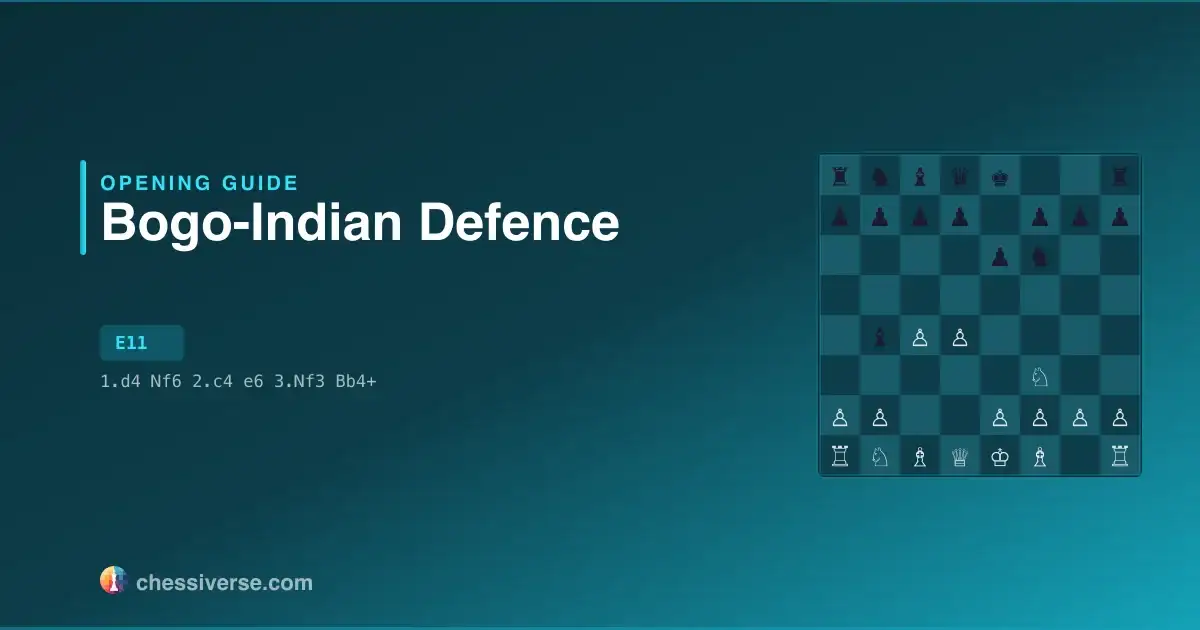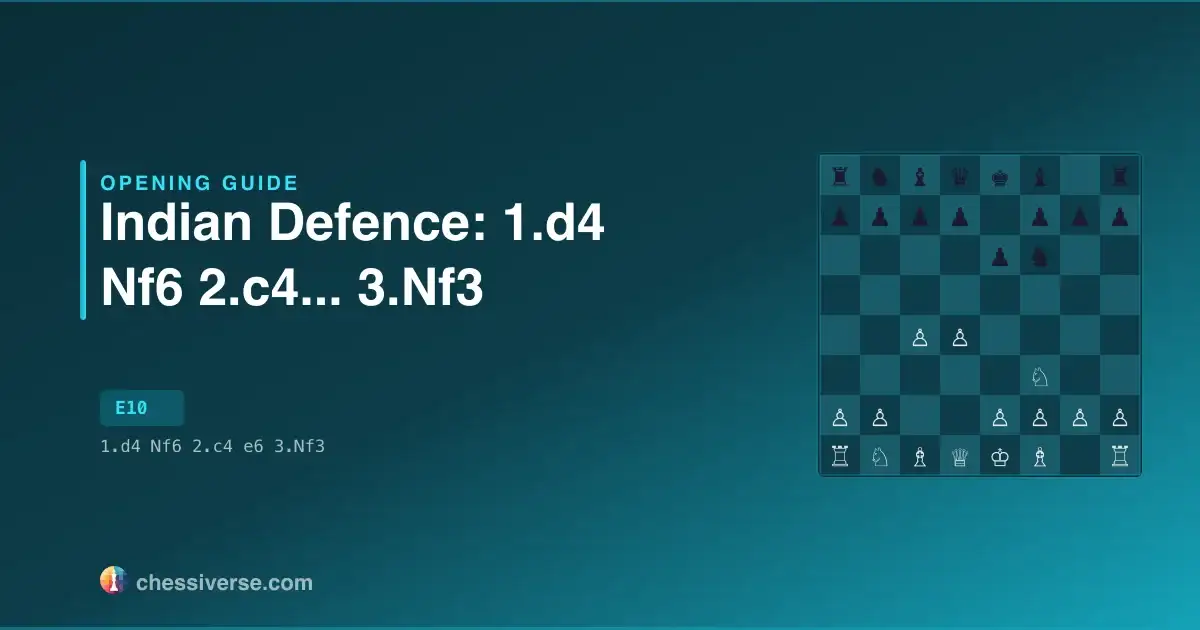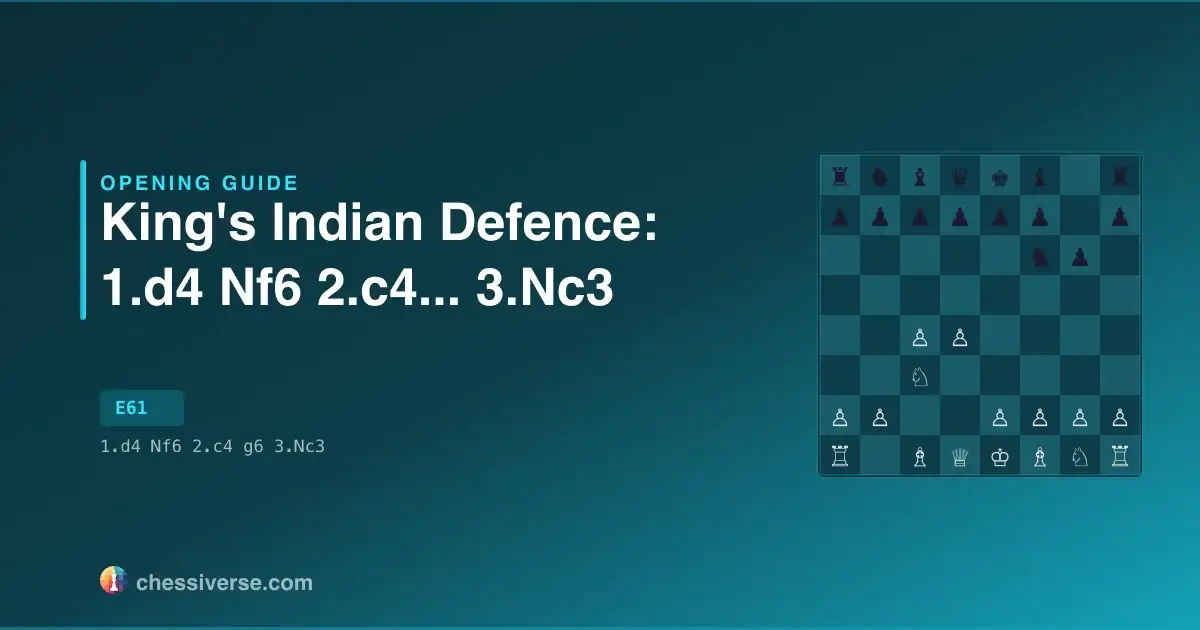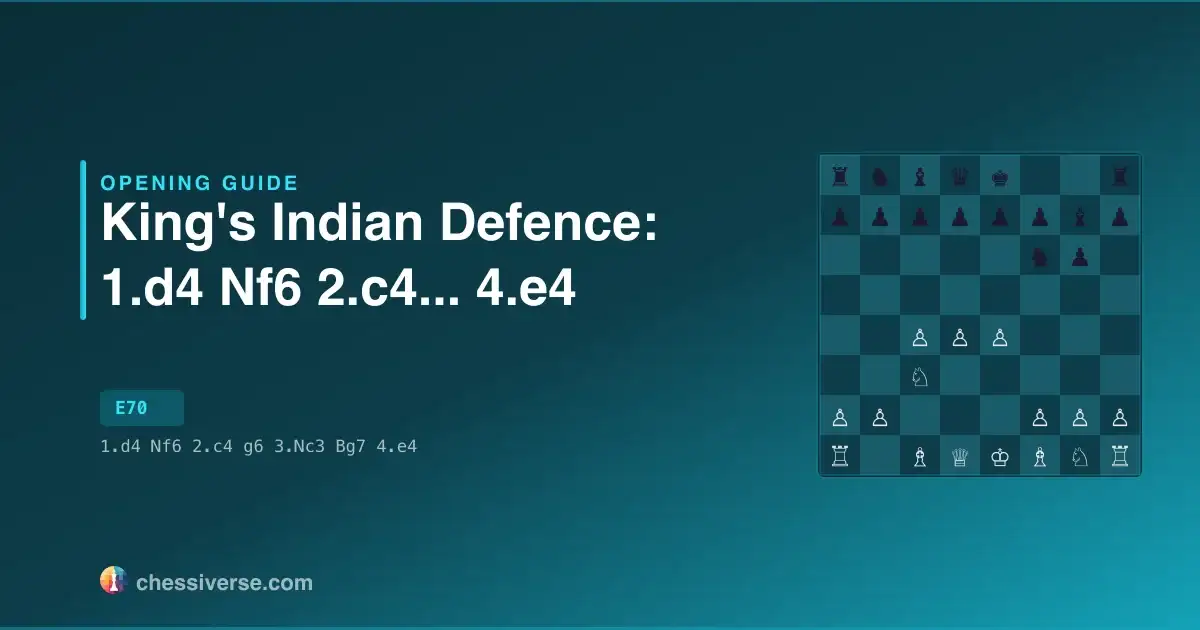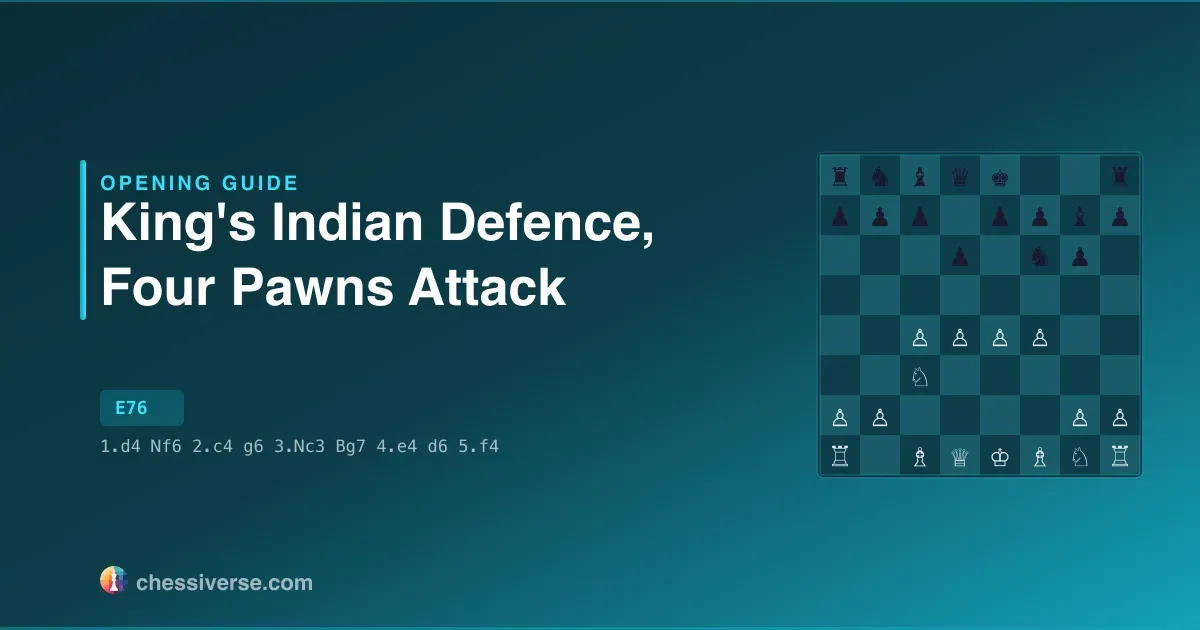
The King's Indian Defense: Four Pawns Attack begins with 1.d4 Nf6 2.c4 g6 3.Nc3 Bg7 4.e4 d6 5.f4 (ECO E76). The most aggressive try against the King's Indian. White builds an enormous pawn centre and dares Black to find a counter before it rolls forward.
Strategic Overview
Four pawns on the fourth rank — c4, d4, e4 and f4 — is the most direct expression of "if you let me have the centre, I'll take it". The setup is genuinely dangerous: if Black plays passively or hesitates with the natural counter-breaks, the f-pawn rolls forward, the centre advances, and Black's king-side gets steamrolled. The classical King's Indian answer of slow manoeuvring with ...Nbd7, ...e5 doesn't work as cleanly because White's f4 means the centre will simply close after e5/d5 with the f-pawn ready to advance. Black's standard counter-strategy is the immediate central challenge with ...c5, transposing into Benoni-flavoured structures, or ...e5 with concrete tactical play to exploit White's weakened diagonals. The catch in White's setup is exactly the price of those four pawns: a lot of dark-square weaknesses behind them, no piece to defend the e3 and f3 squares, and a difficult time getting the king to safety if the centre starts cracking. At master level the Four Pawns is rarely seen because Black has reliable equalising paths; at club level it can be a serious problem if Black doesn't know the right plans. It's a high-variance choice — get the punches landed first or lose the strategic battle.
Key Ideas
When players succeed in this line, they usually do so by leaning on the following themes:
- Massive pawn centre as the main threat — Four pawns on the fourth rank give White a huge spatial advantage and the latent threat of rolling them forward. Passive Black play gets crushed; concrete counterplay is required from move six.
- ...c5 is the principled break — Hitting the centre immediately with ...c5 forces White to decide the central tension on Black's terms. The resulting positions often resemble Benoni structures where Black has counter-chances based on piece activity.
- Dark-square weaknesses behind the pawns — All four pawns on light squares means White's dark squares — especially e3, f3, and the queenside dark squares — are permanently understrength. If Black survives the opening, those weaknesses become long-term targets.
- Rare at master level, dangerous at club level — Black has reliable equalising lines well-mapped at the top, so the Four Pawns appears mostly as a surprise weapon among strong players. Below master level it remains a serious practical try because the attacking ideas come naturally and Black's defence requires precision.
History and Notable Players
It arises from the King's Indian Defense: Normal Variation. Among the most prolific White practitioners are Anatoly Vaisser (56 games), Miso Cebalo (43 games), Evarth Kahn (41 games). Black-side regulars include Mark L Hebden (19 games), Wolfgang Uhlmann (16 games), Joseph G Gallagher (15 games).
Performance Across Rating Levels
Popularity and results vary sharply by rating level. At 1200 Elo, the opening shows up in 0.01% of games (48,755 samples). White scores 51.1%, Black 45.7%, draws 3.2%. Move up to 1800 Elo and the share shifts to 0.10%, with White winning 50.1% versus Black's 45.5%. Among 2500-rated players the line appears in 0.07% of games and draws spike to 8%, indicating tight preparation.
Time Control Patterns
Look at the same opening across time controls and blitz stands out. In bullet, it appears in 0.05% of games (1,358,584); White wins 50.3%. Blitz shows 0.06% adoption across 2,176,397 games, White scoring 50.3%. In rapid, the share rises to 0.03% — 327,300 games, White 50%.
Move Diversity and Theory Depth
Move choice is far from uniform in the King's Indian Defense: Four Pawns Attack. At 1200 Elo (48,614 games), the top reply is O-O, played 57.4% of the time. Three other moves each take at least 5% of games, and the top three moves account for 77.1% of games. Entropy: 2.22. By 2500 (9,798 games), O-O dominates at 87.1% of replies; only one other move still reaches 5% and the top three moves account for 98.6% of games. Entropy drops to 0.70. That entropy collapse is the signature of a line where preparation pays off: at the top, players know the best move and play it.
Historical Trends
Long-term, the trajectory of this opening is informative. Adoption peaked in 2015 at 0.07% (15,201 games). By 2025 it sits at 0.05%, 30% below the peak but still 13% above its 2013 level, so the line is up over the full period despite easing from the high.
Main Lines and Variations
The main branches off 1.d4 Nf6 2.c4 g6 3.Nc3 Bg7 4.e4 d6 5.f4 include:
Each branch leads to a different middlegame character — the resulting pawn structure decides what kind of game you get.
Common Mistakes
- Drifting away from main theory — At 400 Elo, the three most-played moves cover 81.5% of games, against 90.7% at 2000. The most popular deviation is Bg4 (played 17.3% of the time at 400, much less so up top). It looks fine but quietly hands the better-prepared side an edge.
- Neglecting development — It can feel productive to make extra pawn moves early, but falling behind in piece development is what loses most amateur games — especially in open positions where active pieces find squares fast.
- Letting White own the centre — Hypermodern openings concede central space on purpose, but only if you strike back in time. Delay the counter-blow and you end up squeezed.
Practice on Chessiverse
Ready to try the King's Indian Defense: Four Pawns Attack against a bot? Pick an opponent at your level and play a game.