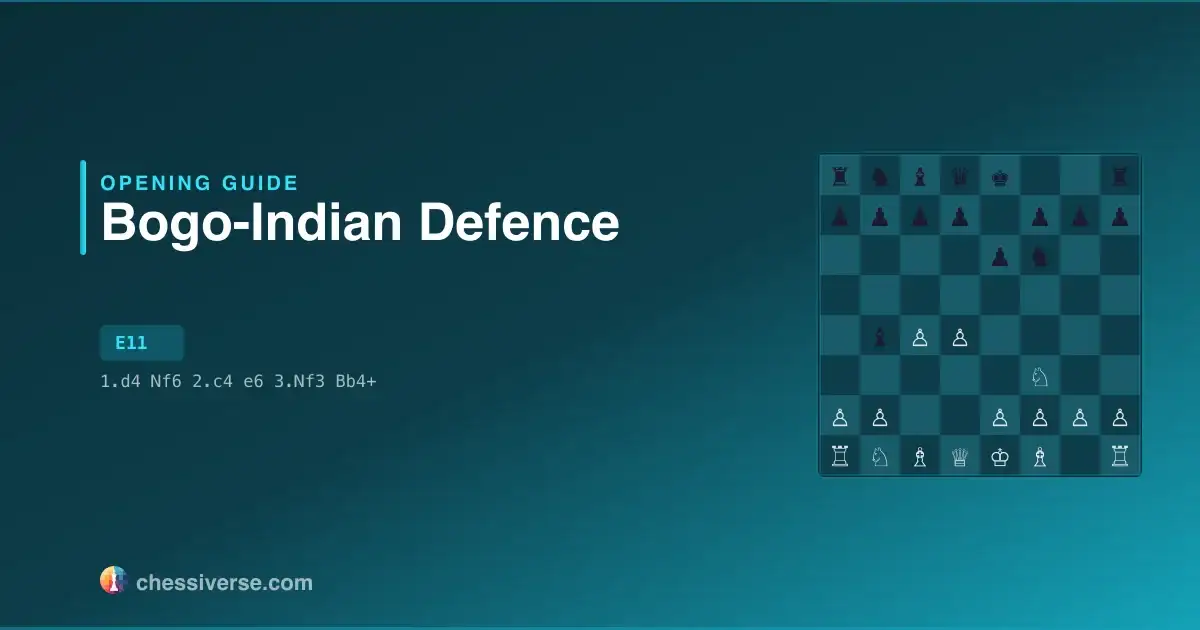




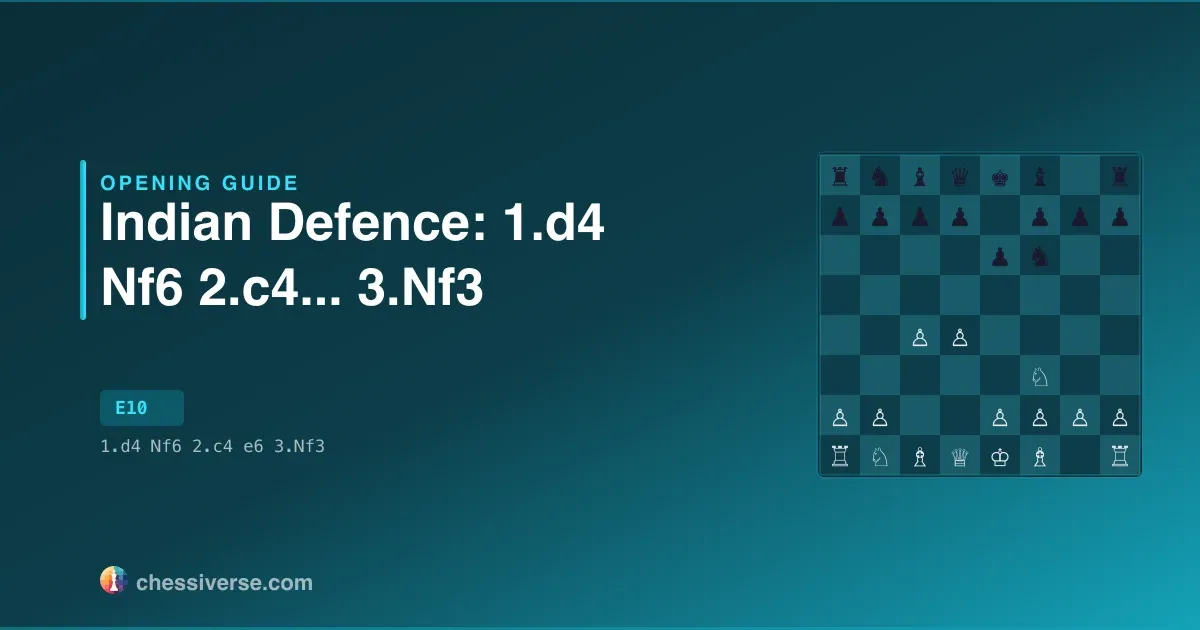
The Indian Defense: Anti-Nimzo-Indian arises after 1.d4 Nf6 2.c4 e6 3.Nf3 and falls under ECO code E10. The knight develops to an active square, reinforcing d4 and e5 while bringing White closer to kingside castling. One drawback is that it blocks the f-pawn, which can serve as a useful lever in certain lines. A major reason White chooses 3.Nf3 over 3.Nc3 is to sidestep the Nimzo-Indian Defense (3.Nc3 Bb4). While 3...Bb4+ remains possible after 3.Nf3, it leads to the Bogo-Indian Defense, which is generally considered less promising for Black than the Nimzo-Indian. On the other hand, because 3.Nf3 does not directly support the e4 break or contest the d5 square, it is slightly more restrained than 3.Nc3. Still, it is a solid choice that offers White numerous paths to a quiet, positional edge. Beyond the Bogo-Indian, Black can steer play toward the Queen's Indian, the Benoni, or various other transpositions. With 11.1 million Lichess games across all rating levels, it is one of the most popular openings.
History and Notable Players
It arises from the Indian Defense Systems. Among the most prolific practitioners on the White side are Ivan Farago (423 games), Aleksey Dreev (363 games), Loek Van Wely (351 games). On the Black side, notable exponents include Viktor Korchnoi (299 games), Anatoly Karpov (274 games), Ivan Farago (260 games).
Statistics
Based on 11.1 million Lichess games across all rating levels:
- White wins: 49.7%
- Black wins: 44.1%
- Draws: 6.2%
The statistics show a roughly balanced opening where both sides have equal chances.
Main Lines and Variations
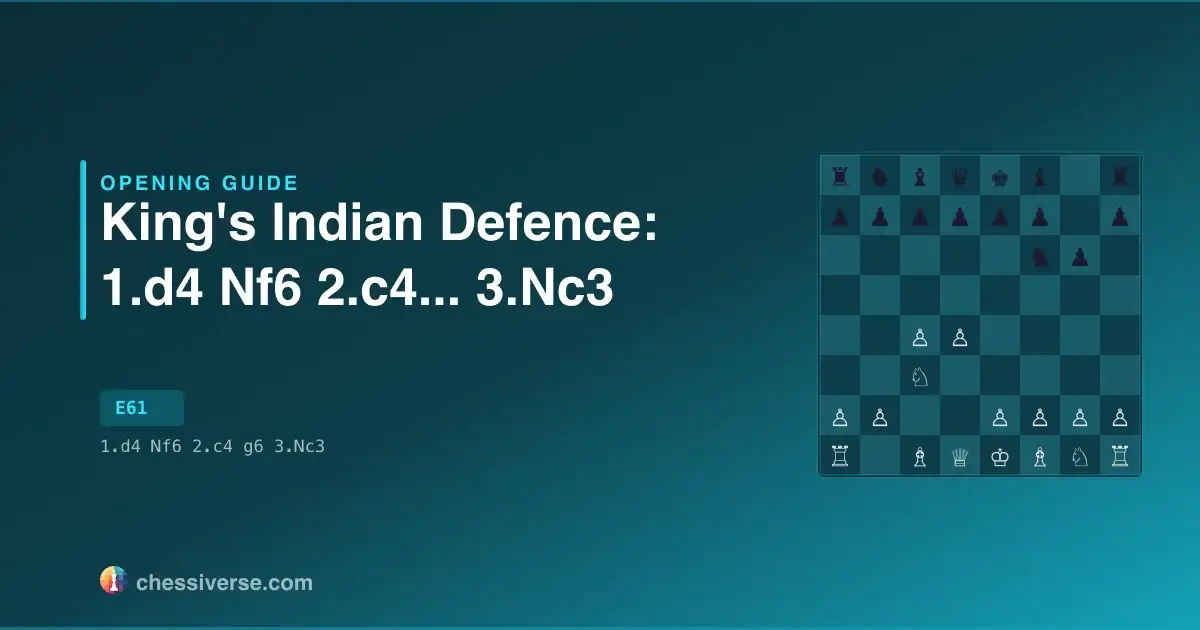
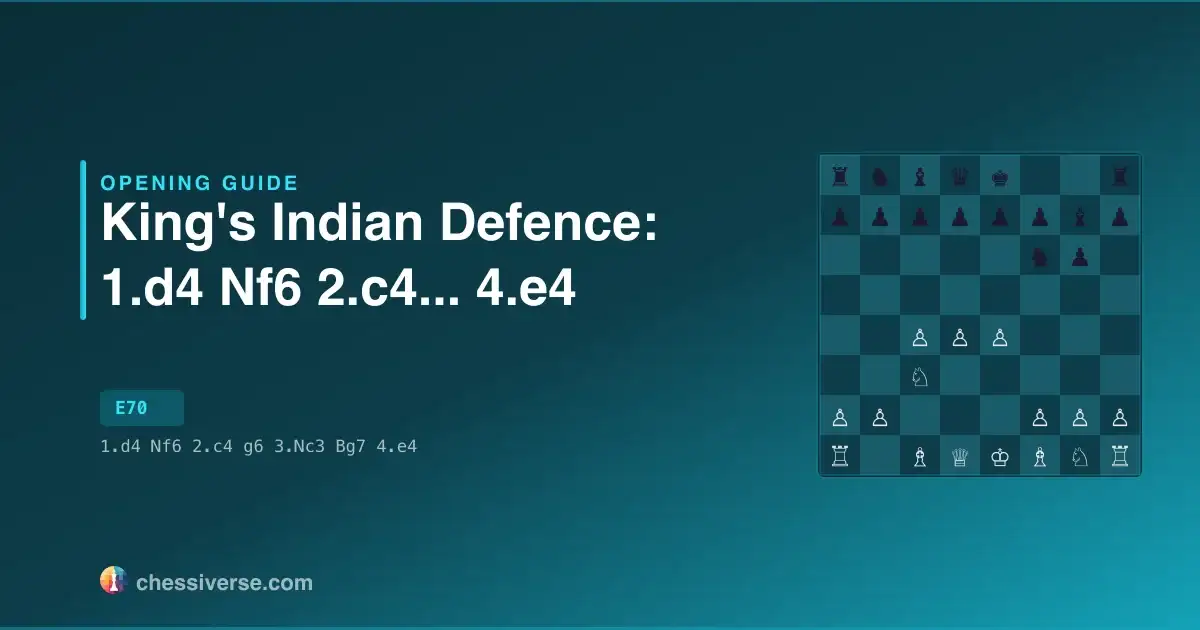
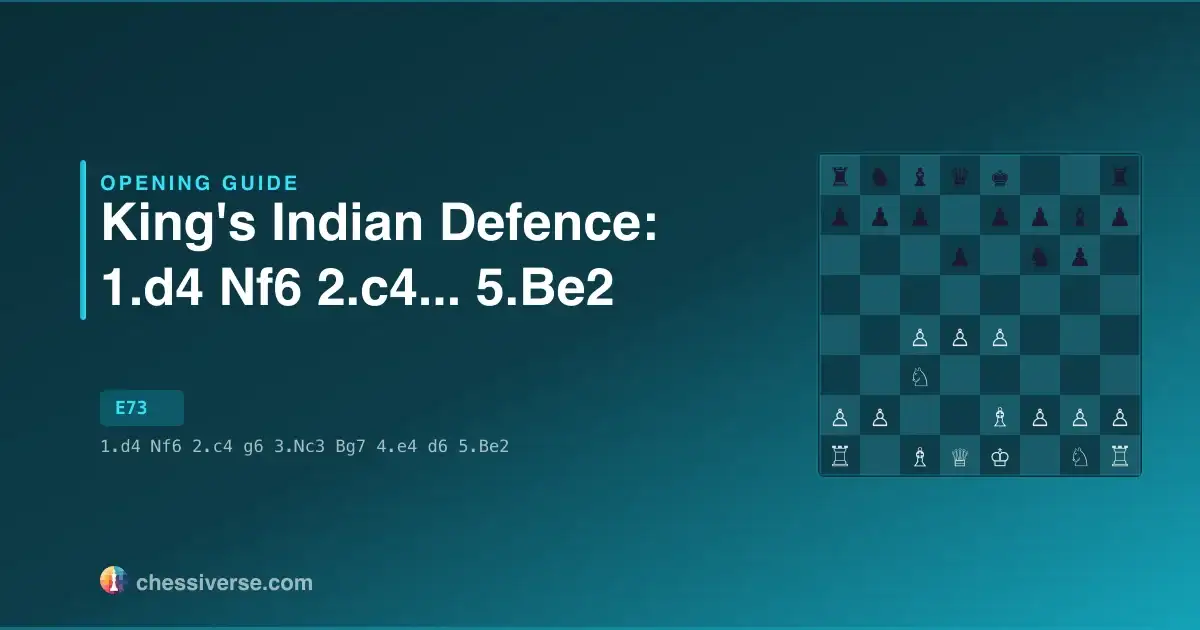
After 1.d4 Nf6 2.c4 e6 3.Nf3, the main continuations include:
Each of these lines leads to distinct types of positions and requires its own understanding of the resulting pawn structures and piece placements.
Common Mistakes to Avoid
- Allowing White to build an overwhelming center: Hypermodern openings allow White space in the center, but you need to strike back at the right moment. Delaying the counterattack too long can leave you without active play.
Practice on Chessiverse
The best way to learn the Indian Defense: Anti-Nimzo-Indian is through practice. On Chessiverse, you can play chess against computer opponents that specialize in this opening. Our AI bots range from beginner to grandmaster level, each with unique playing styles — from aggressive attackers to solid defenders. Choose a bot that matches your rating and work your way up as you master the opening's key ideas.
Performance Across Rating Levels
Popularity and results vary sharply by rating level. Among 1200-rated players, it appears in 0.06% of games — 379,195 of them on record — with White winning 51% and Black 45.4%. Move up to 1800 Elo and the share shifts to 0.30%, with White winning 50.3% versus Black's 44.2%. At 2500, 2.50% of games go into this opening; draws sit at 11% — the line is well-mapped at this level. White's edge erodes by 3.9pp from 1200 to 2500 Elo, suggesting Black's counterplay is easier to find with experience.
Time Control Patterns
Time control matters here: blitz players reach for this opening more than others. In bullet, it appears in 0.20% of games (5,337,643); White wins 50.6%. Blitz shows 0.26% adoption across 9,369,024 games, White scoring 49.8%. In rapid, the share rises to 0.15% — 1,703,922 games, White 49.7%.
Move Diversity and Theory Depth
What players actually play after the opening moves depends heavily on rating. At 1200 Elo (378,516 games), the top reply is d5, played 40.2% of the time. Five other moves each take at least 5% of games, and the top three moves account for 69.7% of games. Entropy: 2.68. By 2500 (340,546 games), d5 is still the top reply, at 43.4%; only three other moves still reach 5% and the top three moves account for 89.1% of games. Entropy drops to 1.97. The narrowing is significant — strong players consolidate around a small set of best moves, while amateurs scatter across many plausible-looking options.
Historical Trends
Year-over-year data tells you whether this opening is a contemporary fixture or a fading one. Adoption peaked in 2015 at 0.29% (64,933 games). By 2025 it sits at 0.21%, 27% below the peak but still 13% above its 2013 level, so the line is up over the full period despite easing from the high.