



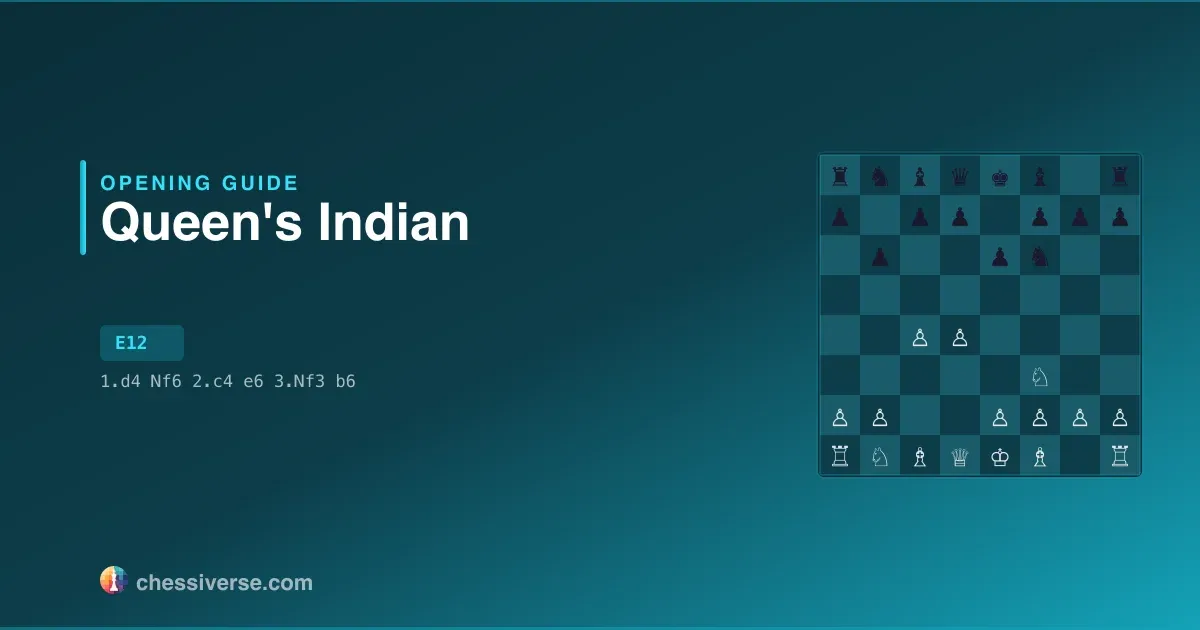
The Queen's Indian Defense arises after 1.d4 Nf6 2.c4 e6 3.Nf3 b6 and falls under ECO code E12. A well-established and relatively modern system, the Queen's Indian sees Black rapidly activate the queenside bishop, which can be fianchettoed to b7 to fight for control of the long diagonal or deployed to a6 to challenge White's c-pawn directly. The opening has been a regular feature in the repertoires of many elite players, including former world champions Anatoly Karpov and Viswanathan Anand. With 2.2 million Lichess games across all rating levels, it is a well-established opening choice.
- Black fianchettoes the queen's bishop to b7 to fight for the light central squares e4 and d5 without occupying the centre with pawns.
- Like its sister opening the Nimzo-Indian, a key point is preventing White from achieving the e4 pawn advance.
- Black seeks counterplay with the ...c5 and ...d5 pawn breaks and queenside pawn pushes such as ...a4 or ...b5.
History and Notable Players
It arises from the Indian Defense Systems. Among the most prolific practitioners on the White side are Ivan Farago (208 games), Loek Van Wely (169 games), Aleksey Dreev (169 games). On the Black side, notable exponents include Ivan Farago (207 games), Anatoly Karpov (204 games), Eduardas Rozentalis (171 games).
A product of the hypermodern school, which preferred controlling the centre with pieces to occupying it with pawns. The classical 4...Bb7 lines were Black's standard through the 1970s, until the 4...Ba6 variation emerged in the 1980s and became the fashionable main line.
Named after: Named for Black's queenside fianchetto with 3...b6, the queen's-side member of the Indian defences and sister opening of the Nimzo-Indian.
Notable players: Lev Polugaevsky, Veselin Topalov, Magnus Carlsen
The solid old 4...Bb7 main lines are notorious for their drawish tendencies - yet the opening still hides traps, one of which has ensnared masters such as Kamran Shirazi.
Statistics
Based on 2.2 million Lichess games across all rating levels:
- White wins: 48%
- Black wins: 45.4%
- Draws: 6.6%
The statistics show a roughly balanced opening where both sides have equal chances.
Main Lines and Variations
After 1.d4 Nf6 2.c4 e6 3.Nf3 b6, the main continuations include:
- Queen's Indian Defense: Spassky System
- Queen's Indian Defense: Fianchetto Variation
- Queen's Indian Defense: Kasparov Variation
Each of these lines leads to distinct types of positions and requires its own understanding of the resulting pawn structures and piece placements.
Common Mistakes to Avoid
- Allowing White to build an overwhelming center: Hypermodern openings allow White space in the center, but you need to strike back at the right moment. Delaying the counterattack too long can leave you without active play.
Practice on Chessiverse
The best way to learn the Queen's Indian Defense is through practice. On Chessiverse, you can play chess against computer opponents that specialize in this opening. Our AI bots range from beginner to grandmaster level, each with unique playing styles — from aggressive attackers to solid defenders. Choose a bot that matches your rating and work your way up as you master the opening's key ideas.
Performance Across Rating Levels
Popularity and results vary sharply by rating level. The 1200 bracket has 37,593 games (0.01% of all games at that level); White wins 49.5%, Black 47.1%, 3.4% are drawn. Move up to 1800 Elo and the share shifts to 0.05%, with White winning 48.3% versus Black's 46.2%. Among 2500-rated players the line appears in 0.63% of games and draws spike to 10.6%, indicating tight preparation.
Time Control Patterns
Look at the same opening across time controls and blitz stands out. In bullet, it appears in 0.03% of games (747,868); White wins 49.1%. Blitz shows 0.05% adoption across 1,909,543 games, White scoring 48.1%. In rapid, the share rises to 0.03% — 311,649 games, White 47.5%.
Move Diversity and Theory Depth
What players actually play after the opening moves depends heavily on rating. At 1200 Elo (37,593 games), the top reply is Nc3, played 44.3% of the time. Three other moves each take at least 5% of games, and the top three moves account for 73.5% of games. Entropy: 2.39. By 2500 (86,362 games), g3 takes over as the top reply at 61.7%; only two other moves still reach 5% and the top three moves account for 93% of games. Entropy drops to 1.65. The narrowing is significant — strong players consolidate around a small set of best moves, while amateurs scatter across many plausible-looking options.