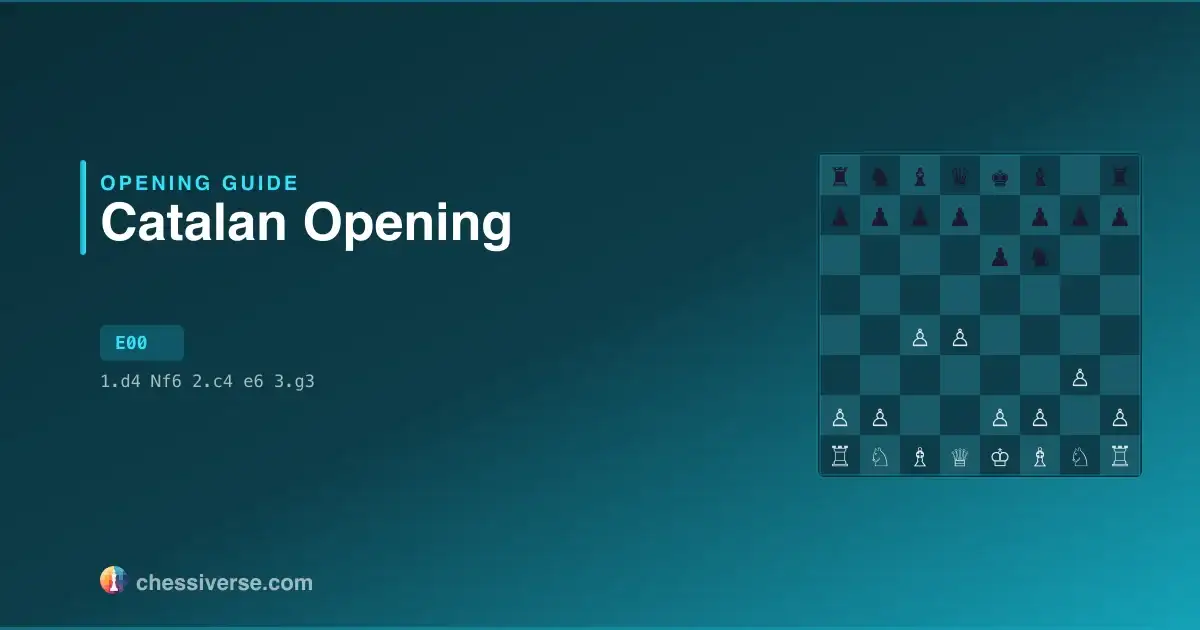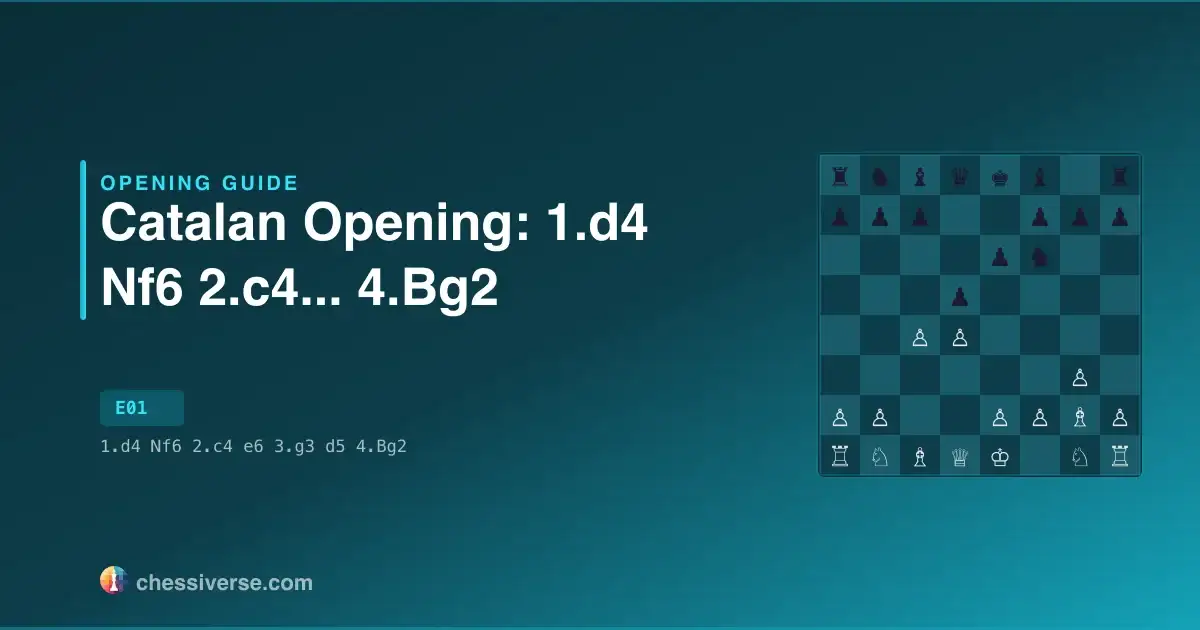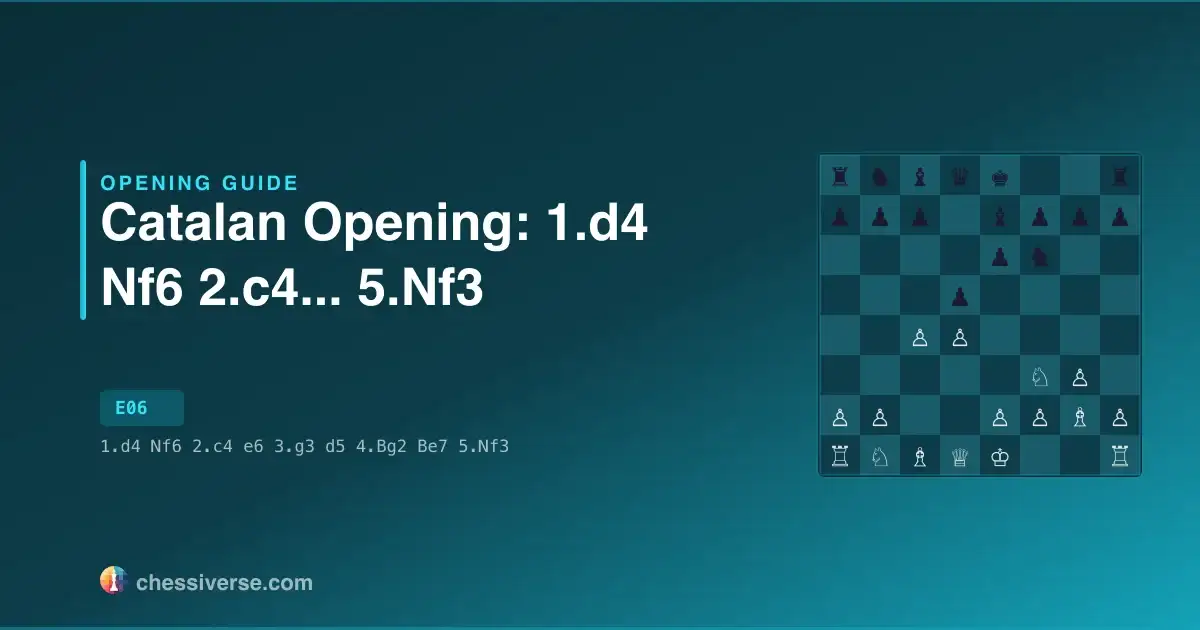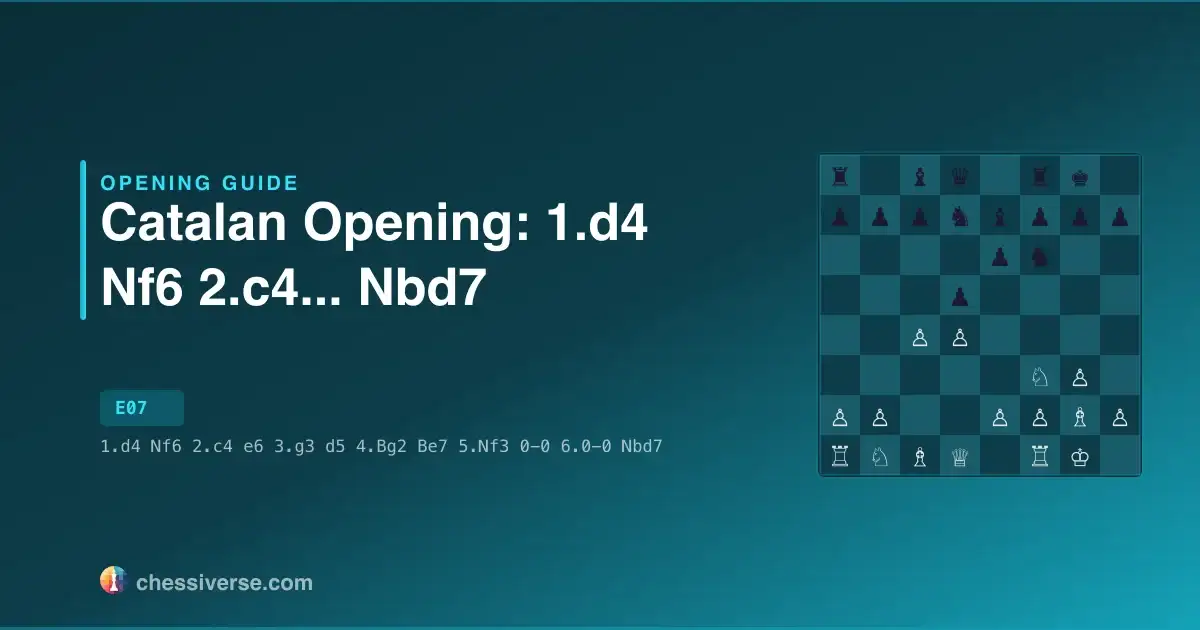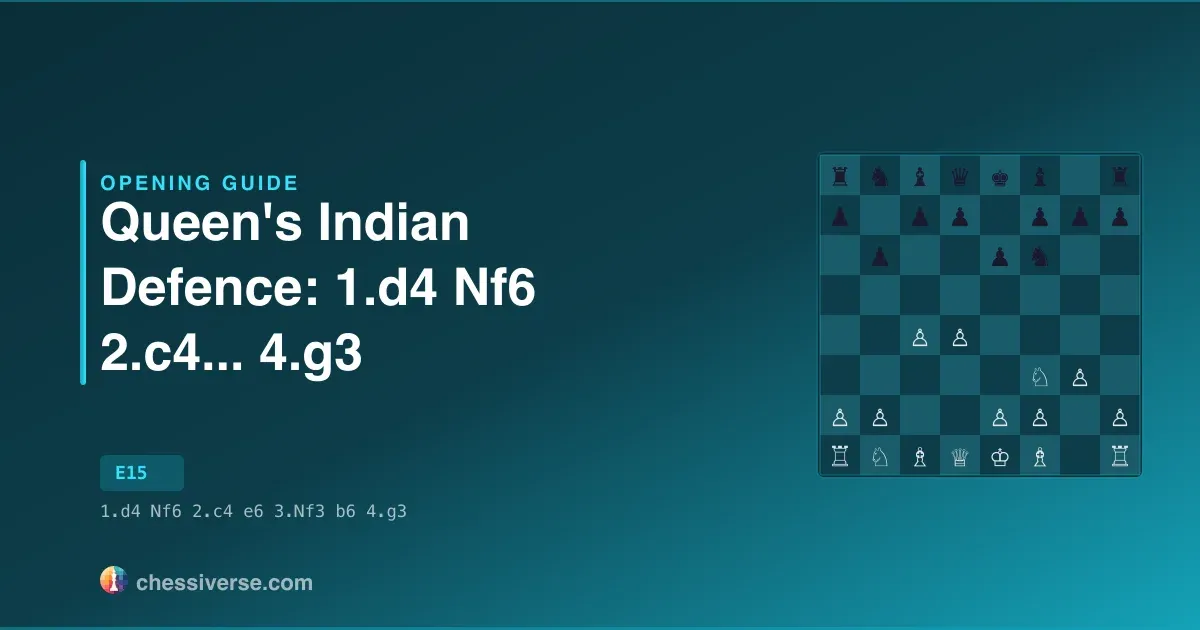
The Queen's Indian Defense: Fianchetto Variation begins with 1.d4 Nf6 2.c4 e6 3.Nf3 b6 4.g3 (ECO E15). The classical answer to the Queen's Indian. White fianchettoes the king's bishop to challenge Black for the long diagonal, turning the opening into a strategic duel over a single critical line.
Strategic Overview
Black's whole point with ...b6 is to fight for the a8-h1 diagonal with a bishop on b7. By answering 4.g3, White says: fine, let's see whose fianchetto is better. The g2 bishop will contest the diagonal directly, and the resulting middlegame revolves around piece placement, control of the e4 square, and the question of whether either side can break the symmetry. The mainstream continuation involves 4...Bb7 5.Bg2, after which Black has several plans depending on style — develop quickly, fight for e4 with a knight on e4 or extra pieces, or aim for a queenside break with ...c5 to open lines. The modern main line has produced a lot of theory because small differences in move order matter. White can prepare central expansion with d5 sacrifices, sometimes giving up a pawn for piece activity, or shift to a slow Nc3, Bd2 setup that defends key pieces while threatening d4-d5 ideas. Black has alternative fourth moves: 4...Ba6 hits the c4 pawn and exploits the fact that e2-e3 is now awkward; 4...Bb4+ borrows Bogo-Indian and Nimzo-Indian themes; 4...c5 attacks the centre directly and can transpose into Benoni territory. The g3 system is the patient, positional answer that rewards understanding of long-diagonal play over forced sequences.
Key Ideas
A few ideas come up again and again in this opening:
- Both sides fight for the long diagonal — White's bishop on g2 and Black's bishop on b7 stare at each other along the a8-h1 diagonal. Who controls it, who trades it, and who reroutes it tends to define the middlegame.
- The e4 square is the central battleground — Control of e4 is the defining strategic fight. Black often manoeuvres a knight to e4 to challenge White's centre, and White's whole development scheme is built to defend or contest that square.
- 4...Ba6 punishes White's bishop commitment — Hitting the c-pawn with the bishop is awkward for White: the natural defence e2-e3 is no longer available because the king's bishop is already on g3-bound, so White has to find a less natural way to hold the pawn.
- 4...Bb4+ borrows from Bogo and Nimzo ideas — Checking on b4 forces White to interpose with bishop or knight. Black accepts a slightly passive position in exchange for a structurally sound and well-mapped middlegame.
- 4...c5 challenges the centre immediately — Pushing the c-pawn at once questions d4 and can transpose into Benoni-style structures or late c5 lines of the Queen's Indian depending on how both sides handle the central tension.
History and Notable Players
It arises from the Queen's Indian Defense. On the White side, Anatoly Karpov (131 games), Predrag Nikolic (122 games), Loek Van Wely (117 games) top the database. Notable Black exponents: Anatoly Karpov (125 games), Ivan Farago (117 games), Gyula Sax (106 games).
Performance Across Rating Levels
Popularity and results vary sharply by rating level. Among 1200-rated players, it appears in 0.00% of games — 5,550 of them on record — with White winning 53.8% and Black 41.9%. By 1800, popularity is 0.02% and White's score is 50.9% to Black's 43.2%. At the top end (2500+ Elo), popularity is 0.39% with 11.1% draws — a clear sign of how much theory rules the line at master level. White's edge erodes by 7.2pp from 1200 to 2500 Elo, suggesting Black's counterplay is easier to find with experience.
Time Control Patterns
Time control matters here: blitz players reach for this opening more than others. In bullet, it appears in 0.01% of games (235,368); White wins 50.3%. Blitz shows 0.02% adoption across 799,273 games, White scoring 49.1%. In rapid, the share rises to 0.01% — 110,274 games, White 49.8%.
Move Diversity and Theory Depth
Move choice is far from uniform in the Queen's Indian Defense: Fianchetto Variation. At 1200 Elo (5,539 games), the top reply is Bb7, played 81.8% of the time. One other move takes at least 5% of games, and the top three moves account for 92.1% of games. Entropy: 1.16. By 2500 (53,356 games), Ba6 takes over as the top reply at 47.4%; one other move reaches 5% and the top three moves account for 97.7% of games. Entropy rises to 1.39.
Historical Trends
Tracking the Queen's Indian Defense: Fianchetto Variation year over year shows a clear story. Adoption peaked in 2018 at 0.024% (45,355 games). By 2025 it sits at 0.019%, 21% below the peak but still 17% above its 2013 level, so the line is up over the full period despite easing from the high.
Main Lines and Variations
After 1.d4 Nf6 2.c4 e6 3.Nf3 b6 4.g3, the established follow-ups are:
Each branch leads to a different middlegame character — the resulting pawn structure decides what kind of game you get.
Common Mistakes
- Drifting away from main theory — At 400 Elo, the three most-played moves cover 80.7% of games, against 98.5% at 2000. The most popular deviation is d5 (played 5.2% of the time at 400, much less so up top). It looks fine but quietly hands the better-prepared side an edge.
- Neglecting development — Extra pawn moves in the opening are tempting, especially when you "know the moves". Developing a piece each turn is the simple correction.
- Letting White own the centre — Hypermodern openings concede central space on purpose, but only if you strike back in time. Delay the counter-blow and you end up squeezed.
Practice on Chessiverse
Ready to try the Queen's Indian Defense: Fianchetto Variation against a bot? Pick an opponent at your level and play a game.