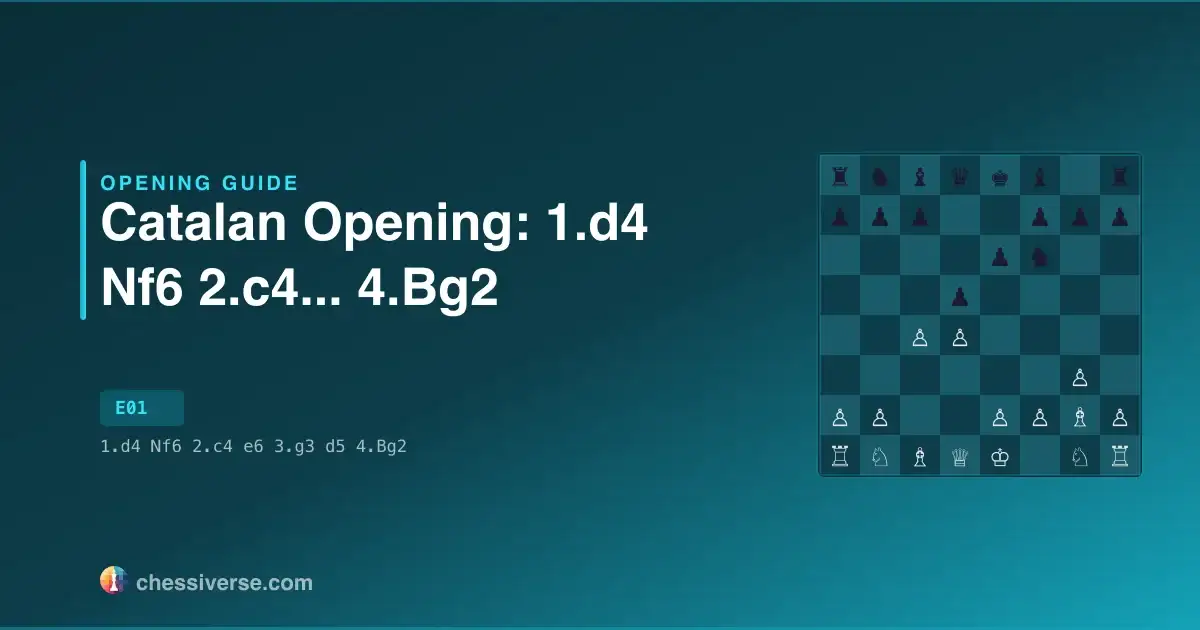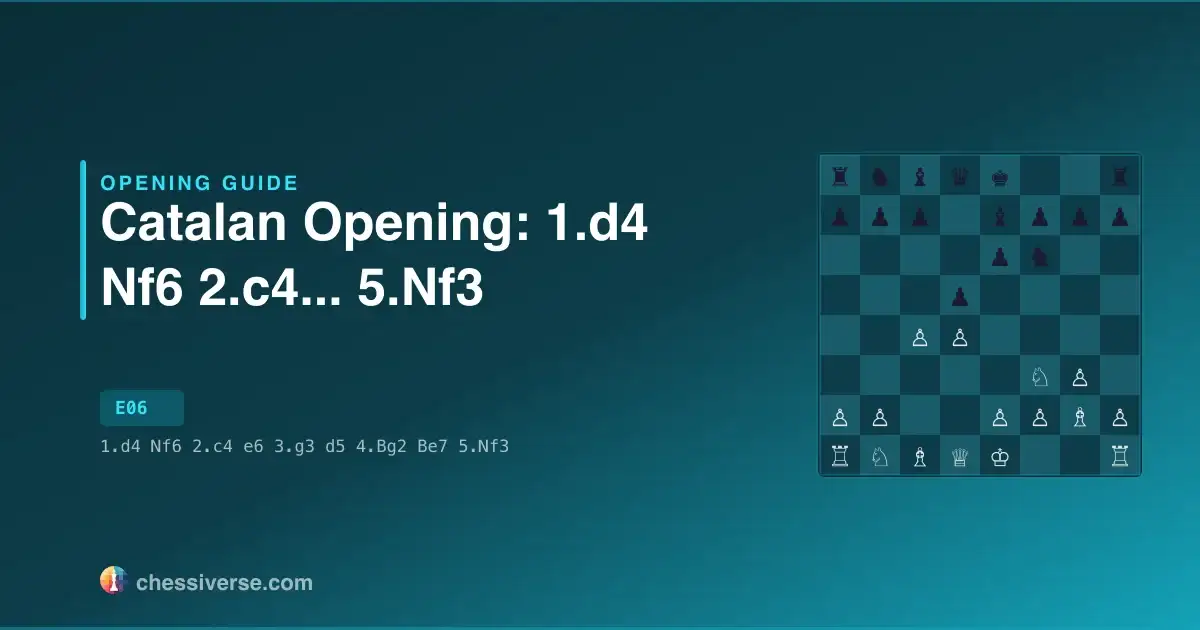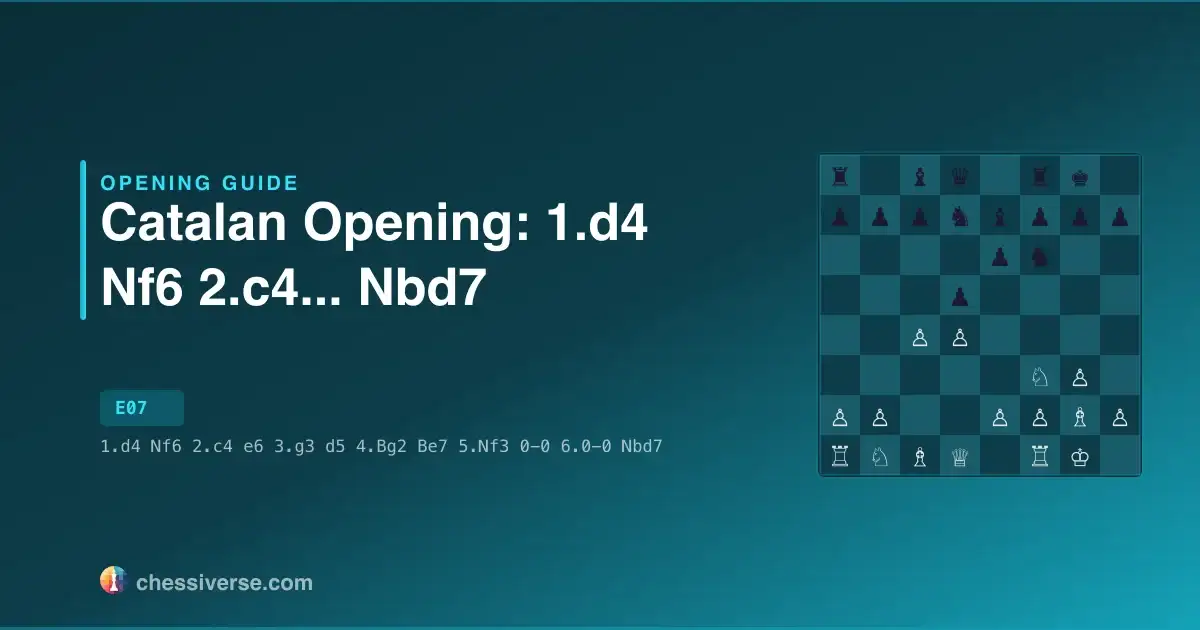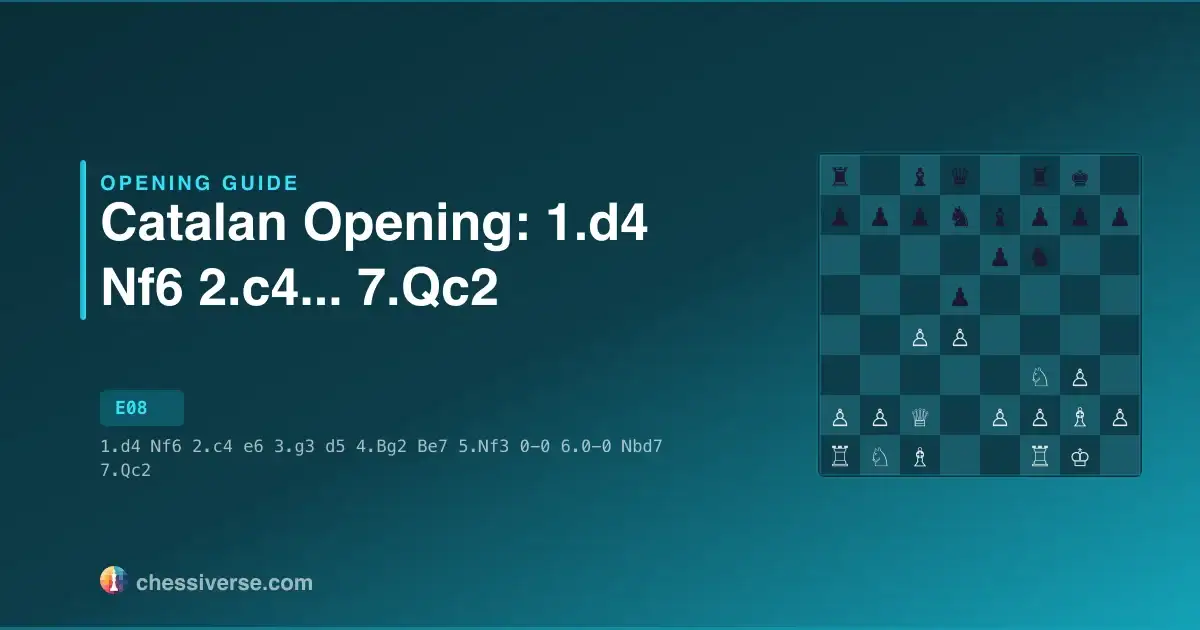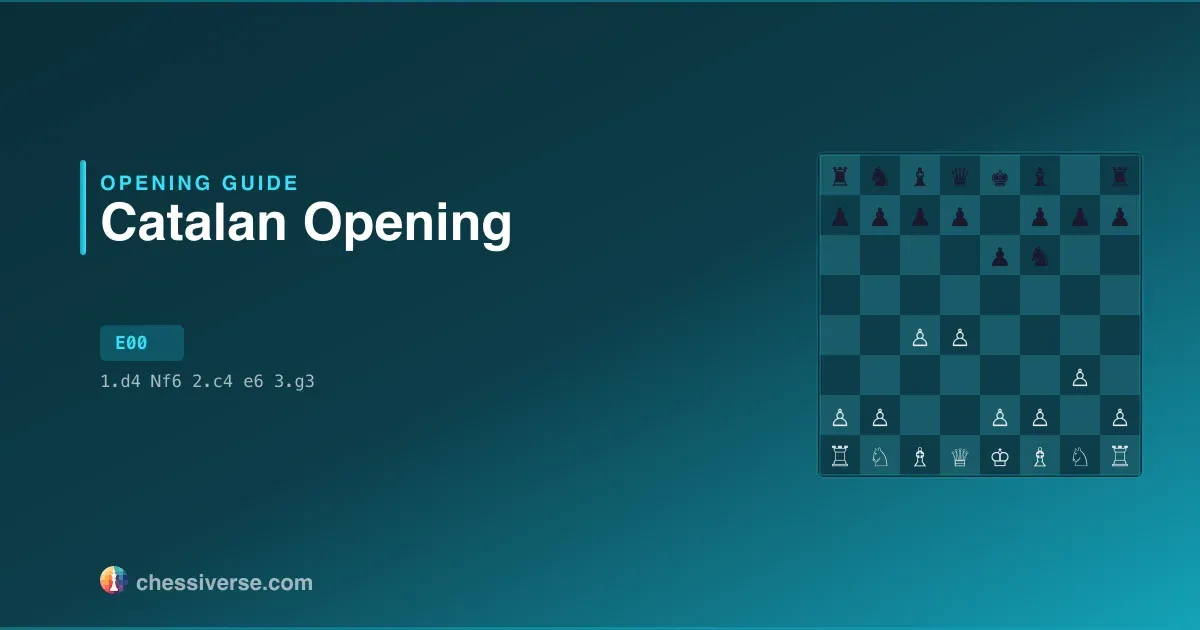
1.d4 Nf6 2.c4 e6 3.g3 opens the Catalan Opening, ECO E00. A Queen's pawn opening dressed in a fianchetto. The bishop slides to g2 and exerts a slow, grinding pressure along the long diagonal that Black has to neutralise without making structural concessions.
Strategic Overview
The Catalan combines the d4-c4 push with a kingside fianchetto, giving White's bishop a permanent home on g2. That bishop is the whole point of the system. It pressures b7, supports central breaks, and often becomes a long-term asset that lingers into the endgame. The game usually continues 3...d5 4.Nf3, after which Black faces a strategic decision that splits the opening in two. In the Open Catalan, Black grabs the c4 pawn with ...dxc4. Holding it is hard — the fianchettoed bishop and natural moves like Qa4, Qc2 and a4 typically win back the material with enduring pressure on the queenside. In the Closed Catalan, Black keeps the pawn on d5 and accepts a passive but solid setup, trying to weather the long-diagonal pressure and look for ...c5 or ...e5 at the right moment. White's overall plan is calm: complete development, double rooks on the c-file, and squeeze. The Catalan rewards patience and long-term thinking over forcing moves, which is why it has been a favourite of world champions from Kasparov to Carlsen for converting microscopic edges into wins.
Key Ideas
The recurring motifs below distinguish a confident handler of this opening from a beginner:
- The g2 bishop is the strategic anchor — Fianchettoing the king's bishop gives White a piece with permanent pressure on the long diagonal. It aims at b7, supports central breaks, and remains an asset throughout the middlegame and endgame.
- Open Catalan: pawn-grab with long-term compensation — After ...dxc4 Black takes the gambit pawn, but White typically regains it with moves like Qa4, Qc2 and a4 while keeping the bishop pair and queenside pressure. Black has to be precise to avoid drifting into a worse position.
- Closed Catalan: structural soundness over activity — Keeping the pawn on d5 with ...c6 or similar blunts the fianchetto bishop but accepts a passive setup. Black looks for the ...c5 or ...e5 break to free the position before White consolidates the squeeze.
- Slow accumulation of small edges — The Catalan rewards patience. White isn't trying to attack the king or win material quickly — the goal is to convert long-term pressure on the queenside and along the long diagonal into a favourable endgame.
History and Notable Players
The earliest known analysis dates to Barcelona 1929, by Savielly Tartakower. The name traces to Catalonia. It arises from the Nimzo-Indian and Queen's Indian. Among the most prolific White practitioners are Ivan Farago (564 games), Svetozar Gligoric (492 games), Loek Van Wely (471 games). Black-side regulars include Anatoly Karpov (468 games), Viktor Korchnoi (458 games), Ivan Farago (413 games).
Tartakower played it at Barcelona 1929, and by the 1930s and 1940s it was part of the repertoires of Capablanca, Alekhine and Botvinnik. It hit the elite spotlight when Kasparov and Korchnoi contested it in five games of their 1983 Candidates semifinal, and later became a world-championship weapon for Kramnik, Anand and Carlsen.
Named after: Named for Catalonia: at Barcelona in 1929 the event's organisers invited Savielly Tartakower to devise a new line honouring the region's chess tradition.
Notable players: Vladimir Kramnik, Viswanathan Anand, Magnus Carlsen, Savielly Tartakower
The Catalan has been a world-championship workhorse: Kramnik played it three times in the 2006 title match and Anand four times in 2010, with White scoring well in both matches.
Performance Across Rating Levels
Popularity and results vary sharply by rating level. The 1200 bracket has 27,089 games (0.00% of all games at that level); White wins 53%, Black 43.3%, 3.8% are drawn. At 1800 the opening surfaces in 0.03% of games; White wins 52.6%, Black 41.9%, draws 5.5%. Among 2500-rated players the line appears in 0.65% of games and draws spike to 10.5%, indicating tight preparation. White's edge erodes by 5.4pp from 1200 to 2500 Elo, suggesting Black's counterplay is easier to find with experience.
Time Control Patterns
Time control matters here: blitz players reach for this opening more than others. In bullet, it appears in 0.02% of games (469,173); White wins 52%. Blitz shows 0.04% adoption across 1,284,696 games, White scoring 51.5%. In rapid, the share rises to 0.02% — 219,755 games, White 51.8%.
Move Diversity and Theory Depth
What players actually play after the opening moves depends heavily on rating. At 1200 Elo (27,030 games), the top reply is d5, played 42.6% of the time. Four other moves each take at least 5% of games, and the top three moves account for 72.2% of games. Entropy: 2.61. By 2500 (87,867 games), d5 dominates at 56.8% of replies; only two other moves still reach 5% and the top three moves account for 96.8% of games. Entropy drops to 1.62. The narrowing is significant — strong players consolidate around a small set of best moves, while amateurs scatter across many plausible-looking options.
Historical Trends
Year-over-year data tells you whether this opening is a contemporary fixture or a fading one. Adoption peaked in 2022 at 0.035% (255,530 games). By 2025 it sits at 0.031%, 10% below the peak but still 64% above its 2013 level, so the line is up over the full period despite easing from the high.
Main Lines and Variations
After 1.d4 Nf6 2.c4 e6 3.g3, the established follow-ups are:
Each branch leads to a different middlegame character — the resulting pawn structure decides what kind of game you get.
Common Mistakes
- Drifting away from main theory — At 400 Elo, the three most-played moves cover 64.4% of games, against 87.8% at 2000. The most popular deviation is Nc6 (played 10% of the time at 400, much less so up top). It looks fine but quietly hands the better-prepared side an edge.
- Neglecting development — It can feel productive to make extra pawn moves early, but falling behind in piece development is what loses most amateur games — especially in open positions where active pieces find squares fast.
- Playing without a plan — Each Catalan Opening middlegame demands a specific approach. Decide whether the position calls for attack, manoeuvre, or simplification before reaching for a move.
Practice on Chessiverse
Ready to try the Catalan Opening against a bot? Pick an opponent at your level and play a game.