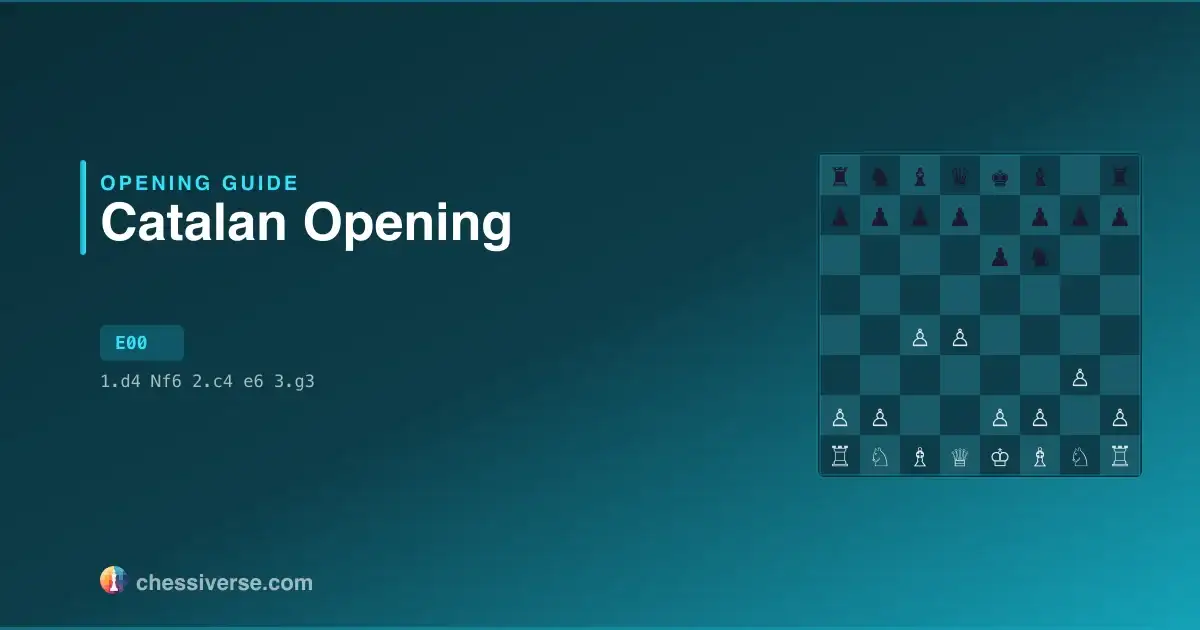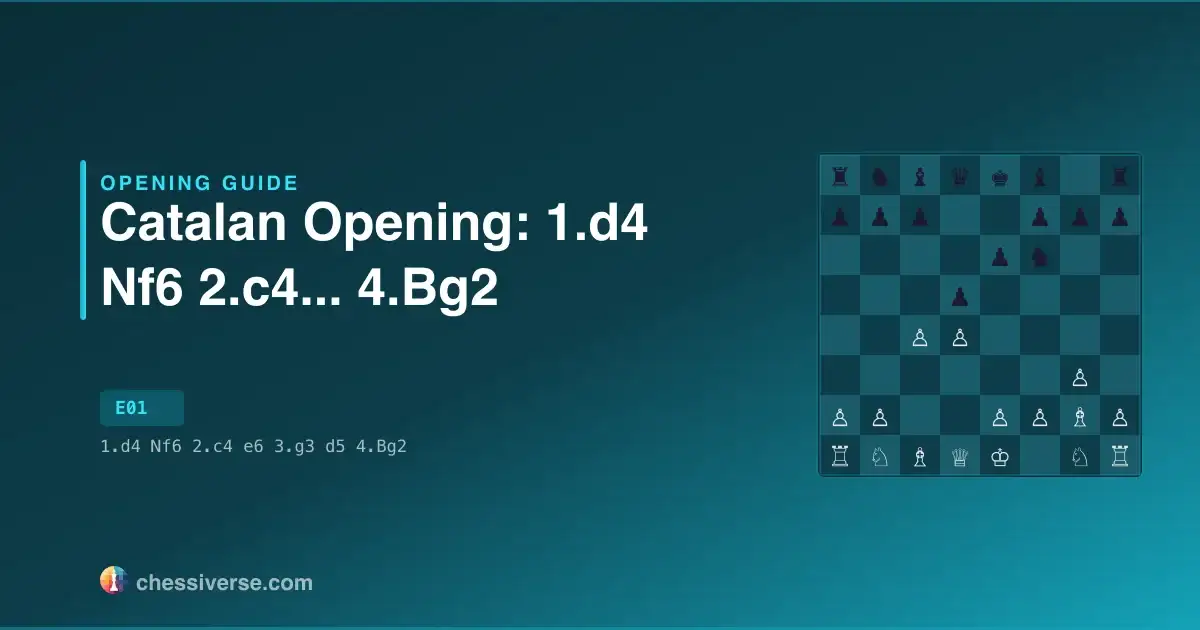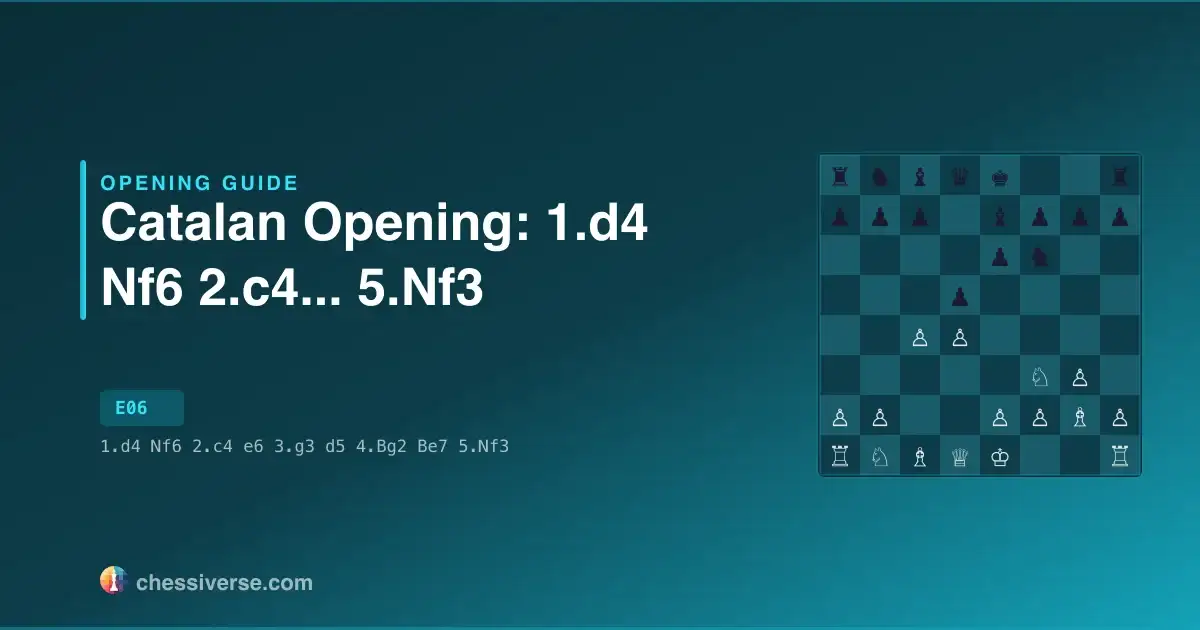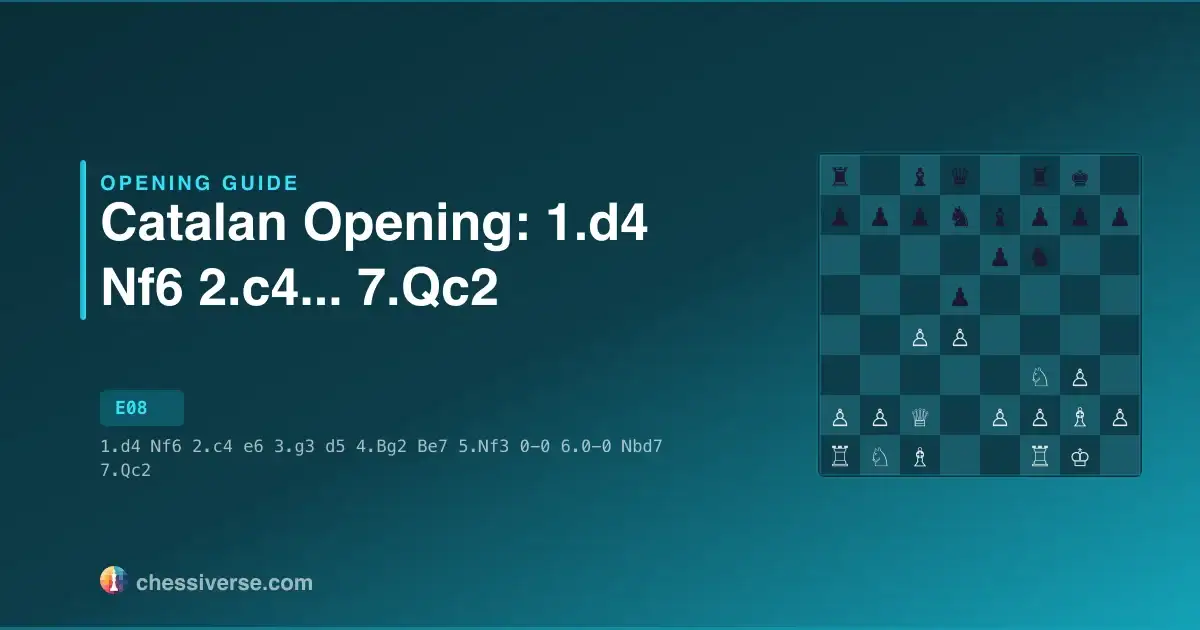




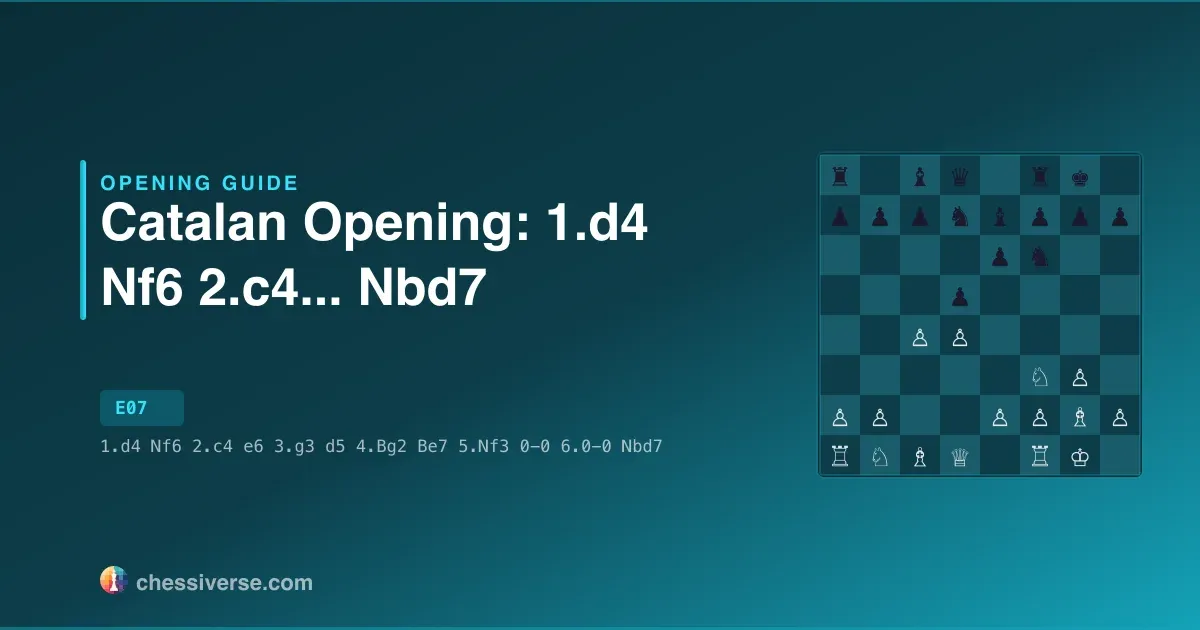
Starting from 1.d4 Nf6 2.c4 e6 3.g3 d5 4.Bg2 Be7 5.Nf3 0-0 6.0-0 Nbd7, players enter the Catalan Opening: Closed (6...Nbd7) — ECO E07. Lichess records 196,451 games in this line, which gives us a reliable view of how it actually performs in practice.
History and Notable Players
It arises from the Catalan Opening: Closed (5.Nf3). On the White side, Gennadi Sosonko (10 games), Jan Smejkal (9 games), Lev Polugaevsky (9 games) top the database. Notable Black exponents: Ivan Farago (23 games), Arthur Bernard Bisguier (16 games), Branimir Maksimovic (14 games).
Performance Across Rating Levels
How well the Catalan Opening: Closed (6...Nbd7) works depends on what level you're playing at. At 1200 Elo, the opening shows up in 0.00% of games (1,203 samples). White scores 49.8%, Black 45.6%, draws 4.7%. By 1800, popularity is 0.00% and White's score is 52.5% to Black's 41.7%. At 2500, 0.06% of games go into this opening; draws sit at 12.2% — the line is well-mapped at this level. White's edge erodes by 5.2pp from 1200 to 2500 Elo, suggesting Black's counterplay is easier to find with experience.
Move Diversity and Theory Depth
Looking at move selection shows how forcing — or not — the position really is. At 1200 Elo (1,199 games), the top reply is Nc3, played 35.4% of the time. Five other moves each take at least 5% of games, and the top three moves account for 63.9% of games. Entropy: 2.90. By 2500 (8,029 games), Qc2 takes over as the top reply at 58.6%; only three other moves still reach 5% and the top three moves account for 88.2% of games. Entropy drops to 1.87. The narrowing is significant — strong players consolidate around a small set of best moves, while amateurs scatter across many plausible-looking options.
Main Lines and Variations
The main branches off 1.d4 Nf6 2.c4 e6 3.g3 d5 4.Bg2 Be7 5.Nf3 0-0 6.0-0 Nbd7 include:
Each branch leads to a different middlegame character — the resulting pawn structure decides what kind of game you get.
Common Mistakes
- Drifting away from main theory — At 1000 Elo, the three most-played moves cover 60.9% of games, against 80.4% at 2000. The most popular deviation is cxd5 (played 13.6% of the time at 1000, much less so up top). It looks fine but quietly hands the better-prepared side an edge.
- Neglecting development — Extra pawn moves in the opening are tempting, especially when you "know the moves". Developing a piece each turn is the simple correction.
- Playing without a plan — Each Catalan Opening: Closed (6...Nbd7) middlegame demands a specific approach. Decide whether the position calls for attack, manoeuvre, or simplification before reaching for a move.
Practice on Chessiverse
Ready to try the Catalan Opening: Closed (6...Nbd7) against a bot? Pick an opponent at your level and play a game.