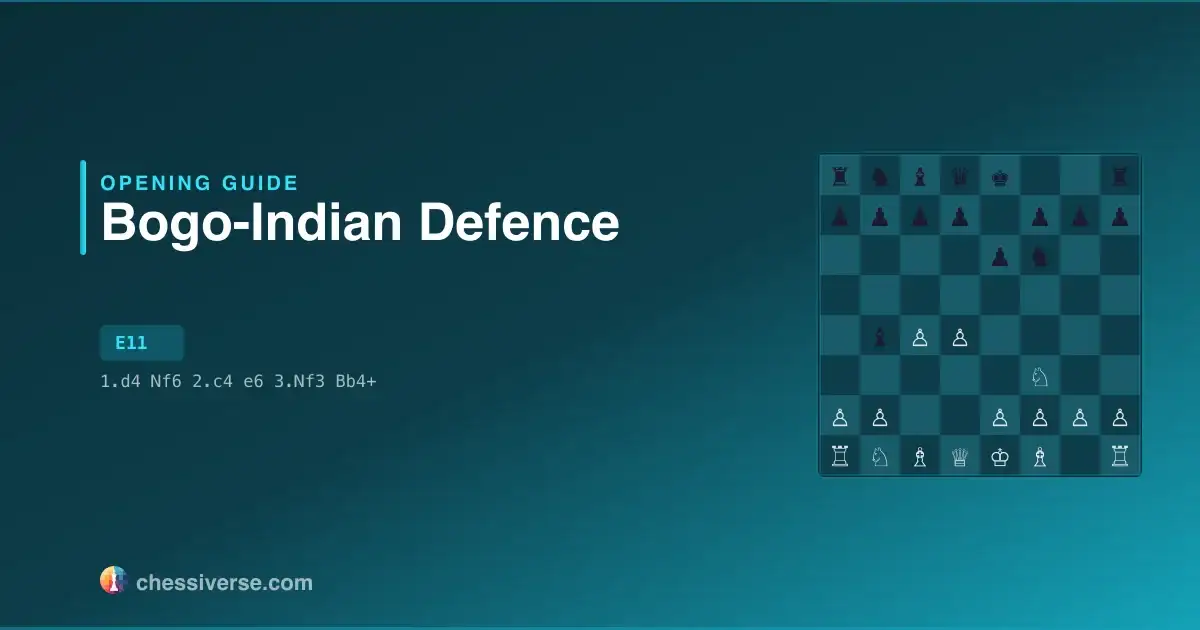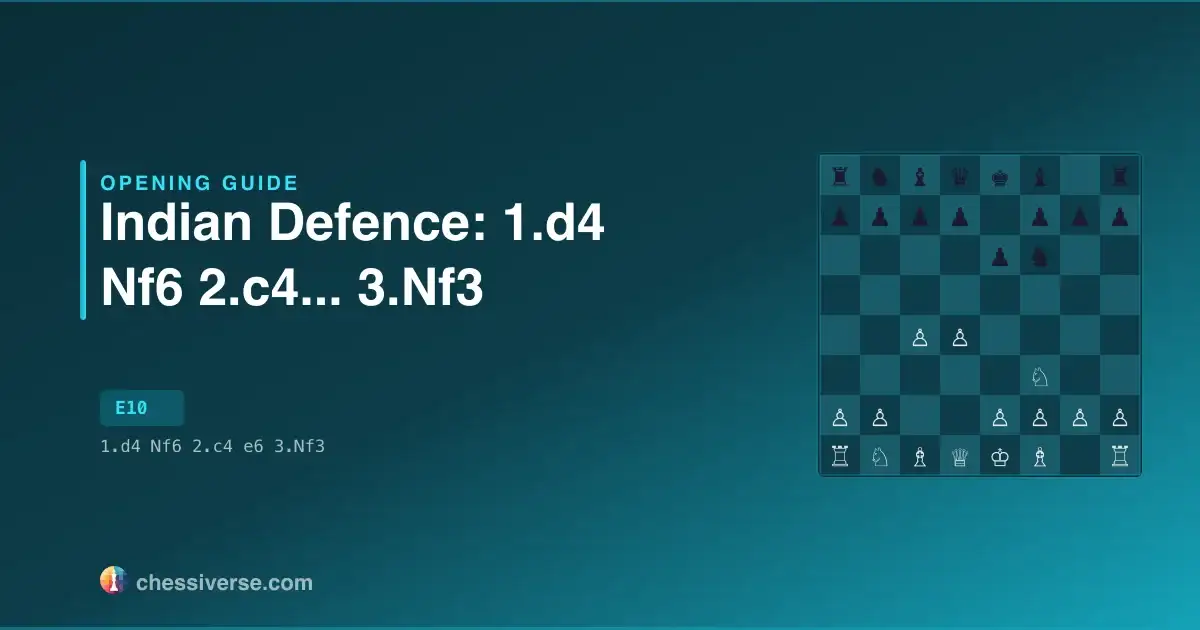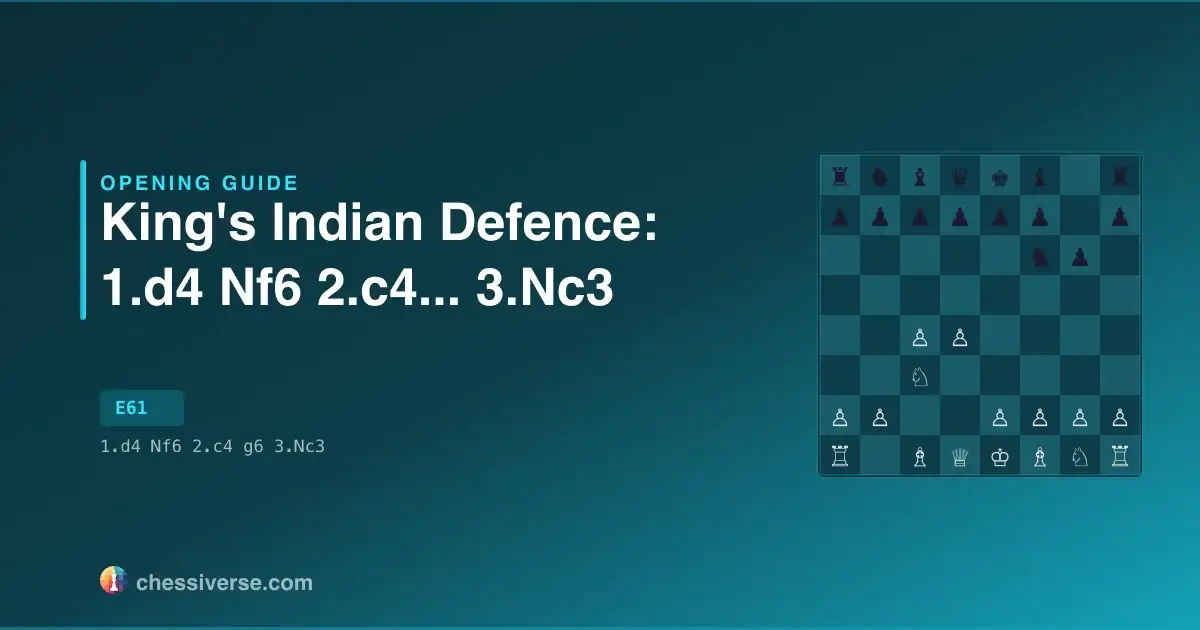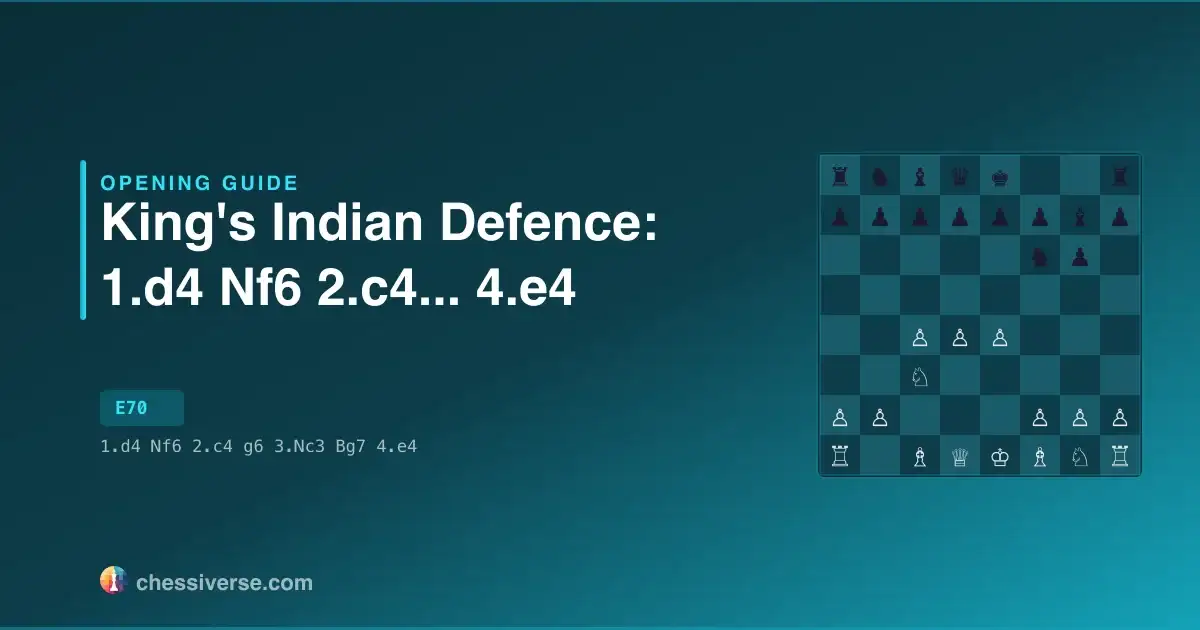




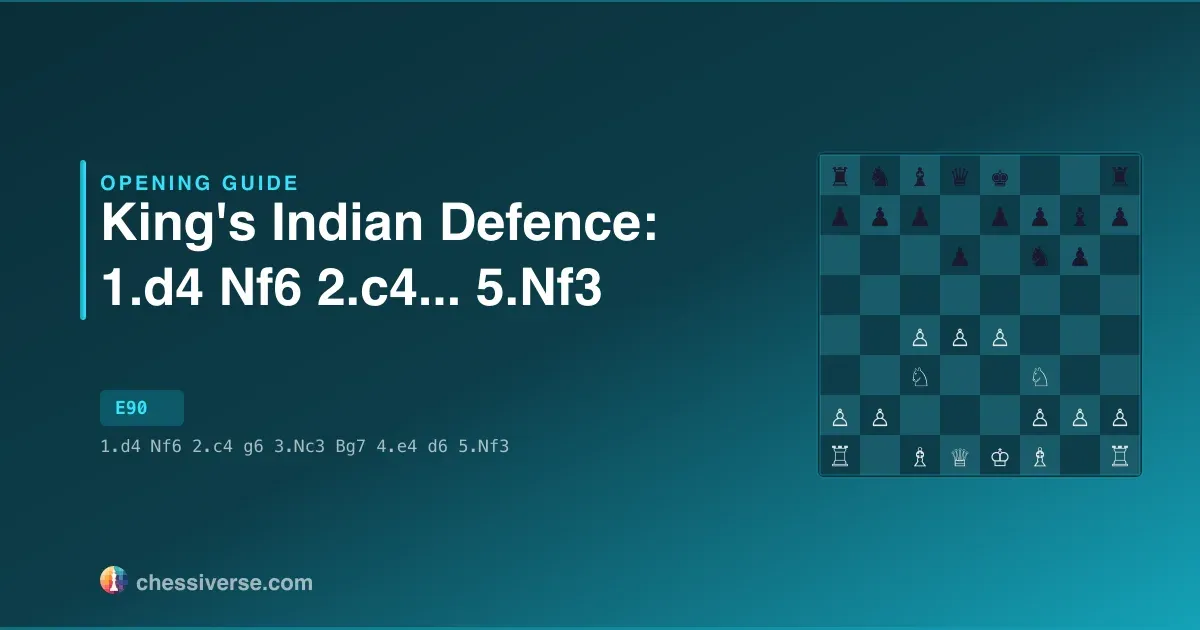
The King's Indian Defense: Normal Variation, Rare Defenses begins with 1.d4 Nf6 2.c4 g6 3.Nc3 Bg7 4.e4 d6 5.Nf3 (ECO E90). The most natural square for the king's knight, and the gateway to the entire Classical King's Indian. White's centre looks unassailable — for now.
Strategic Overview
5.Nf3 is the move that opens up the full classical King's Indian. Every pawn is defended, the knight goes to its best square, and the structure looks rock-solid from White's perspective. The trick — and the reason the King's Indian has remained a viable answer to 1.d4 for nearly a century — is that the classical centre is also a target. Once Black castles, the standard counter-strategy unfolds: ...e5 challenges d4 and tries to lock the centre on Black's terms, leading to the Mar del Plata and Bayonet structures where Black storms the kingside with ...f5-...f4-...g4 while White attacks on the queenside. The alternative is ...c5, transposing into Benoni positions where Black plays for piece activity against White's central pawns. From here, White's specific scheme of development matters enormously. 6.Be2 with castling kingside is the Classical mainline; 6.h3 prepares Be3 with a sturdier centre; 6.Bd3 enters the Petrosian and other less common systems. Each has its own theory and its own typical middlegame, but the underlying tension is the same: White wants the centre to be a long-term asset, Black wants it to be a long-term target.
Key Ideas
A few ideas come up again and again in this opening:
- Best square for the king's knight — Nf3 is the natural classical move that supports d4 and prepares short castling. Every pawn is defended, every piece can develop harmoniously, and White heads for the calmest interpretation of the King's Indian.
- Black's main response is to castle and break — After short castling, Black uses either ...e5 or ...c5 to challenge the centre. Without one of these breaks, Black simply gets squeezed by White's space advantage.
- Mar del Plata and Bayonet are downstream — If Black plays ...e5 and White locks the centre with d5, the classical kingside-versus-queenside attacking races begin. Both sides race to attack opposite wings as fast as possible.
- Specific sixth-move choice shapes the middlegame — Whether White plays 6.Be2, 6.h3, or 6.Bd3 leads to very different theoretical paths. The choice between the Classical, Makogonov, and Petrosian systems is a major fork in the road for both sides.
History and Notable Players
It arises from the King's Indian Defense: Normal Variation. On the White side, Loek Van Wely (147 games), Vladimir Epishin (116 games), Ruslan Pogorelov (108 games) top the database. Notable Black exponents: Zdenko Kozul (129 games), Branko Damljanovic (114 games), Ilia Smirin (110 games).
Performance Across Rating Levels
The picture changes a lot as you climb the rating ladder. At 1200 Elo, the opening shows up in 0.07% of games (438,760 samples). White scores 48.5%, Black 47.7%, draws 3.8%. At 1800 the opening surfaces in 0.26% of games; White wins 48.1%, Black 46.9%, draws 5%. At 2500, 0.79% of games go into this opening; draws sit at 9.4% — the line is well-mapped at this level. Positions also become less sharp as level rises (sharpness 0.96 → 0.91).
Time Control Patterns
The King's Indian Defense: Normal Variation, Rare Defenses skews toward blitz chess. In bullet, it appears in 0.16% of games (4,203,588); White wins 48.5%. Blitz shows 0.20% adoption across 7,133,730 games, White scoring 48.8%. In rapid, the share rises to 0.13% — 1,430,223 games, White 48.4%.
Move Diversity and Theory Depth
Move choice is far from uniform in the King's Indian Defense: Normal Variation, Rare Defenses. At 1200 Elo (437,649 games), the top reply is O-O, played 66.7% of the time. Two other moves each take at least 5% of games, and the top three moves account for 86.2% of games. Entropy: 1.81. By 2500 (106,778 games), O-O dominates at 94.5% of replies; no other move reaches 5% and the top three moves account for 98.7% of games. Entropy drops to 0.42. The narrowing is significant — strong players consolidate around a small set of best moves, while amateurs scatter across many plausible-looking options.
Historical Trends
Long-term, the trajectory of this opening is informative. Adoption peaked in 2018 at 0.22% (415,770 games). By 2025 it sits at 0.16%, 29% below the peak but still 29% above its 2013 level, so the line is up over the full period despite easing from the high.
Main Lines and Variations
The main branches off 1.d4 Nf6 2.c4 g6 3.Nc3 Bg7 4.e4 d6 5.Nf3 include:
Each branch leads to a different middlegame character — the resulting pawn structure decides what kind of game you get.
Common Mistakes
- Drifting away from main theory — At 400 Elo, the three most-played moves cover 82% of games, against 93.5% at 2000. The most popular deviation is Bg4 (played 13.6% of the time at 400, much less so up top). It looks fine but quietly hands the better-prepared side an edge.
- Neglecting development — Extra pawn moves in the opening are tempting, especially when you "know the moves". Developing a piece each turn is the simple correction.
- Letting White own the centre — Hypermodern openings concede central space on purpose, but only if you strike back in time. Delay the counter-blow and you end up squeezed.
Practice on Chessiverse
Ready to try the King's Indian Defense: Normal Variation, Rare Defenses against a bot? Pick an opponent at your level and play a game.