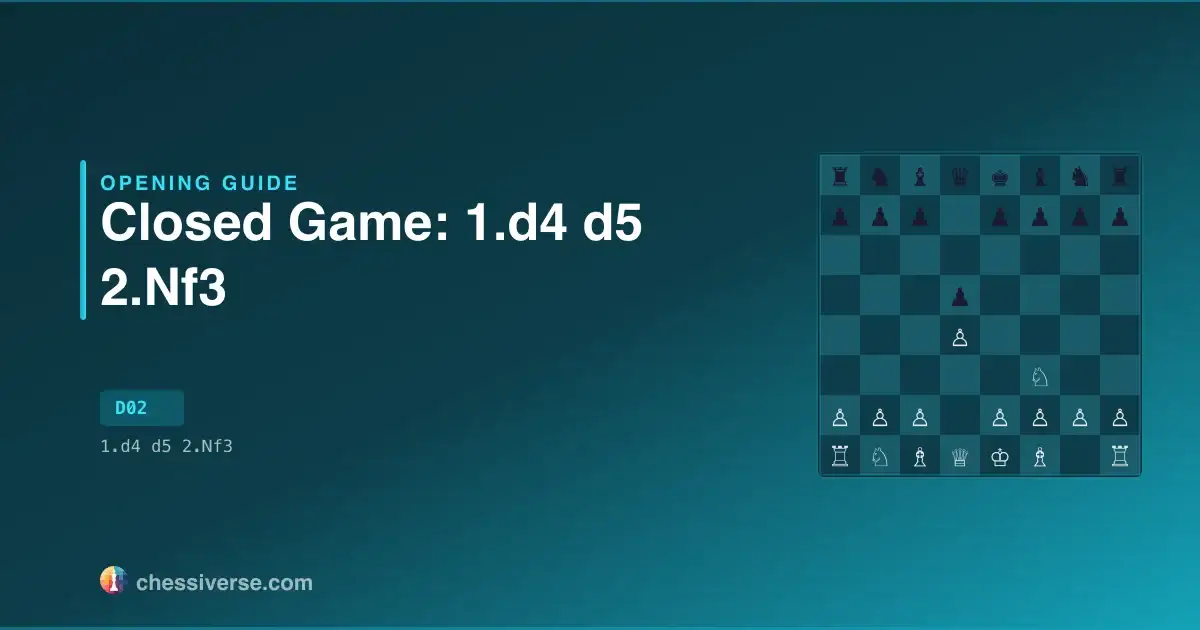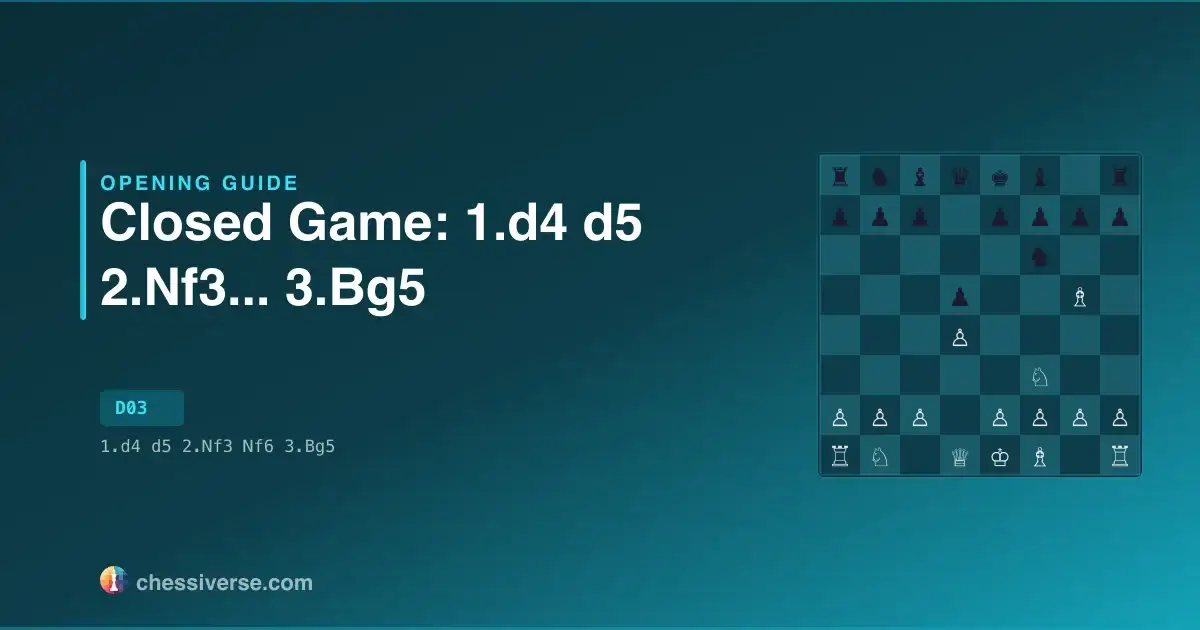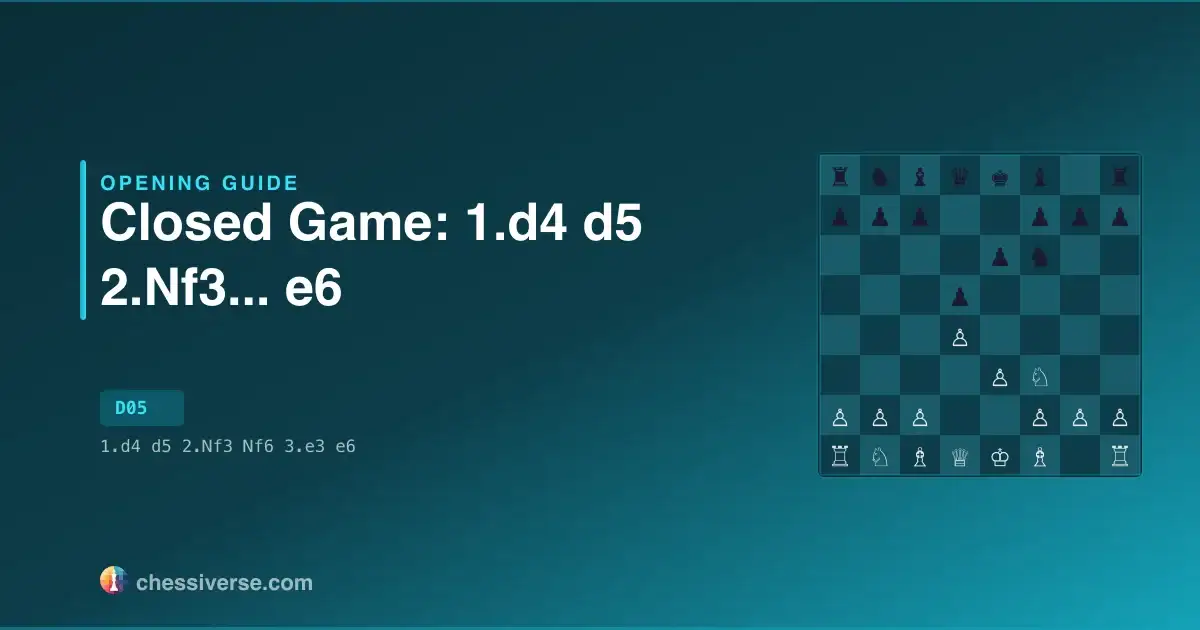




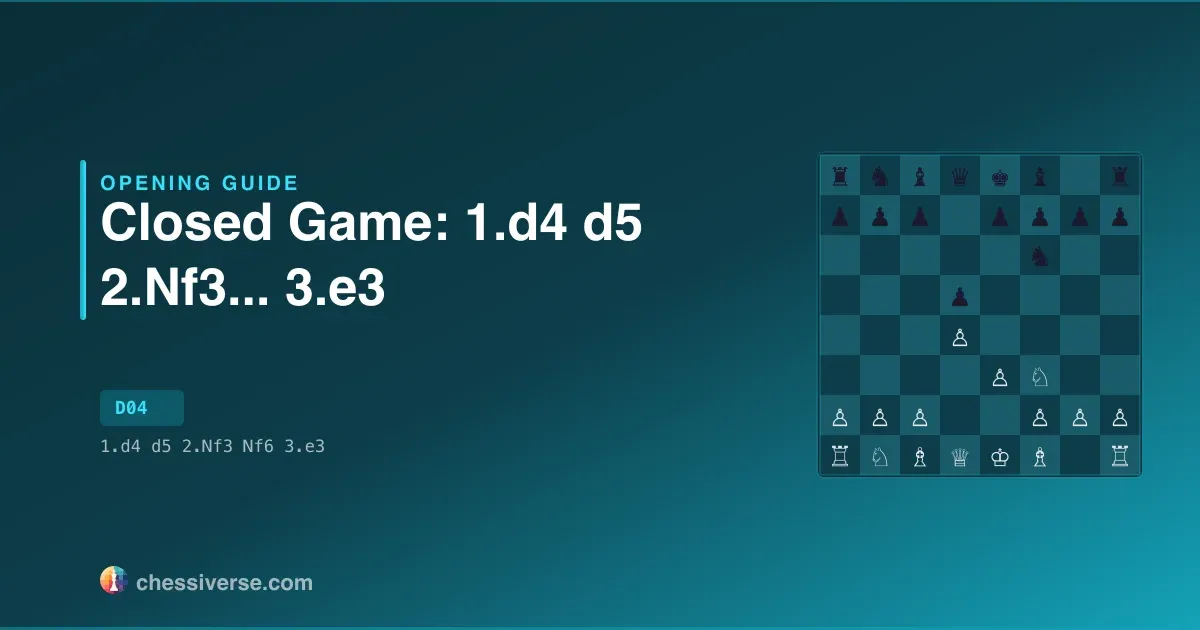
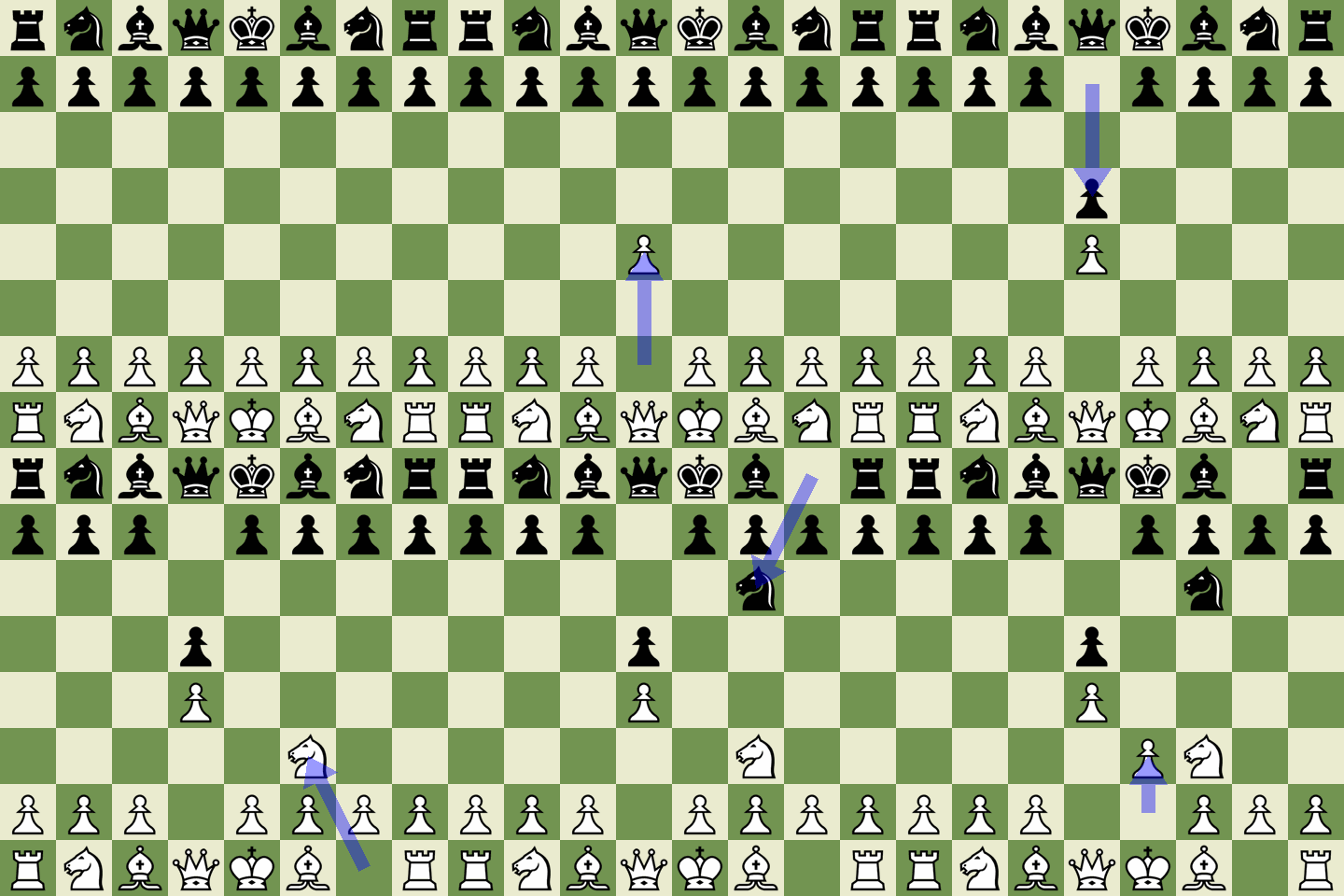
1.d4 d5 2.Nf3 Nf6 3.e3 opens the Queen's Pawn Game: Colle System, ECO D04. Welcome to the Colle System — the opening where White plays the same six moves against everything, develops behind a wall of pawns, and lives for one big break in the centre.
Strategic Overview
The Colle is a system opening built around a single strategic idea: prepare the e3-e4 break under ideal conditions. White sets up with Bd3, c3, Nbd2, O-O, and then waits for the right moment to fire e4, opening the position when their pieces are perfectly placed and Black's are not. There are two flavours of the same system. The classical Colle plays c3 and develops the queen's bishop modestly (often it never gets out of the back rank in any active way). The Colle-Zukertort sidesteps the bad-bishop problem with b3 and Bb2, fianchettoing the queen's bishop along the long diagonal and supporting a future c2-c4 break instead. Both versions emphasise simple development, king safety, and the central break as the source of any advantage. The trade-off is that Black has total freedom to choose their set-up — there's no concrete theoretical fight, so well-prepared Black players can equalise without much trouble. At club level the Colle is excellent because the plans are clear, the attacking patterns (Ne5, f4, queen lifts) are repeatable, and White rarely gets a bad position out of the opening. At higher levels it offers very little to play for, which is why it stays a club-and-rapid weapon rather than a serious tournament try.
Key Ideas
When players succeed in this line, they usually do so by leaning on the following themes:
- The whole opening prepares one break: e4 — Every Colle move is set-up for the central pawn push. Once White has Bd3, c3, Nbd2, and is castled, the e4 break opens lines for the bishops and rooks all at once. Timing it right is the entire skill of the opening.
- Classical Colle vs Colle-Zukertort — The classical version plays c3 and accepts a passive queen's bishop. The Zukertort version plays b3 and Bb2 instead, fianchettoing the bishop along the long diagonal and aiming for c4 later. The Zukertort is the more flexible modern choice.
- Black has total freedom to choose a set-up — Because White's first six moves are predictable, Black isn't forced into anything concrete. The Colle's strength is also its weakness — well-prepared Black players know exactly what they're facing and can equalise without much trouble.
History and Notable Players
It arises from the Queen's Pawn Game: Zukertort Variation. Among the most prolific White practitioners are Edgard Colle (50 games), Carlos Enrique Guimard (47 games), Jozsef Harmatosi (42 games). Black-side regulars include Dawid Markelowicz Janowski (15 games), Mikhail Chigorin (13 games), Oleg Korneev (11 games).
Performance Across Rating Levels
The picture changes a lot as you climb the rating ladder. The 1200 bracket has 1,827,502 games (0.27% of all games at that level); White wins 50%, Black 45.9%, 4.1% are drawn. Move up to 1800 Elo and the share shifts to 0.34%, with White winning 48.6% versus Black's 45.7%. Among 2500-rated players the line appears in 0.24% of games and draws spike to 12.3%, indicating tight preparation. White's edge erodes by 4.5pp from 1200 to 2500 Elo, suggesting Black's counterplay is easier to find with experience.
Time Control Patterns
Time control matters here: bullet players reach for this opening more than others. In bullet, it appears in 0.32% of games (8,528,951); White wins 51.3%. Blitz shows 0.31% adoption across 11,159,796 games, White scoring 49.4%. In rapid, the share rises to 0.28% — 3,062,297 games, White 48.2%. White's score swings 3.1pp across formats, so time control isn't just a stylistic choice here — it shifts the actual results.
Move Diversity and Theory Depth
Move choice is far from uniform in the Queen's Pawn Game: Colle System. At 1200 Elo (1,827,502 games), the top reply is Nc6, played 29.3% of the time. Four other moves each take at least 5% of games, and the top three moves account for 69.5% of games. Entropy: 2.75. By 2500 (32,563 games), c5 takes over as the top reply at 30.2%; five other moves reach 5% and the top three moves account for 68.1% of games. Entropy drops to 2.55.
Historical Trends
Long-term, the trajectory of this opening is informative. Adoption peaked in 2025 at 0.33% (2,483,872 games). 2025 marks the high — the opening is stable, currently at 0.33%.
Main Lines and Variations
After 1.d4 d5 2.Nf3 Nf6 3.e3, the established follow-ups are:
Each branch leads to a different middlegame character — the resulting pawn structure decides what kind of game you get.
Common Mistakes
- Neglecting development — It can feel productive to make extra pawn moves early, but falling behind in piece development is what loses most amateur games — especially in open positions where active pieces find squares fast.
- Playing without a plan — Each Queen's Pawn Game: Colle System middlegame demands a specific approach. Decide whether the position calls for attack, manoeuvre, or simplification before reaching for a move.
Practice on Chessiverse
Ready to try the Queen's Pawn Game: Colle System against a bot? Pick an opponent at your level and play a game.