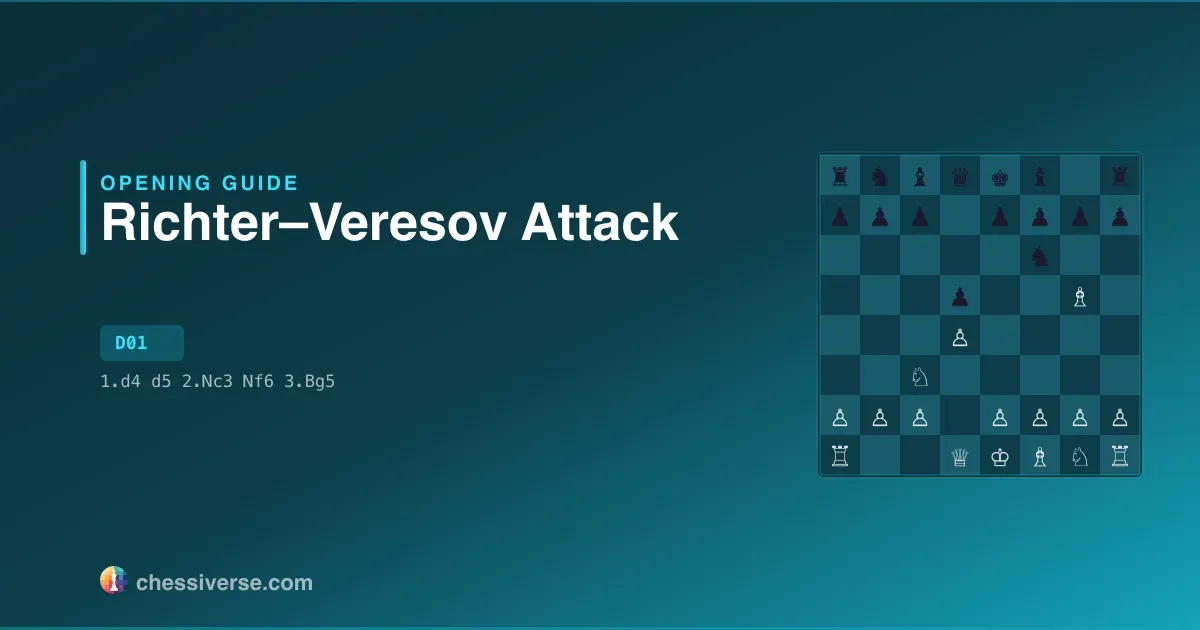
The Richter–Veresov Attack begins with 1.d4 d5 2.Nc3 Nf6 3.Bg5 (ECO D01). Imagine the Ruy Lopez, but White's slamming the bishop on the long diagonal at f6 instead of c6. The Veresov is the queen's pawn cousin nobody plays at the top — and that's exactly why it works in a club game.
Strategic Overview
The Veresov is the rare 1.d4 system where White attacks first and develops the queenside bishop before the kingside knight. The whole point is the pressure on the f6-knight: Bg5 threatens to ruin Black's pawn structure with Bxf6, and combined with Nc3 hitting d5, Black has to make a real decision about how to handle the pin. Compared to the Trompowsky (where Bg5 comes on move two) the Veresov adds Nc3 first, which controls e4 and prepares concrete f3-e4 expansion plans down the road. The drawback is that c2-c4 — the central break that defines Queen's Gambit play — is no longer easy because the knight is already on c3. White accepts that structural limitation in exchange for surprise value and an early initiative. Black's most common reply, ...e6, is solid but slightly passive and tends to give White the kind of attacking chances they signed up for. Sharper responses aim to grab the initiative back before White's attack gets rolling. At club level the Veresov is genuinely dangerous because few players have studied the lines; at master level it's been judged to give White nothing concrete, which is why it stays a sideline.
Key Ideas
The recurring motifs below distinguish a confident handler of this opening from a beginner:
- Early Bg5 targets the f6-knight — The pin on f6 isn't decorative — Bxf6 doubles Black's pawns and disrupts the kingside. Black has to either accept the structural concession or spend tempi breaking the pin, which is exactly the time White uses to attack.
- Nc3 trades flexibility for piece pressure — Putting the knight on c3 early means c2-c4 is off the table. White accepts a less classical pawn structure in exchange for an immediate attacking set-up and the constant threat of f3-e4 expansion.
- Black must play accurately or get crushed — The Veresov looks innocuous but has real venom against passive defence. If Black tries to play standard d-pawn moves without addressing the pin and the central tension, White's kingside attack arrives quickly and lethally.
History and Notable Players
The earliest known analysis dates to 1902. The name traces to Kurt Richter Gavriil Veresov. It arises from the Veresov Attack. Among the most prolific White practitioners are Zvonimir Mestrovic (71 games), Guenther Koksch (56 games), Robert Graham Wade (54 games). Black-side regulars include Wolfgang Uhlmann (8 games), David Bronstein (8 games), Ticia Gara (6 games).
The first recorded outing was Marshall-Wolf, Monte Carlo 1902, and Savielly Tartakower employed it regularly from the 1920s into the early 1950s. Kurt Richter scored dazzling attacking wins with it in the 1930s, and after the war Gavriil Veresov showed the system held far more subtlety and depth than previously believed.
Named after: Named after German master Kurt Richter and Soviet master Gavriil Veresov, who between them championed it for over a quarter of a century.
Notable players: Kurt Richter, Gavriil Veresov, Savielly Tartakower, Alexander Morozevich
Set up the position and it looks like a Ruy Lopez mirrored onto the queenside - yet the play is completely different. Greats such as Tal, Spassky, Smyslov and Karpov have all given it an occasional outing.
Performance Across Rating Levels
Popularity and results vary sharply by rating level. Among 1200-rated players, it appears in 0.10% of games — 707,308 of them on record — with White winning 49.2% and Black 46.5%. Move up to 1800 Elo and the share shifts to 0.07%, with White winning 49.1% versus Black's 46.3%. Among 2500-rated players the line appears in 0.30% of games and draws spike to 8.7%, indicating tight preparation. White's edge erodes by 4.2pp from 1200 to 2500 Elo, suggesting Black's counterplay is easier to find with experience.
Time Control Patterns
Look at the same opening across time controls and rapid stands out. In bullet, it appears in 0.05% of games (1,259,242); White wins 50.6%. Blitz shows 0.09% adoption across 3,297,530 games, White scoring 49.5%. In rapid, the share rises to 0.10% — 1,136,815 games, White 47.6%. White's score swings 3.0pp across formats, so time control isn't just a stylistic choice here — it shifts the actual results.
Move Diversity and Theory Depth
Looking at move selection shows how forcing — or not — the position really is. At 1200 Elo (707,308 games), the top reply is e6, played 34.9% of the time. Five other moves each take at least 5% of games, and the top three moves account for 67.5% of games. Entropy: 2.82. By 2500 (40,622 games), Nbd7 takes over as the top reply at 36.8%; only four other moves still reach 5% and the top three moves account for 63.6% of games. Entropy drops to 2.69.
Common Mistakes
- Neglecting development — It can feel productive to make extra pawn moves early, but falling behind in piece development is what loses most amateur games — especially in open positions where active pieces find squares fast.
- Playing without a plan — Each Richter–Veresov Attack middlegame demands a specific approach. Decide whether the position calls for attack, manoeuvre, or simplification before reaching for a move.
Practice on Chessiverse
Ready to try the Richter–Veresov Attack against a bot? Pick an opponent at your level and play a game.