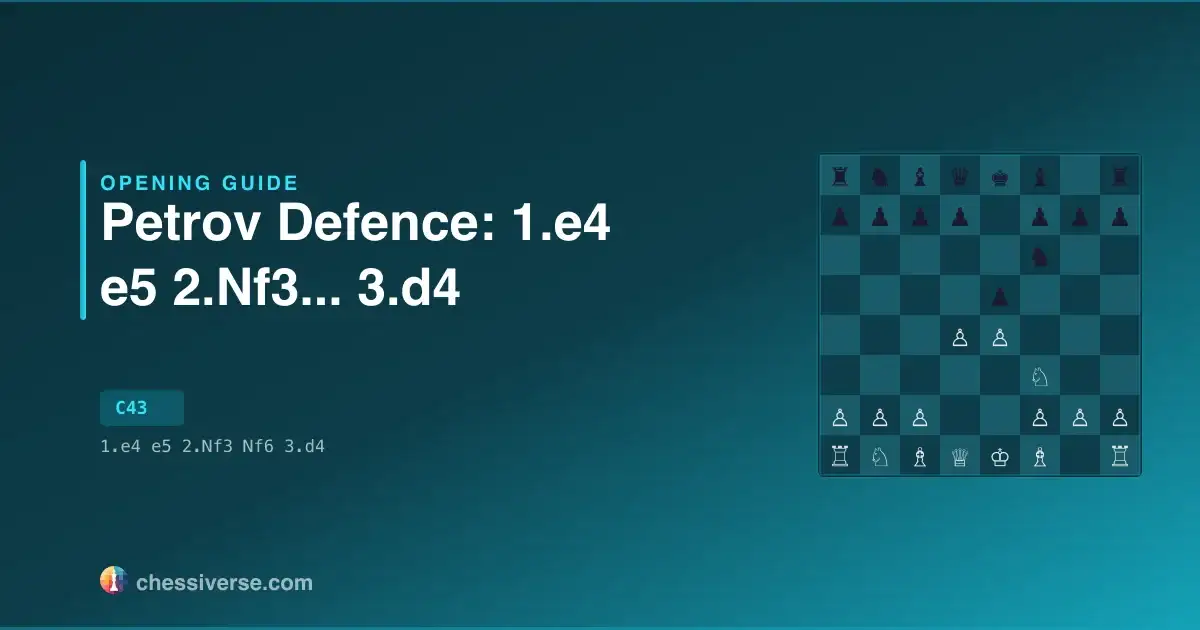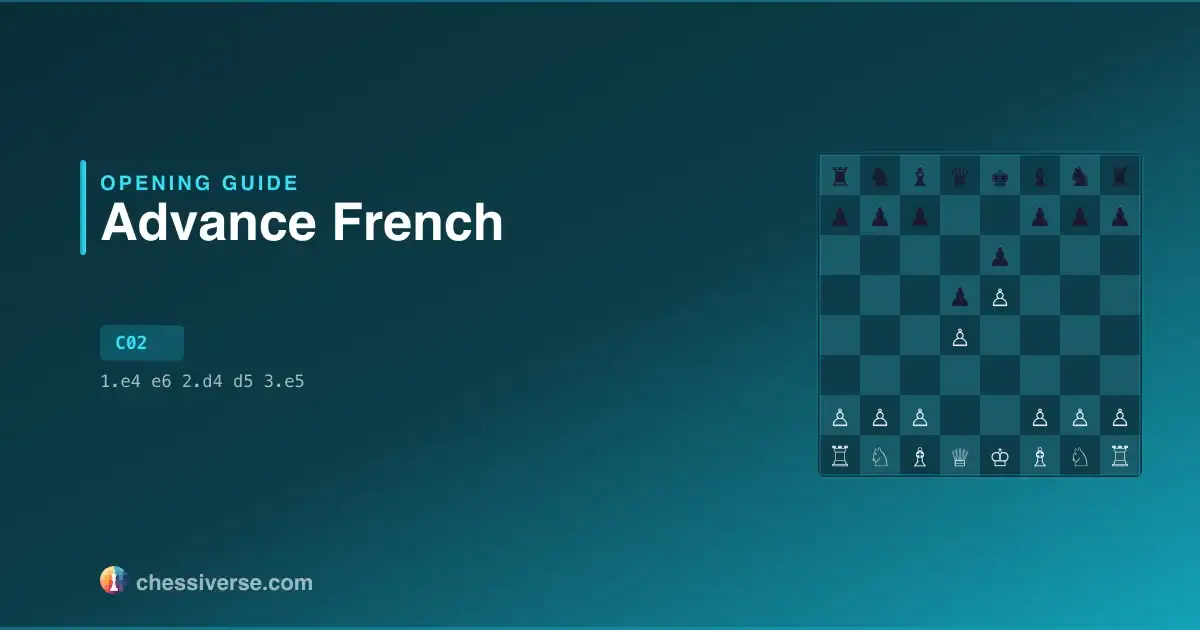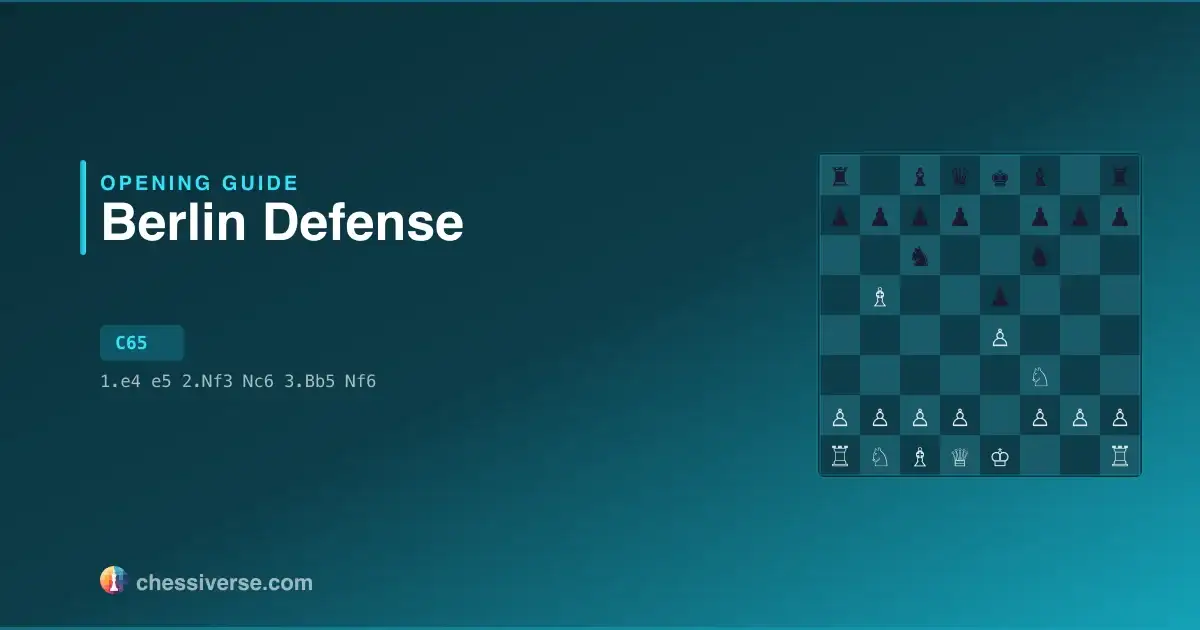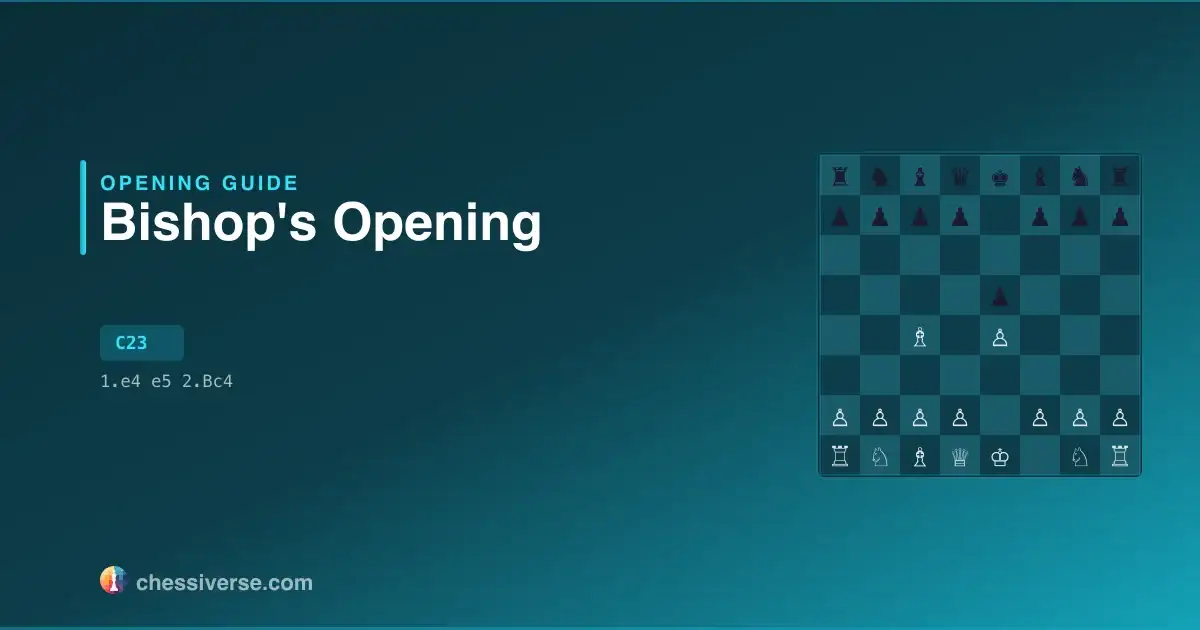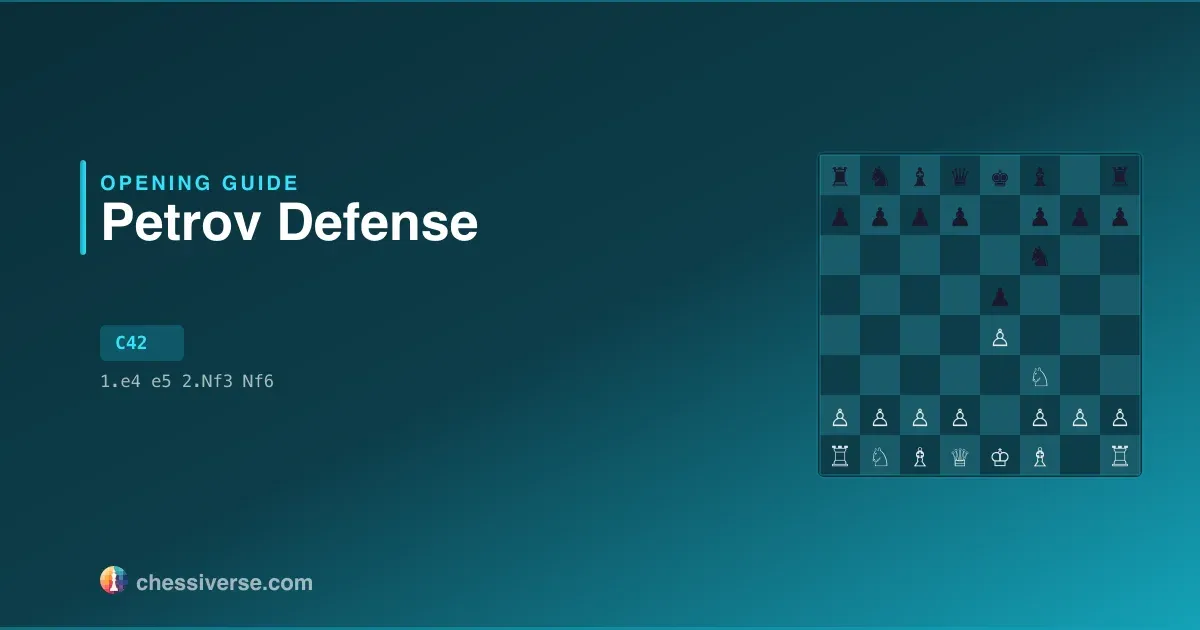
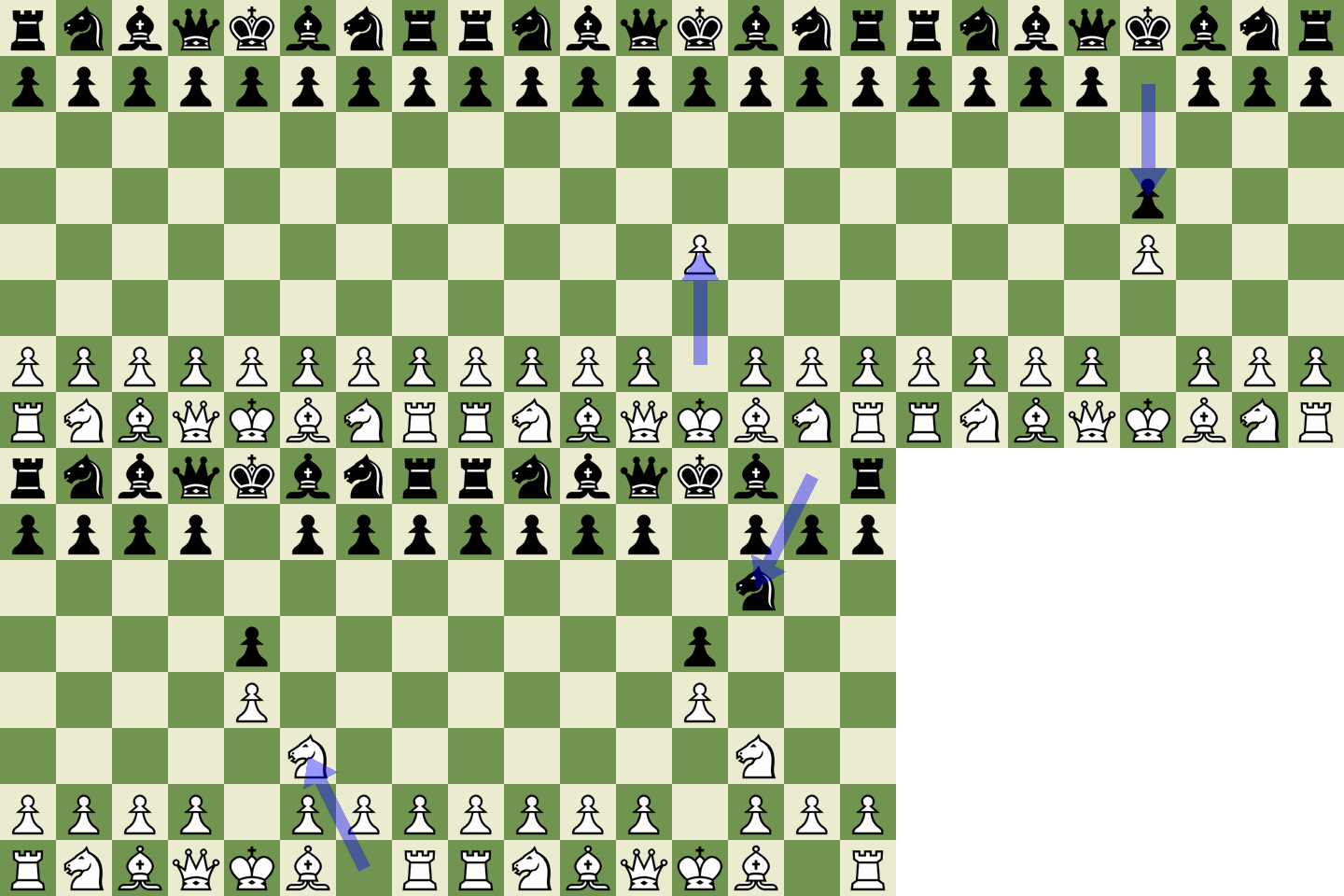
The Petrov Defense arises after 1.e4 e5 2.Nf3 Nf6 and falls under ECO code C42. Instead of defending the e5 pawn, Black strikes back at e4, giving rise to the Russian Game (also called Petroff's Defense), an opening renowned for its solidity and tendency toward draws. White generally aims to open up the centre, which often leads to pawn exchanges, though gambiting or defending the e4 pawn are also options. The Classical variation, 3. Nxe5, is the main line: White captures the undefended pawn, and while Black can win it back, doing so immediately with 3...Nxe4!? runs into the dangerous 4. Qe2!, which exploits the open e-file (and sets the notorious trap 4...Nf6?? 5. Nc6+, winning the queen). The correct response is 3...d6, driving the knight away, after which 4...Nxe4 is safe since 5. Qe2 can be met by Qe7, defending the knight. In amateur games, 3...Nc6?!, the Stafford Gambit, is a popular but dubious alternative in which Black sacrifices a pawn for open lines and attacking chances. The Modern Attack, 3. d4, championed by Steinitz, is another significant option; after it, 3...Nxe4 is the most common capture, while 3...exd4 is playable but leaves Black struggling after 4. e5 as the knight gets pushed around (4...Ne4 5. Qxd4 d5 6. exd6 Nxd6 with a slight White edge). With 95 million Lichess games across all rating levels, it is a well-established opening choice.
- Instead of defending the e5 pawn, Black mirrors White and counterattacks the e4 pawn at once, fighting for the center with pieces.
- White's two main tries are 3.Nxe5, grabbing the pawn before Black recaptures, and 3.d4, striking in the center immediately.
- Play tends to be balanced and solid, though attacking chances exist for both sides and a handful of lines turn genuinely sharp.
History and Notable Players
It arises from the Open Games (1...e5). Among the most prolific practitioners on the White side are Viswanathan Anand (91 games), Alexei Shirov (76 games), Peter Leko (67 games). On the Black side, notable exponents include Artur Jussupow (170 games), Zlatko Ilincic (151 games), Eduardas Rozentalis (139 games).
Petrov brought this symmetrical defense into fashion in the mid-1800s. Steinitz later championed 3.d4 in his 1889 book and used it against Pillsbury at St Petersburg 1895-96. It became a mainstay of world champions like Smyslov, Petrosian, Karpov and Kramnik.
Named after: Alexander Petrov, the 19th-century Russian master who popularized it; it is also called the Russian Game after early work by Petrov and Carl Jaenisch.
Notable players: Anatoly Karpov, Vladimir Kramnik, Fabiano Caruana, Vasily Smyslov
The Petrov carries a famously drawish reputation, yet it hides real venom: dubious but tricky tries like the Stafford Gambit are packed with traps.
Statistics
Based on 95 million Lichess games across all rating levels:
- White wins: 51.1%
- Black wins: 44.7%
- Draws: 4.2%
White holds a moderate edge statistically, though Black has good practical chances.
Main Lines and Variations
After 1.e4 e5 2.Nf3 Nf6, the main continuations include:
Each of these lines leads to distinct types of positions and requires its own understanding of the resulting pawn structures and piece placements.
Practice on Chessiverse
The best way to learn the Petrov Defense is through practice. On Chessiverse, you can play chess against computer opponents that specialize in this opening. Our AI bots range from beginner to grandmaster level, each with unique playing styles — from aggressive attackers to solid defenders. Choose a bot that matches your rating and work your way up as you master the opening's key ideas.
Performance Across Rating Levels
Popularity and results vary sharply by rating level. At 1200 Elo, the opening shows up in 2.66% of games (17,920,525 samples). White scores 51.8%, Black 44.6%, draws 3.7%. By 1800, popularity is 1.38% and White's score is 49.5% to Black's 45.7%. At 2500, 0.89% of games go into this opening; draws sit at 12.2% — the line is well-mapped at this level. White's edge erodes by 5.4pp from 1200 to 2500 Elo, suggesting Black's counterplay is easier to find with experience.
Time Control Patterns
The Petrov Defense skews toward rapid chess. In bullet, it appears in 1.25% of games (33,303,252); White wins 50.5%. Blitz shows 1.86% adoption across 66,748,299 games, White scoring 50.6%. In rapid, the share rises to 2.55% — 28,219,141 games, White 52%.
Move Diversity and Theory Depth
What players actually play after the opening moves depends heavily on rating. At 1200 Elo (17,920,525 games), the top reply is Nc3, played 33% of the time. Three other moves each take at least 5% of games, and the top three moves account for 84.2% of games. Entropy: 2.27. By 2500 (120,941 games), Nxe5 takes over as the top reply at 51.2%; only two other moves still reach 5% and the top three moves account for 92.7% of games. Entropy drops to 1.81.
Historical Trends
Long-term, the trajectory of this opening is informative. Adoption peaked in 2021 at 2.62% (20,041,935 games). By 2025 it sits at 1.71%, 35% below the peak and roughly back to its 2013 level, leaving the line flat over the full period.