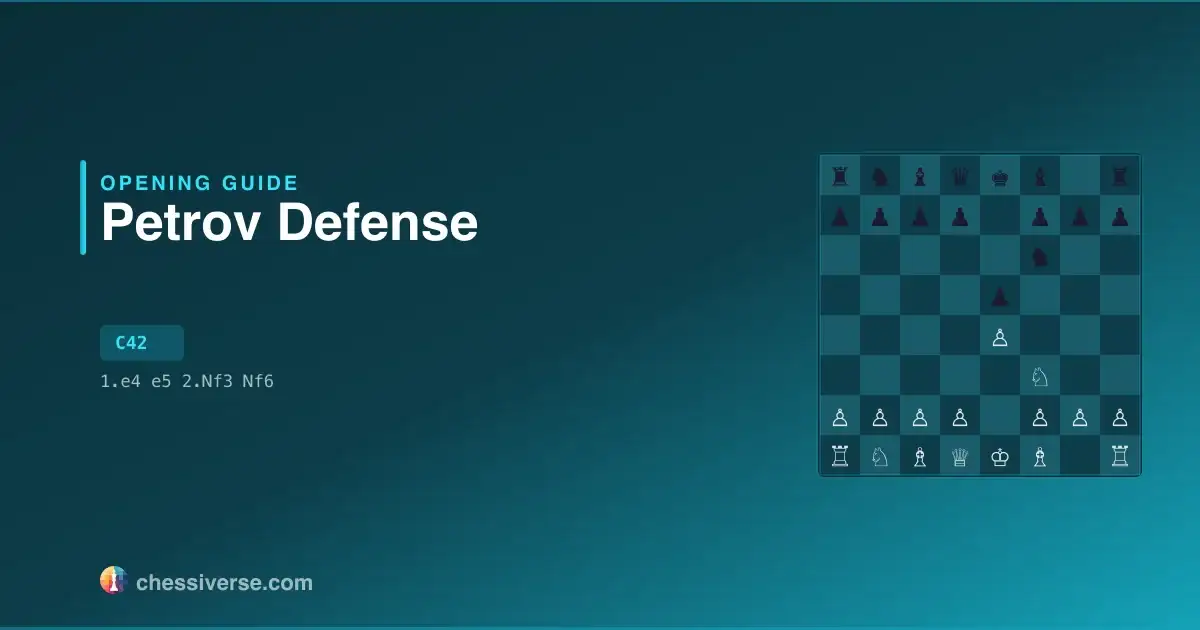


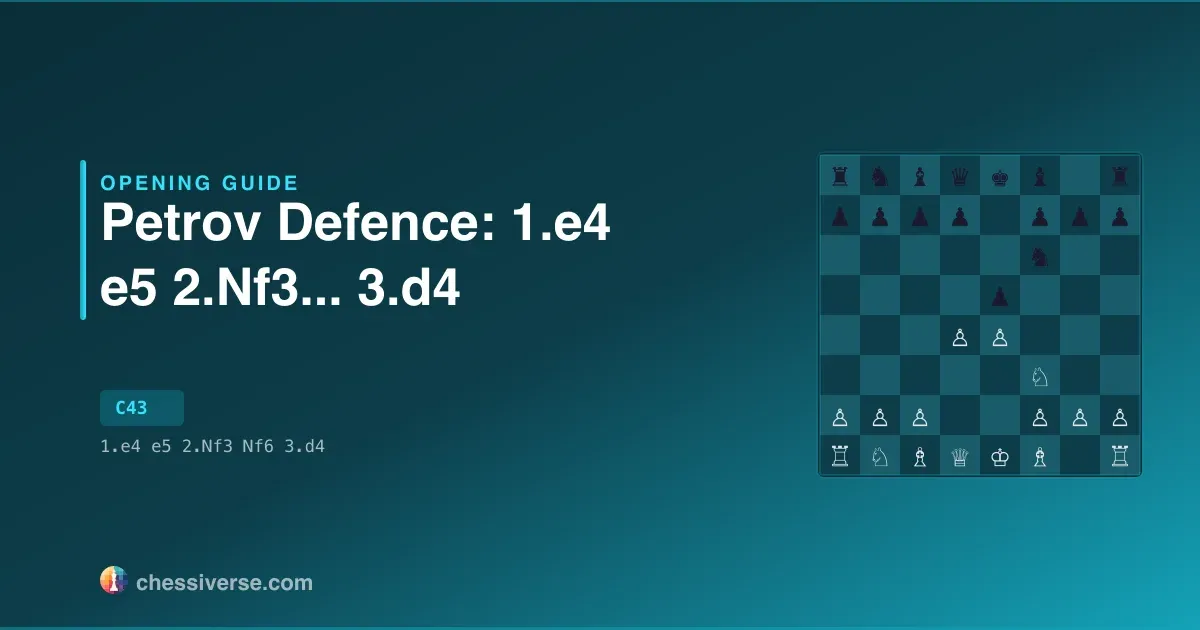
Starting from 1.e4 e5 2.Nf3 Nf6 3.d4, players enter the Petrov's Defense: Modern Attack — ECO C43. White skips the obvious knight-trade and opens the centre instead, offering Black a choice between two pawns and three different middlegames.
Strategic Overview
3.d4 is the principled alternative to the main-line 3.Nxe5 in the Petrov. Instead of accepting the symmetrical trade, White grabs central space and asks Black to define the position. Three replies define modern theory. 3...exd4 is the daring move: Black takes the centre pawn, but it allows 4.e5 to kick the knight, and the resulting positions usually involve trading both d-pawns and e-pawns with the centre wide open. Lines like 4...Ne4 5.Qxd4 d5 6.exd6 e.p. give White lasting central pressure but also let Black activate pieces quickly. 3...Nxe4 is the main line, leading to a clean trade of e-pawns. White typically reroutes through 4.Bd3 d5 5.Nxe5, holding back the immediate recapture to keep the knight on its strong square. 3...d5, the Symmetrical Variation, throws the question back to White and creates positions of mutual central tension where one slip in move order can be punished. Across all three lines, the strategic theme is open positions, active piece play, and concrete decisions about which pawns to keep and which to trade. The Petrov has a reputation for being drawish, but 3.d4 is precisely the line that injects life into it by making both sides commit to definite plans in the opening.
Key Ideas
When players succeed in this line, they usually do so by leaning on the following themes:
- Open the centre, force decisions — 3.d4 refuses the symmetrical knight trade and demands that Black commit to a structural plan. The position will not stay quiet for long.
- 3...exd4 invites the centre attack — Taking the pawn allows 4.e5 kicking the knight, and the position usually opens fully with both d- and e-pawns being traded. White gets initiative; Black gets piece activity.
- 3...Nxe4 is the principal trade — The classical reply leads to a clean exchange of e-pawns. The accurate move order goes through 4.Bd3 d5 first, preventing Black from chasing the knight with ...d6.
- 3...d5 mirrors the centre — The Symmetrical reply lets Black retain choice on which trade to take. Move orders matter because a wrong capture can leave Black with isolated doubled pawns.
- Most active line in the Petrov — Among the standard third moves in the Petrov, 3.d4 is the one that consistently produces dynamic, unbalanced positions rather than drawish symmetry.
History and Notable Players
It arises from the Petrov Defense. Among the most prolific White practitioners are Oleg Korneev (41 games), Sergei Tiviakov (27 games), Evgeny Sveshnikov (24 games). Black-side regulars include Artur Jussupow (52 games), Boris Gelfand (28 games), Eduardas Rozentalis (28 games).
Performance Across Rating Levels
Popularity and results vary sharply by rating level. The 1200 bracket has 909,934 games (0.13% of all games at that level); White wins 52.4%, Black 44%, 3.6% are drawn. At 1800 the opening surfaces in 0.11% of games; White wins 52.3%, Black 43.1%, draws 4.6%. At 2500, 0.15% of games go into this opening; draws sit at 12.3% — the line is well-mapped at this level. White's edge erodes by 4.3pp from 1200 to 2500 Elo, suggesting Black's counterplay is easier to find with experience.
Time Control Patterns
Time control matters here: bullet players reach for this opening more than others. In bullet, it appears in 0.15% of games (3,888,967); White wins 52.4%. Blitz shows 0.13% adoption across 4,611,664 games, White scoring 52.2%. In rapid, the share rises to 0.14% — 1,504,642 games, White 52.5%.
Move Diversity and Theory Depth
Move choice is far from uniform in the Petrov's Defense: Modern Attack. At 1200 Elo (909,934 games), the top reply is exd4, played 51.9% of the time. Three other moves each take at least 5% of games, and the top three moves account for 81.9% of games. Entropy: 2.14. By 2500 (20,819 games), Nxe4 takes over as the top reply at 84.7%; only one other move still reaches 5% and the top three moves account for 98.3% of games. Entropy drops to 0.84. That entropy collapse is the signature of a line where preparation pays off: at the top, players know the best move and play it.
Historical Trends
Tracking the Petrov's Defense: Modern Attack year over year shows a clear story. Adoption peaked in 2021 at 0.15% (1,168,197 games). By 2025 it sits at 0.13%, 17% below the peak but still 22% above its 2013 level, so the line is up over the full period despite easing from the high.
Common Mistakes
- Drifting away from main theory — At 400 Elo, the three most-played moves cover 66.5% of games, against 93.5% at 2000. The most popular deviation is Nc6 (played 14.9% of the time at 400, much less so up top). It looks fine but quietly hands the better-prepared side an edge.
- Neglecting development — It can feel productive to make extra pawn moves early, but falling behind in piece development is what loses most amateur games — especially in open positions where active pieces find squares fast.
- Playing without a plan — Each Petrov's Defense: Modern Attack middlegame demands a specific approach. Decide whether the position calls for attack, manoeuvre, or simplification before reaching for a move.
Practice on Chessiverse
Ready to try the Petrov's Defense: Modern Attack against a bot? Pick an opponent at your level and play a game.