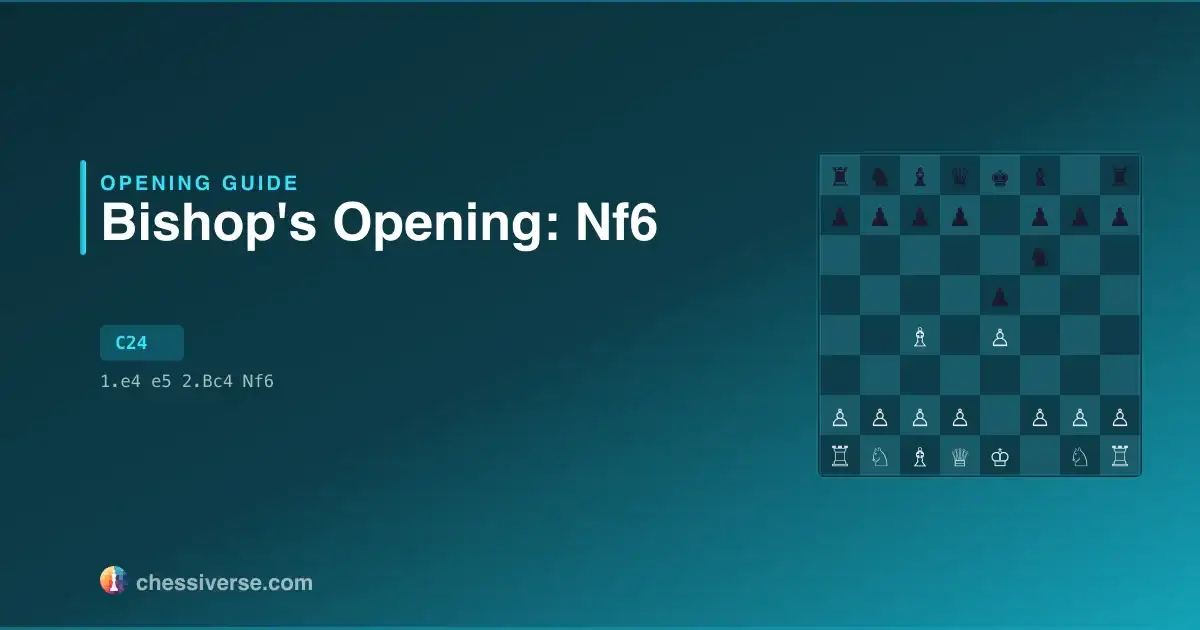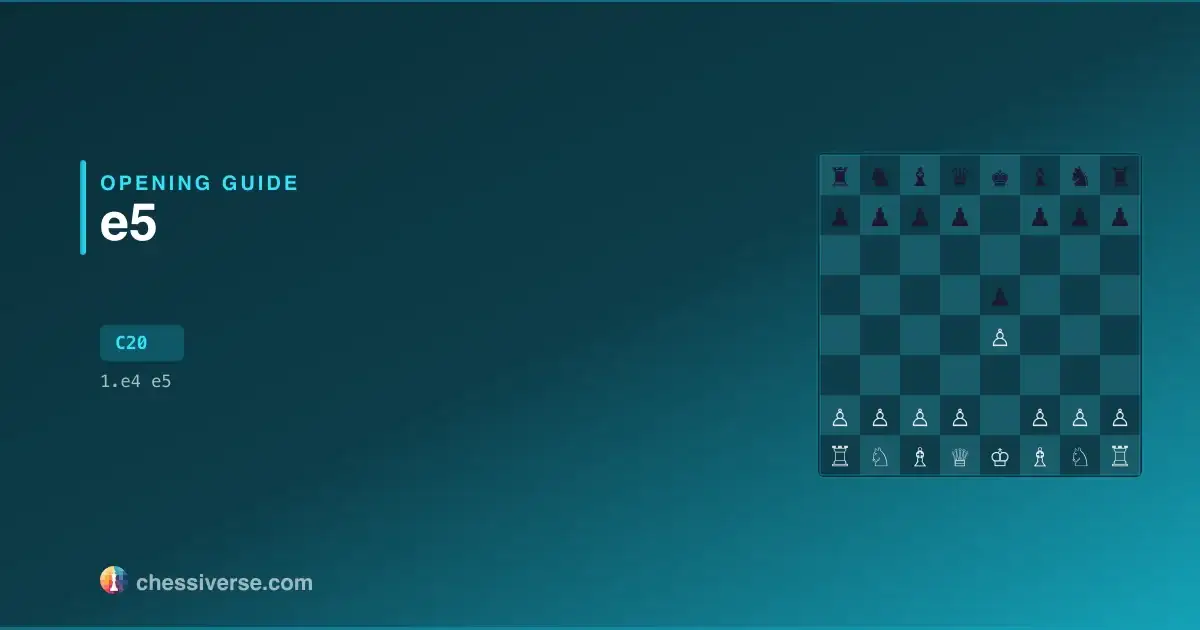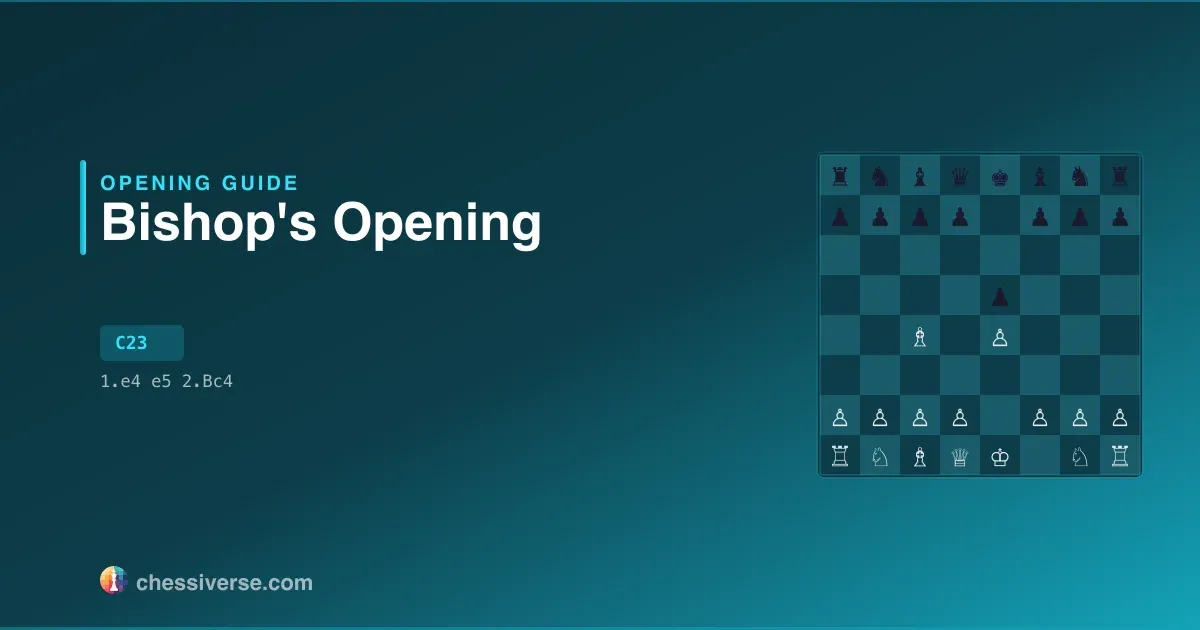
The Bishop's Opening arises after 1.e4 e5 2.Bc4 and falls under ECO code C23. White places the bishop on an active diagonal, strengthening control over d5 and targeting f7, the most vulnerable point in Black's camp. A defining feature of this opening is its highly transpositional nature: because White has not yet committed the knight to f3, the door remains open for f4, allowing potential transpositions into the Vienna Game or King's Gambit, while an Italian or Russian Game setup is also possible. Since 2. Bc4 does not threaten the e5 pawn the way 2. Nf3 would, Black enjoys considerable flexibility, with 2...Nf6 and 2...Bc5 as the principal replies. After 2...Nf6, Black puts pressure on e4, and White can choose to defend with 3. Nc3 (transposing into a Vienna), 3. d3 (keeping the bishop outside the pawn chain), or leave e4 unguarded in favour of 3. Nf3 (transposing into a Russian Game) or counterattacking moves like 3. d4 or 3. f4 (the Ponziani and Greco gambits). After the classical 2...Bc5, transpositions to Vienna or Italian lines arise via 3. Nc3 or 3. Nf3, while 3. b4 offers an Evans Gambit-style sacrifice and 3. c3 prepares an eventual d4 advance. With 142.7 million Lichess games across all rating levels, it is a well-established opening choice.
- The c4-bishop takes aim at Black's f7-square.
- Holding back the f-pawn keeps a later f4 push available, echoing King's Gambit ideas.
- It transposes readily into the Giuoco Piano, Two Knights or Vienna Game, while sidestepping defenses like the Petrov.
History and Notable Players
It arises from the Open Games (1...e5). Among the most prolific practitioners on the White side are Nikola Mitkov (90 games), Sergei Tiviakov (51 games), Willy Hendriks (50 games). On the Black side, notable exponents include Atousa Pourkashiyan (25 games), Daniel Fridman (23 games), Howard Staunton (16 games).
One of the oldest analyzed openings, studied by Lucena and Ruy Lopez and given lasting popularity by Philidor. It fell out of favor in the mid-1800s once stronger replies for Black were found, but Bent Larsen took it up often after 1964 and Kasparov has used it as an occasional surprise weapon.
Named after: Named for White's 2.Bc4 developing the bishop; analysts have argued the proper name would be Philidor's Opening, since Philidor built its theory.
Notable players: Bent Larsen, Garry Kasparov, John Nunn, Peter Leko
Weaver Adams claimed the Bishop's Opening won for White by force from move two, but he could never prove it against stronger opponents and eventually gave it up.
Statistics
Based on 142.7 million Lichess games across all rating levels:
- White wins: 51%
- Black wins: 45.1%
- Draws: 4%
White holds a moderate edge statistically, though Black has good practical chances.
Main Lines and Variations
After 1.e4 e5 2.Bc4, the main continuations include:
Each of these lines leads to distinct types of positions and requires its own understanding of the resulting pawn structures and piece placements.
Practice on Chessiverse
The best way to learn the Bishop's Opening is through practice. On Chessiverse, you can play chess against computer opponents that specialize in this opening. Our AI bots range from beginner to grandmaster level, each with unique playing styles — from aggressive attackers to solid defenders. Choose a bot that matches your rating and work your way up as you master the opening's key ideas.
Performance Across Rating Levels
How well the Bishop's Opening works depends on what level you're playing at. Among 1200-rated players, it appears in 4.21% of games — 28,392,822 of them on record — with White winning 51.4% and Black 44.9%. By 1800, popularity is 1.84% and White's score is 49.9% to Black's 45.7%. Among 2500-rated players the line appears in 0.24% of games and draws spike to 9.1%, indicating tight preparation. White's edge erodes by 3.4pp from 1200 to 2500 Elo, suggesting Black's counterplay is easier to find with experience.
Time Control Patterns
The Bishop's Opening skews toward rapid chess. In bullet, it appears in 1.44% of games (38,312,509); White wins 52.4%. Blitz shows 2.71% adoption across 97,394,547 games, White scoring 51.1%. In rapid, the share rises to 4.09% — 45,268,149 games, White 50.7%.
Move Diversity and Theory Depth
Move choice is far from uniform in the Bishop's Opening. At 1200 Elo (28,392,822 games), the top reply is Nf6, played 37.1% of the time. Three other moves each take at least 5% of games, and the top three moves account for 78.6% of games. Entropy: 2.44. By 2500 (32,915 games), Nf6 dominates at 66.4% of replies; only one other move still reaches 5% and the top three moves account for 95.3% of games. Entropy drops to 1.37. The narrowing is significant — strong players consolidate around a small set of best moves, while amateurs scatter across many plausible-looking options.
Historical Trends
Long-term, the trajectory of this opening is informative. Adoption peaked in 2013 at 4.47% (128,834 games). By 2025 it sits at 3.06%, down 32% from that high, leaving the line in decline.