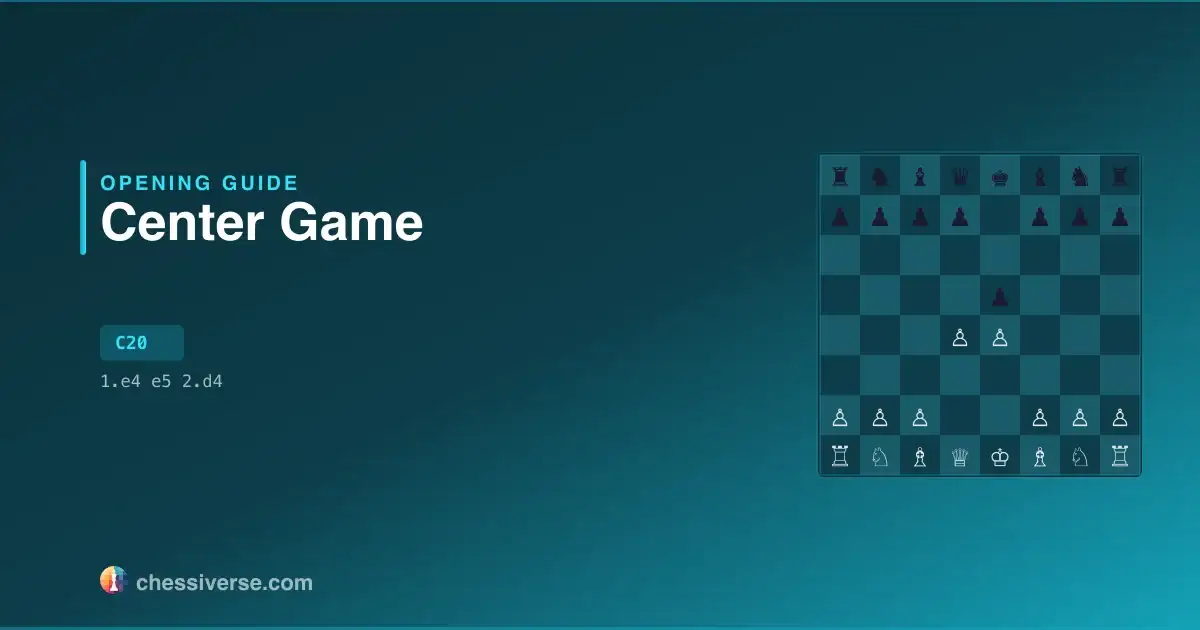


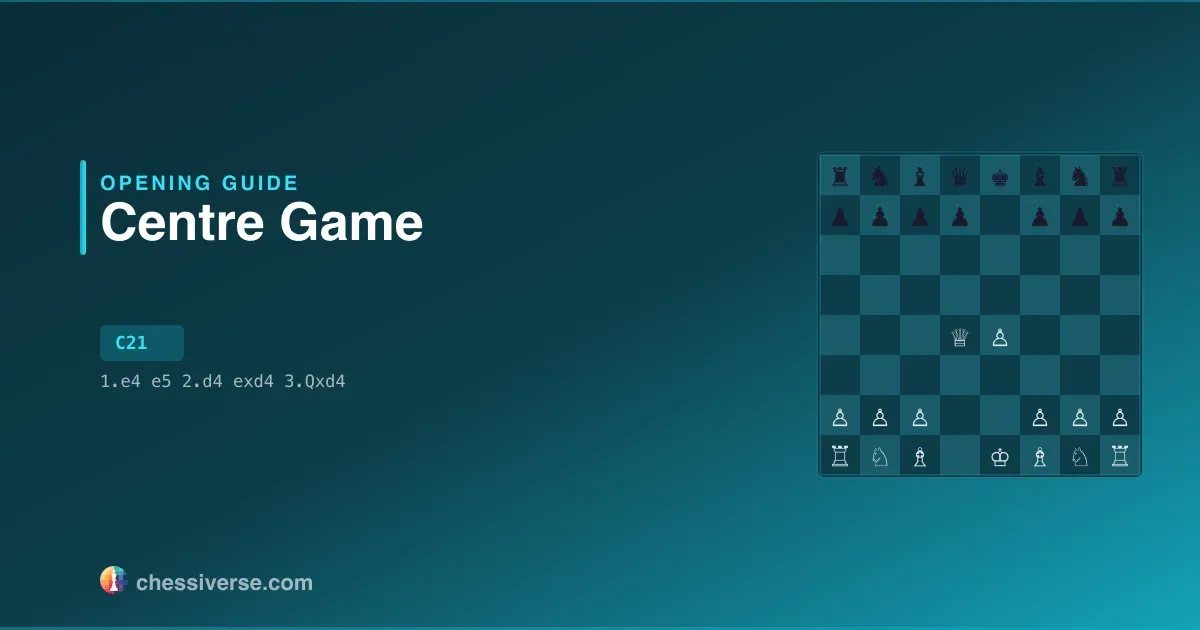
The Center Game arises after 1.e4 e5 2.d4 exd4 3.Qxd4 and falls under ECO code C22. After recapturing with the queen, White has eliminated Black's only central pawn and momentarily controls all four centre squares. While this looks like a substantial advantage, it comes with a clear drawback: 3...Nc6 develops a piece with tempo by attacking the queen, forcing it to vacate its dominant post. Early queen development is generally risky, but Black must still exercise caution, as careless play can lead to trouble. The standard response is 3...Nc6, which simultaneously develops a knight and compels White's queen to retreat. With 22.4 million Lichess games across all rating levels, it is a specialized opening choice.
- White's queen enters the game very early and 3...Nc6 hits it at once, so Black develops with tempo while White counts on open lines for the pieces.
- In the main line White retreats the queen to e3, the Paulsen Attack, then castles long while Black castles short, putting the kings on opposite wings.
- Black is thought to equalize with accurate play, so White's practical hopes rest on initiative and attacking chances rather than an opening edge.
History and Notable Players
It arises from the Open Games (1...e5). Among the most prolific practitioners on the White side are Jacques Mieses (57 games), Frank James Marshall (31 games), Miguel Munoz Pantoja (23 games). On the Black side, notable exponents include Siegbert Tarrasch (9 games), Mikhail Chigorin (7 games), Joseph Henry Blackburne (7 games).
One of the oldest recorded openings, dating to around 1590 and first analysed by Philipp Stamma in 1745. Tarrasch, Chigorin and Wilfried Paulsen played it regularly in the late 1800s, but it was mostly abandoned after 1900 when no White advantage could be demonstrated, until Alexander Shabalov revived it in the 1990s.
Notable players: Jacques Mieses, Alexander Shabalov, Alexander Morozevich, Ian Nepomniachtchi
Known from 1590 or earlier, it was mostly abandoned after 1900 and stayed off the elite radar until Shabalov brought it back in the 1990s.
Statistics
Based on 22.4 million Lichess games across all rating levels:
- White wins: 46.2%
- Black wins: 49.7%
- Draws: 4.1%
Interestingly, Black scores well in this opening, suggesting it offers strong counterplay.
Practice on Chessiverse
The best way to learn the Center Game is through practice. On Chessiverse, you can play chess against computer opponents that specialize in this opening. Our AI bots range from beginner to grandmaster level, each with unique playing styles — from aggressive attackers to solid defenders. Choose a bot that matches your rating and work your way up as you master the opening's key ideas.
Performance Across Rating Levels
The picture changes a lot as you climb the rating ladder. At 1200 Elo, the opening shows up in 0.83% of games (5,582,105 samples). White scores 44.9%, Black 51.1%, draws 4%. Move up to 1800 Elo and the share shifts to 0.21%, with White winning 51.1% versus Black's 44.8%. At 2500, 0.09% of games go into this opening; draws sit at 7.5% — the line is well-mapped at this level. White's score improves by 5.6pp from the 1200 bracket to the 2500 bracket — the line rewards preparation.
Time Control Patterns
Time control matters here: rapid players reach for this opening more than others. In bullet, it appears in 0.26% of games (6,849,742); White wins 50.5%. Blitz shows 0.45% adoption across 16,051,193 games, White scoring 47.1%. In rapid, the share rises to 0.57% — 6,359,843 games, White 43.8%. White's score swings 6.7pp across formats, so time control isn't just a stylistic choice here — it shifts the actual results.
Move Diversity and Theory Depth
Move choice is far from uniform in the Center Game. At 1200 Elo (5,582,105 games), the top reply is Nc6, played 83.7% of the time. No other move reaches 5% of games, and the top three moves account for 92.5% of games. Entropy: 1.08. By 2500 (12,078 games), Nc6 dominates at 96.2% of replies; no other move reaches 5% and the top three moves account for 98.9% of games. Entropy drops to 0.31. The narrowing is significant — strong players consolidate around a small set of best moves, while amateurs scatter across many plausible-looking options.
Historical Trends
Tracking the Center Game year over year shows a clear story. Adoption peaked in 2013 at 0.65% (18,751 games). By 2025 it sits at 0.46%, down 30% from that high, leaving the line in decline.