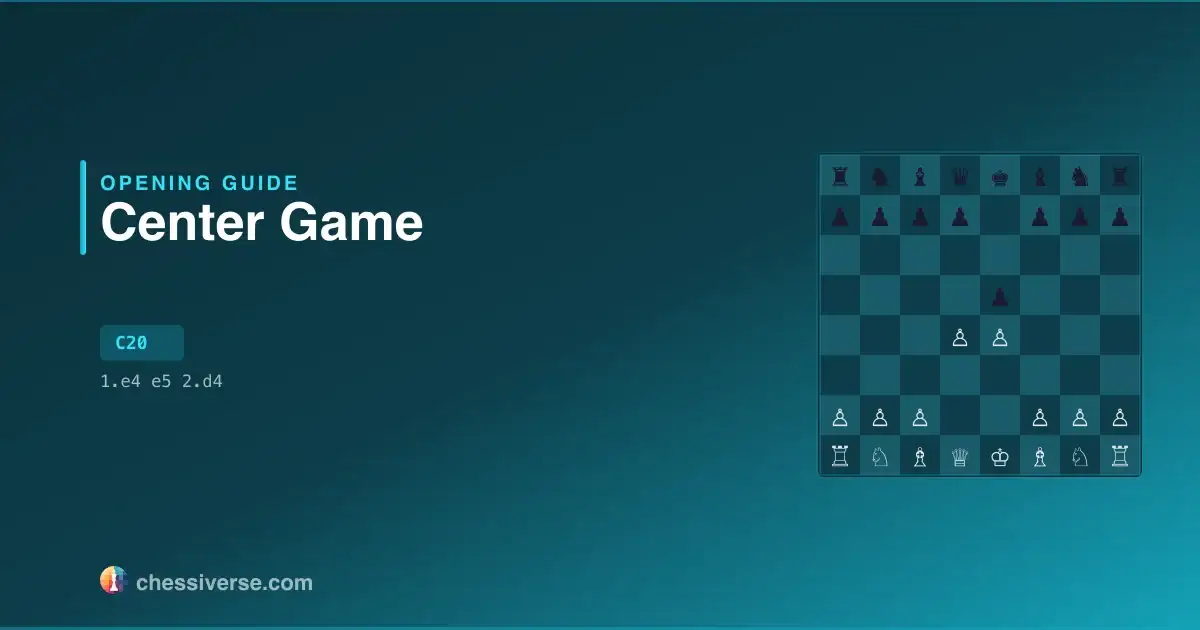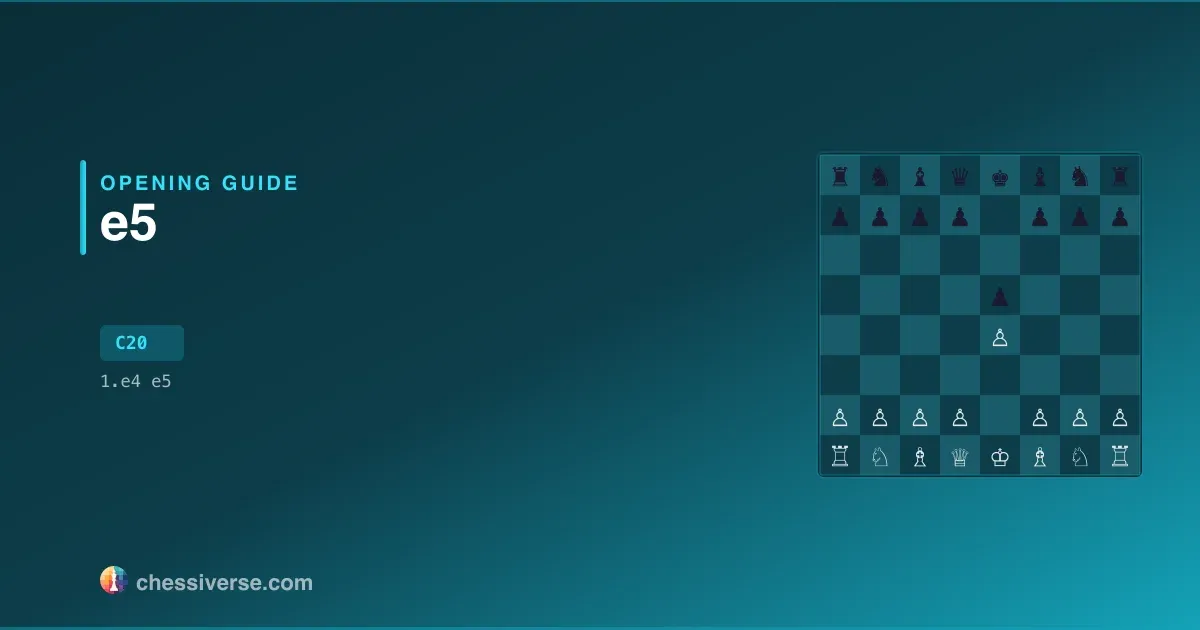
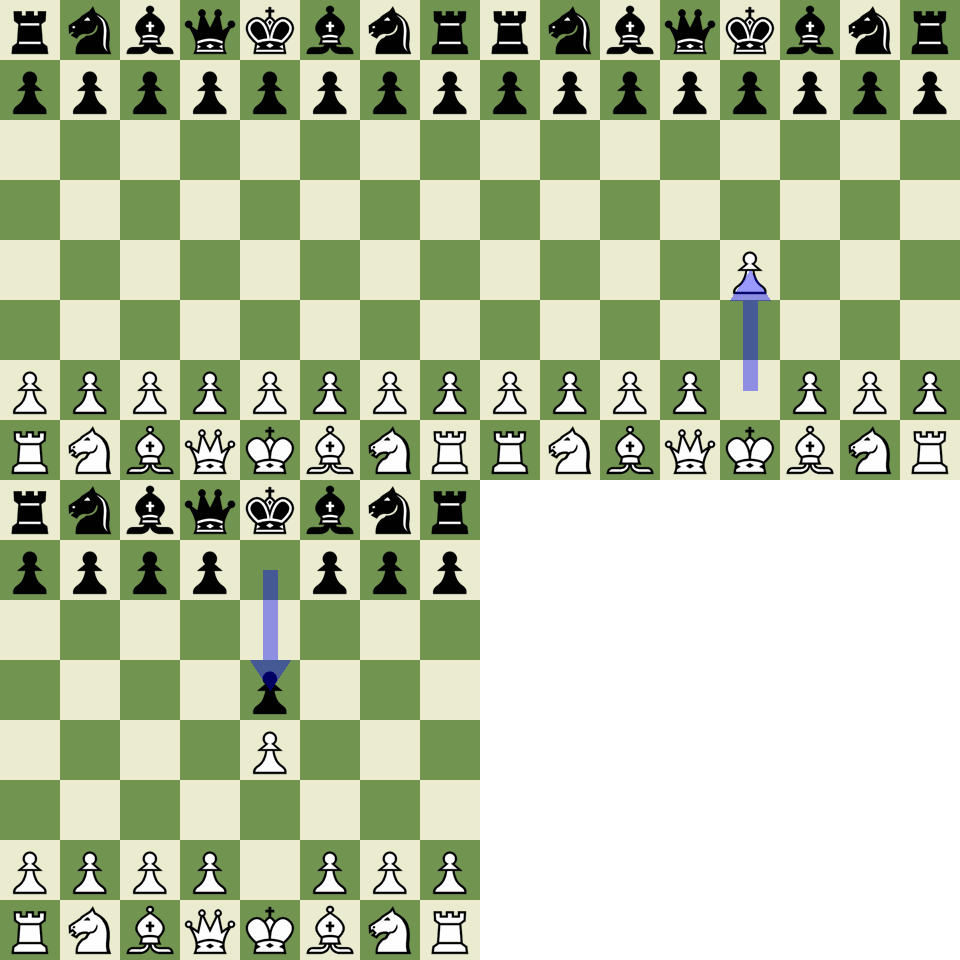
The Open Games (1...e5) arises after 1.e4 e5 and falls under ECO code C20. Known as the Open Game or Double King's Pawn, 1...e5 represents Black's most traditional answer to 1. e4, immediately claiming an equal stake in the centre and opening lines for piece development. Crucially, it is one of the rare replies that directly challenges White's ambition to play d4. The symmetry, however, cuts both ways: as long as the position remains a mirror image, White's first-move advantage persists, which partly explains a gentle decline in the opening's popularity over the course of the 20th century. Because the e5 pawn sits undefended, White can steer development in a way that pressures it, limiting Black's options, and this is in fact White's most frequent strategy, though quieter setups that avoid an immediate attack are also viable. When White does target e5, the initiative stays firmly in White's hands, compelling Black to respond to threats rather than pursue independent plans. With 1314.2 million Lichess games across all rating levels, it is one of the most popular openings.
- By mirroring 1.e4, Black claims an equal share of the center and blocks White's ideal plan of an early d4.
- Black's e5 pawn starts out undefended, so White develops with threats: 2.Nf3 attacks it while preparing a later d4 push.
History and Notable Players
Among the most prolific practitioners on the White side are Viswanathan Anand (627 games), Sergey Karjakin (439 games), Alexei Shirov (429 games). On the Black side, notable exponents include Ivan Sokolov (531 games), Levon Aronian (499 games), Aleksej Aleksandrov (471 games).
The Open Game family includes some of chess's oldest and most heavily analyzed openings, among them the Italian Game and the Ruy Lopez. It was the most common answer to 1.e4 until the mid-20th century, then saw a modest decline, yet it remains the second most popular reply to 1.e4 at the top level.
Open Games are often among the very first openings taught to beginners, and Bobby Fischer summed up the move that starts them all with his verdict that 1.e4 is 'best by test'.
Statistics
Based on 1314.2 million Lichess games across all rating levels:
- White wins: 50.9%
- Black wins: 44.9%
- Draws: 4.2%
White holds a moderate edge statistically, though Black has good practical chances.
Main Lines and Variations
After 1.e4 e5, the main continuations include:
Each of these lines leads to distinct types of positions and requires its own understanding of the resulting pawn structures and piece placements.
Practice on Chessiverse
The best way to learn the Open Games (1...e5) is through practice. On Chessiverse, you can play chess against computer opponents that specialize in this opening. Our AI bots range from beginner to grandmaster level, each with unique playing styles — from aggressive attackers to solid defenders. Choose a bot that matches your rating and work your way up as you master the opening's key ideas.
Performance Across Rating Levels
How well the Open Games (1...e5) works depends on what level you're playing at. Among 1200-rated players, it appears in 37.37% of games — 252,143,717 of them on record — with White winning 51% and Black 45.1%. By 1800, popularity is 19.52% and White's score is 50.8% to Black's 44.7%. At 2500, 8.64% of games go into this opening; draws sit at 10.4% — the line is well-mapped at this level. White's edge erodes by 4.1pp from 1200 to 2500 Elo, suggesting Black's counterplay is easier to find with experience.
Time Control Patterns
The Open Games (1...e5) skews toward rapid chess. In bullet, it appears in 16.12% of games (428,583,498); White wins 51.2%. Blitz shows 25.61% adoption across 920,743,069 games, White scoring 50.9%. In rapid, the share rises to 35.56% — 393,441,672 games, White 51%.
Move Diversity and Theory Depth
What players actually play after the opening moves depends heavily on rating. At 1200 Elo (252,143,717 games), the top reply is Nf3, played 63.3% of the time. Three other moves each take at least 5% of games, and the top three moves account for 81% of games. Entropy: 1.98. By 2500 (1,178,645 games), Nf3 dominates at 83.3% of replies; only one other move still reaches 5% and the top three moves account for 93.7% of games. Entropy drops to 1.00. The narrowing is significant — strong players consolidate around a small set of best moves, while amateurs scatter across many plausible-looking options.
Historical Trends
Year-over-year data tells you whether this opening is a contemporary fixture or a fading one. Adoption peaked in 2013 at 31.65% (912,193 games). By 2025 it sits at 27.26%, down 14% from that high, leaving the line in decline.