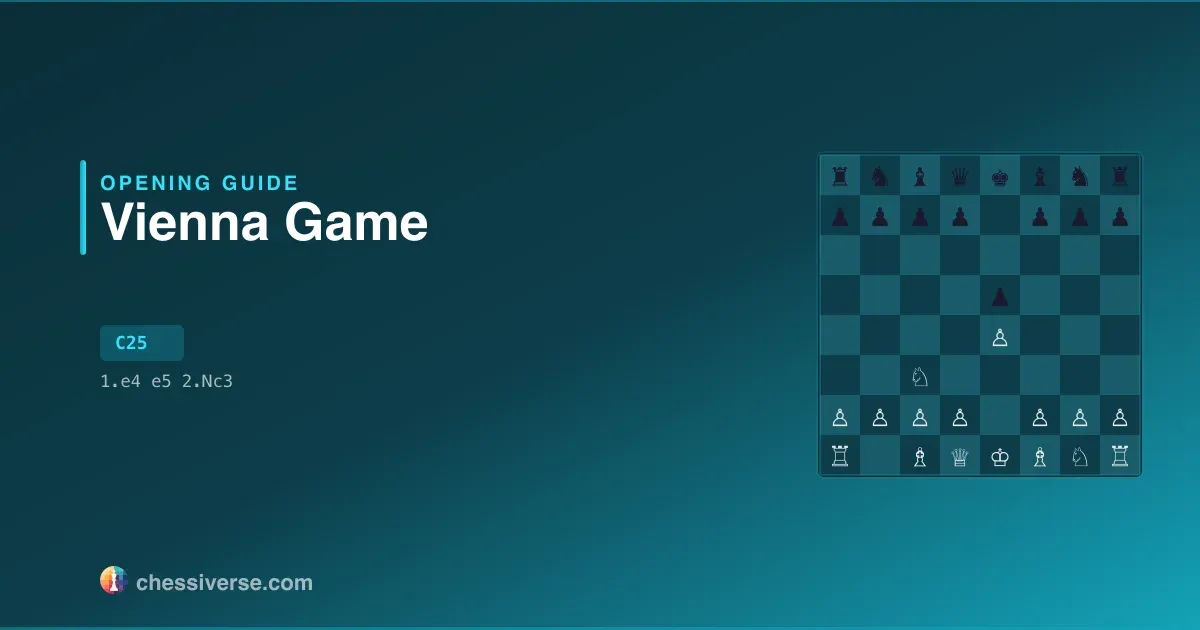
The Vienna Game arises after 1.e4 e5 2.Nc3 and falls under ECO code C25. White's underlying plan is to push f4, dislodging Black's e5 pawn and striking at the centre. While an immediate 2. f4 (the King's Gambit) achieves this directly, the Vienna Game takes a more measured approach by first developing the knight and waiting to see how Black arranges their pieces before launching the f-pawn advance. Dating back to the nineteenth century, this opening can lead to dangerously sharp attacks, but the aggressive intentions come at a cost: the more White invests in a kingside assault, the less time is spent on natural development and territorial control, so Black stands to benefit in the long run if they weather the early storm. Black faces no immediate threat apart from the looming f4 push, which cannot practically be prevented. The most common and natural reply is to develop a knight, which prepares to meet f4 with ...d5, introducing additional central tension that White must account for. With 76.5 million Lichess games across all rating levels, it is a well-established opening choice.
- White holds back the f-pawn to play f4 a move later than a King's Gambit; after 2...Nf6 3.f4 Black usually counters in the center with 3...d5.
- 3.Bc4 heads for sharp tactics, including the wild Frankenstein-Dracula Variation after 3...Nxe4 4.Qh5.
- The quiet 3.g3 fianchetto, favored by Smyslov, gives a slower positional game with hypermodern flavor.
History and Notable Players
It arises from the Open Games (1...e5). Among the most prolific practitioners on the White side are Jacques Mieses (122 games), Jana Krivec (70 games), William Steinitz (64 games). On the Black side, notable exponents include Frank James Marshall (25 games), Joseph Henry Blackburne (20 games), Dawid Markelowicz Janowski (18 games).
The Vienna arose in the 19th century as a new idea: develop the queen's knight first and keep a delayed King's Gambit with f4 in reserve. An 1888 New York Times reviewer called it the only new opening introduced since Morphy. Steinitz championed his gambit line 4.d4, while modern theory, per Nick de Firmian in Modern Chess Openings, holds that it leads to equality with best play.
Named after: The city of Vienna, Austria. The opening became popular in the 19th century.
Notable players: Wilhelm Steinitz, Vasily Smyslov, Weaver W. Adams
Weaver W. Adams famously claimed the Vienna Game wins by force for White, and the 1872 Hamppe-Meitner game in Vienna produced the celebrated Immortal Draw - modern theory settles for equality.
Statistics
Based on 76.5 million Lichess games across all rating levels:
- White wins: 50.7%
- Black wins: 45%
- Draws: 4.2%
White holds a moderate edge statistically, though Black has good practical chances.
Main Lines and Variations
After 1.e4 e5 2.Nc3, the main continuations include:
Each of these lines leads to distinct types of positions and requires its own understanding of the resulting pawn structures and piece placements.
Practice on Chessiverse
The best way to learn the Vienna Game is through practice. On Chessiverse, you can play chess against computer opponents that specialize in this opening. Our AI bots range from beginner to grandmaster level, each with unique playing styles — from aggressive attackers to solid defenders. Choose a bot that matches your rating and work your way up as you master the opening's key ideas.
Performance Across Rating Levels
Popularity and results vary sharply by rating level. At 1200 Elo, the opening shows up in 2.06% of games (13,915,319 samples). White scores 50.4%, Black 45.7%, draws 3.9%. By 1800, popularity is 1.16% and White's score is 51.8% to Black's 43.8%. At the top end (2500+ Elo), popularity is 0.65% with 10.1% draws — a clear sign of how much theory rules the line at master level. White's edge erodes by 3.7pp from 1200 to 2500 Elo, suggesting Black's counterplay is easier to find with experience.
Time Control Patterns
Time control matters here: rapid players reach for this opening more than others. In bullet, it appears in 1.74% of games (46,270,271); White wins 51.8%. Blitz shows 1.59% adoption across 57,095,197 games, White scoring 50.9%. In rapid, the share rises to 1.76% — 19,436,632 games, White 50.3%.
Move Diversity and Theory Depth
Move choice is far from uniform in the Vienna Game. At 1200 Elo (13,915,319 games), the top reply is Nf6, played 33.6% of the time. Three other moves each take at least 5% of games, and the top three moves account for 76.2% of games. Entropy: 2.46. By 2500 (88,354 games), Nf6 dominates at 58.1% of replies; only one other move still reaches 5% and the top three moves account for 95.4% of games. Entropy drops to 1.45. The narrowing is significant — strong players consolidate around a small set of best moves, while amateurs scatter across many plausible-looking options.
Historical Trends
Year-over-year data tells you whether this opening is a contemporary fixture or a fading one. Adoption peaked in 2023 at 1.89% (15,023,922 games). By 2025 it sits at 1.80%, 5% below the peak but still 85% above its 2013 level, so the line is up over the full period despite easing from the high.