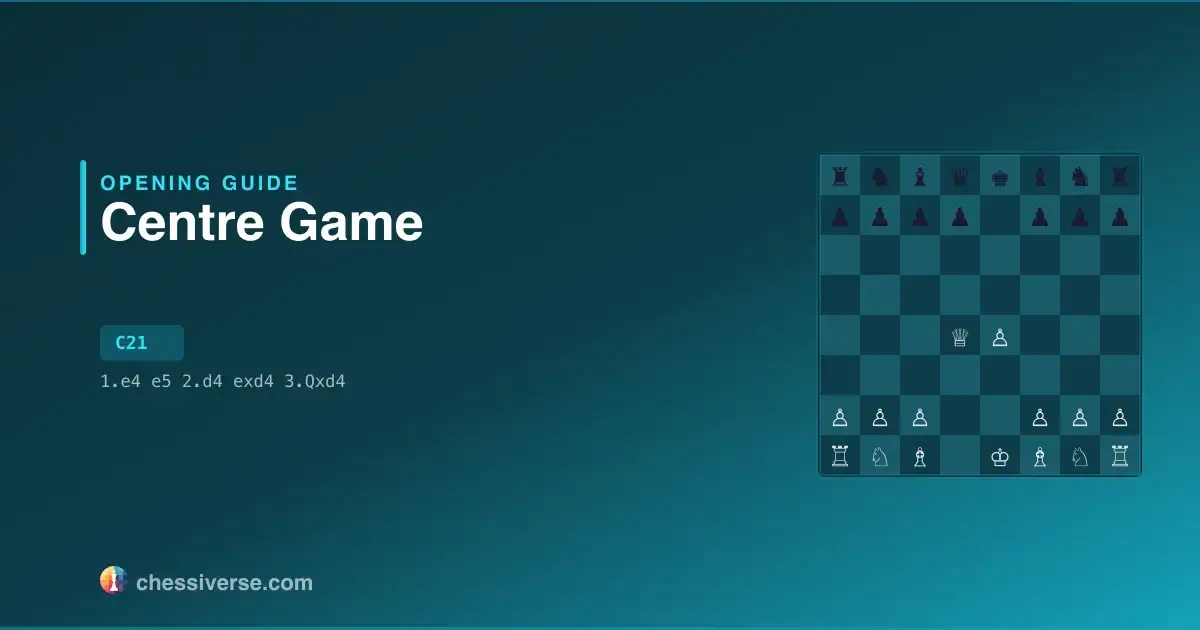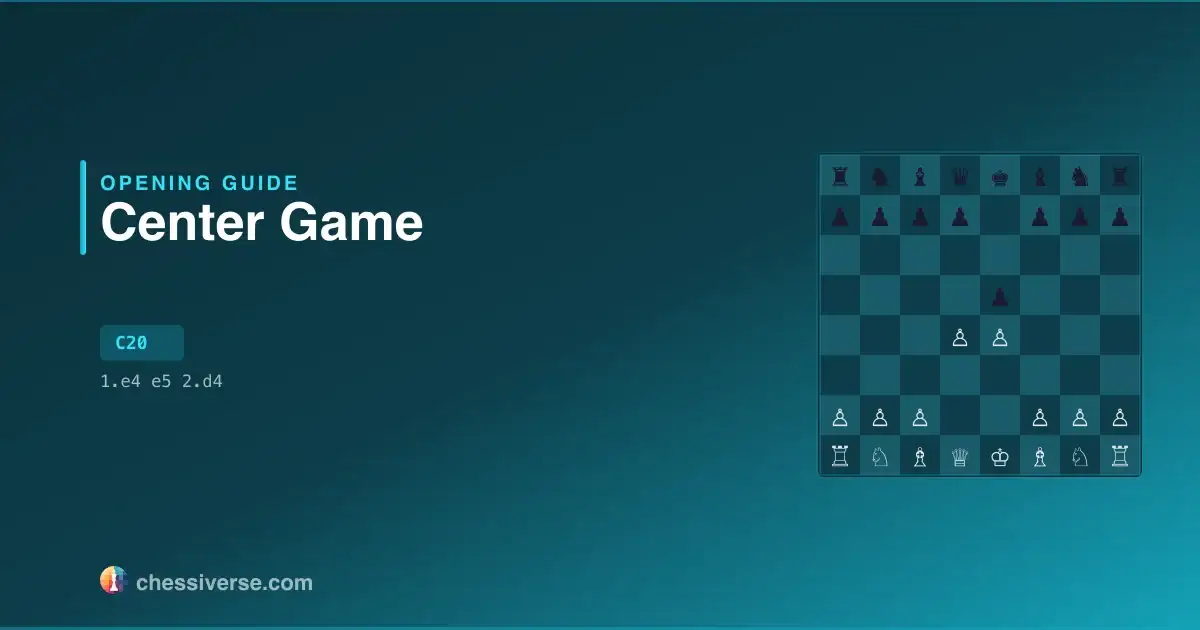




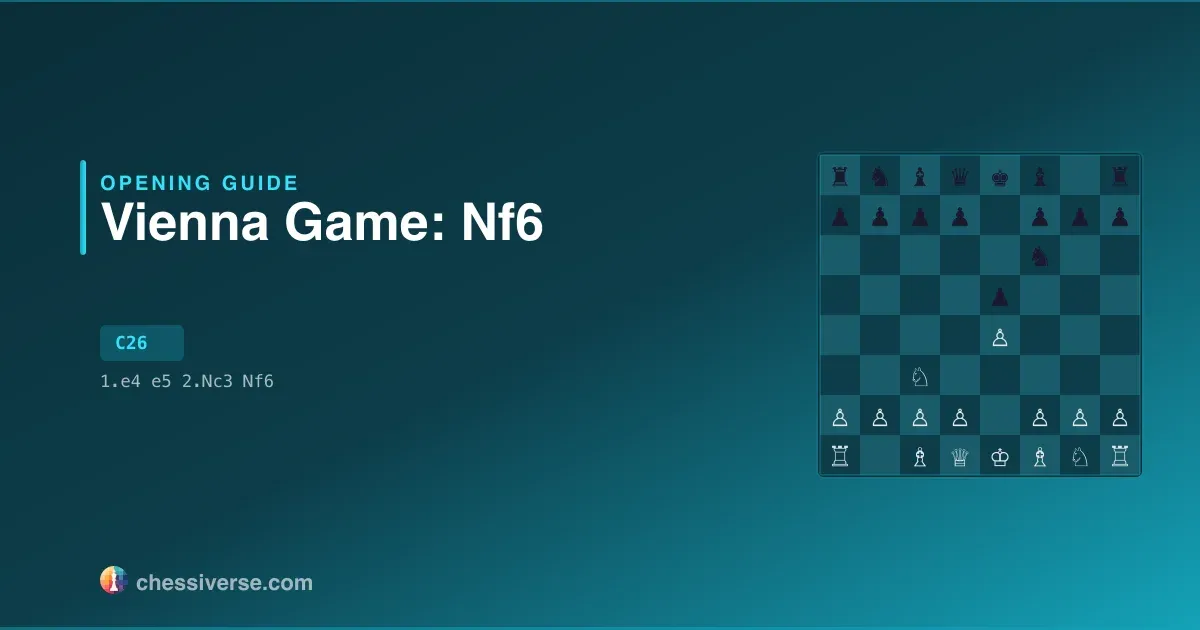
Starting from 1.e4 e5 2.Nc3 Nf6, players enter the Vienna Game: Falkbeer Variation — ECO C26. Black develops, contests d5, and forces White to decide whether the Vienna is still about the big f4 push or about something quieter and more positional.
Strategic Overview
2...Nf6 is the principal answer to the Vienna. The knight develops to its best square, fights for control of e4 and d5, and refuses to be intimidated by the threatened f4 advance. White now has a real strategic choice. The traditional Vienna idea is still 3.f4, treating the position as a delayed King's Gambit with the knight pre-developed on c3. That leads to sharp, classical play where Black often replies ...d5 to challenge the centre immediately. The modern, slower 3.Bc4 invites tactical complications around f2 and f7, including the famous lines where Black grabs e4 and creates a mini-gambit. 3.g3 is the calm, hypermodern interpretation, fianchettoing the bishop and aiming for a long positional game. For Black, the typical plan is to develop with ...Bc5 or ...Bb4, prepare ...d5 at the right moment, and treat the position as a slightly unusual e5 setup. The Vienna is what 1.e4 players reach for when they want to keep some of the romantic spirit of the King's Gambit without committing a pawn on move two. Black's job is to take the position seriously: if you treat it like a sleepy Italian, you can get blown off the board in 20 moves.
Key Ideas
When players succeed in this line, they usually do so by leaning on the following themes:
- Knight contests d5 and prepares ...d5 — Putting the knight on f6 makes Black's central ...d5 break realistic. That break is the standard equaliser against most Vienna setups.
- f4 is still the thematic Vienna idea — White can still go for the King's Gambit feel with f4, just with the knight already developed on c3. Black needs a plan against this aggressive setup.
- 3.Bc4 invites complications — The bishop sortie aims at f7 and sets up tactical possibilities. Black can grab the e4 pawn in some lines, but needs concrete preparation to come out ahead.
- g3 turns the Vienna positional — The hypermodern interpretation gives up early ambition for long-term piece harmony. The game becomes a slow strategic battle rather than a fight for the centre.
History and Notable Players
It arises from the Vienna Game. Among the most prolific White practitioners are Jacques Mieses (71 games), Jana Krivec (53 games), Alexander Alekhine (40 games). Black-side regulars include Evgeni Janev (22 games), Jorge Szmetan (21 games), Frank James Marshall (19 games).
Performance Across Rating Levels
Popularity and results vary sharply by rating level. At 1200 Elo, the opening shows up in 0.77% of games (5,196,894 samples). White scores 51.2%, Black 45%, draws 3.9%. By 1800, popularity is 0.44% and White's score is 51.6% to Black's 44%. Among 2500-rated players the line appears in 0.46% of games and draws spike to 10.5%, indicating tight preparation. White's edge erodes by 4.3pp from 1200 to 2500 Elo, suggesting Black's counterplay is easier to find with experience.
Time Control Patterns
Time control matters here: rapid players reach for this opening more than others. In bullet, it appears in 0.47% of games (12,432,727); White wins 52.2%. Blitz shows 0.58% adoption across 20,735,204 games, White scoring 51.2%. In rapid, the share rises to 0.77% — 8,504,763 games, White 50.5%.
Move Diversity and Theory Depth
What players actually play after the opening moves depends heavily on rating. At 1200 Elo (5,196,894 games), the top reply is Nf3, played 41.6% of the time. Three other moves each take at least 5% of games, and the top three moves account for 83.3% of games. Entropy: 2.31. By 2500 (62,987 games), Bc4 takes over as the top reply at 28.2%; four other moves reach 5% and the top three moves account for 72.9% of games. Entropy stays at 2.31. Move diversity stays high even at master level, suggesting the opening doesn't force one specific response.
Historical Trends
Long-term, the trajectory of this opening is informative. Adoption peaked in 2021 at 0.70% (5,328,003 games). By 2025 it sits at 0.63%, 10% below the peak but still 44% above its 2013 level, so the line is up over the full period despite easing from the high.
Main Lines and Variations
After 1.e4 e5 2.Nc3 Nf6, the established follow-ups are:
- Vienna Game: Frankenstein-Dracula Variation
- Vienna Game: Stanley Variation, Three Knights Variation
- Vienna Game: Vienna Gambit, Main Line
Each branch leads to a different middlegame character — the resulting pawn structure decides what kind of game you get.
Common Mistakes
- Drifting away from main theory — At 400 Elo, the three most-played moves cover 77.6% of games, against 84.5% at 2000. The most popular deviation is d3 (played 7.5% of the time at 400, less so up top). It looks fine but quietly hands the better-prepared side an edge.
- Neglecting development — It can feel productive to make extra pawn moves early, but falling behind in piece development is what loses most amateur games — especially in open positions where active pieces find squares fast.
- Playing without a plan — Each Vienna Game: Falkbeer Variation middlegame demands a specific approach. Decide whether the position calls for attack, manoeuvre, or simplification before reaching for a move.
Practice on Chessiverse
Ready to try the Vienna Game: Falkbeer Variation against a bot? Pick an opponent at your level and play a game.