Vienna Game: 1.e4 e5 2.Nc3...... Nxe4

+16%
C271.e4 e5 2.Nc3 Nf6 3.Bc4 Nxe4
Feb 16, 2028
TL;DR

The Frankenstein-Dracula: Black grabs e4, dares White to prove the compensation, and walks into one of the most theory-soaked tactical lines in the King's Pawn. Lines run 20-plus moves deep with Black's king dragged across the board.

Reviewed by

IM John Bartholomew
IM John BartholomewCo-Founder & Chess Educator

International Master and chess educator. Co-founded Chessable and joined Chessiverse as co-founder. Best known for his "Climbing the Rating Ladder" YouTube series and structured opening courses.

Vienna Game: 1.e4 e5 2.Nc3...... Nxe4: A Complete Guide
Vienna Game: 1.e4 e5 2.Nc3...... Nxe4 - Opening Moves
Summary

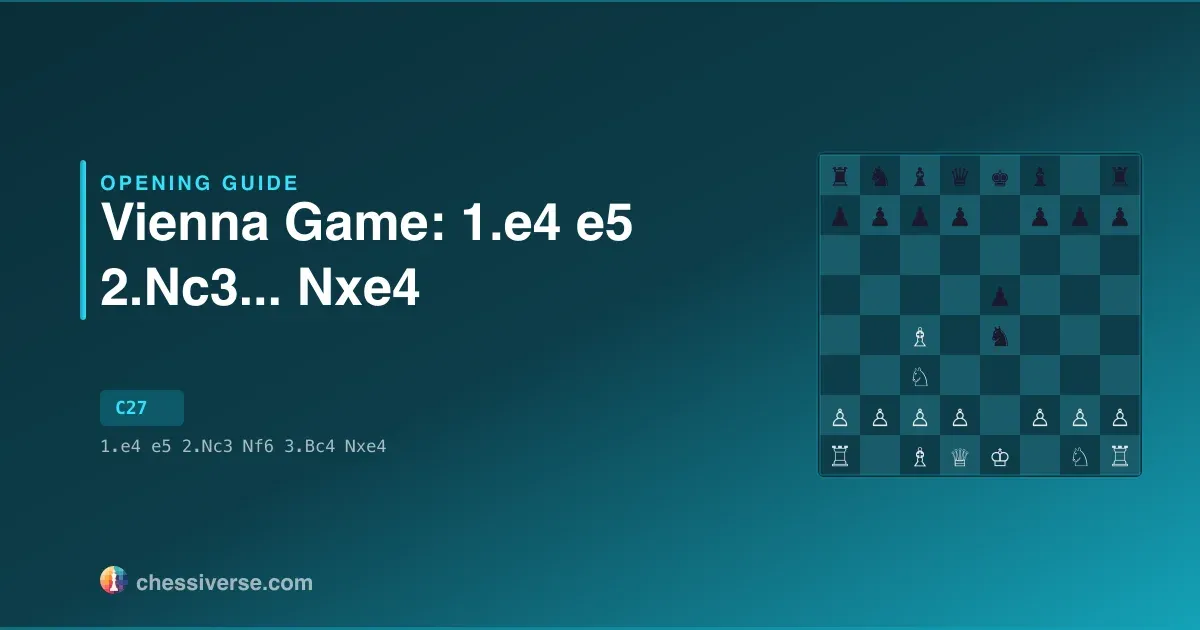
The Vienna Game: 1.e4 e5 2.Nc3... Nxe4 begins with 1.e4 e5 2.Nc3 Nf6 3.Bc4 Nxe4 (ECO C27). Black just grabbed the pawn and walked into one of the most chaotic positions in classical theory, where the bishop on c4 and the queen lined up on h5 promise pure attacking warfare.

Strategic Overview

The Frankenstein-Dracula is exactly what it sounds like: a brutal, theory-soaked variation where Black accepts a pawn and dares White to make the position pay. The naive idea of trying to recover the pawn cleanly does not work, because the natural ...d5 and Bxd5 line leaves White's knight pinned against g2 after ...Qxd5, and Black ends up better. So 3.Nxe4 in this sense is a real gambit: White is committing to dynamic compensation rather than trying to win the pawn back. The main attacking idea is to launch the queen to h5 hitting the f7 pawn and the e5 pawn at once, forcing Black to make uncomfortable defensive moves. Black's task is to weather the storm, often returning the material at the right moment to consolidate and reach an endgame where the extra structure tells. White's task is to coordinate the queen and bishop quickly enough to either crash through to f7 or build long-term pressure on the king. The position is not for the faint-hearted on either side. Lines run twenty moves deep and require concrete preparation. This is the variation you choose when you want the kind of position where general principles will not save you and only memorised tactics will.

Key Ideas

A few ideas come up again and again in this opening:

  • The pawn grab is genuine, not a trap — After 3...Nxe4 Black is genuinely up a pawn. White cannot recover it cleanly because the obvious 4.Bxd5 line after ...d5 lets the queen pin the knight against g2.
  • 3.Bc4 was a real gambit all along — The Vienna with 3.Bc4 is effectively offering material once Black grabs on e4. White must commit to dynamic compensation, not chase the pawn back.
  • Queen sorties define the attack — White's plan revolves around an early queen move toward h5, hitting f7 and forcing Black to make awkward defensive choices. Speed of attack is everything.
  • Black aims to give material back at the right time — Holding the extra pawn is rarely safe. Black's practical plan is to return the pawn at the right moment, reach a healthy structure, and convert the resulting endgame.
  • Deep concrete theory required — Both sides need to know specific move orders far past the opening. This is not a line you can navigate by general principles or middlegame feel.

History and Notable Players

It arises from the Vienna Game: Nf6. On the White side, Jacques Mieses (10 games), Petr Buchnicek (6 games), Mihaly Bodrogi (5 games) top the database. Notable Black exponents: Karel Svihel (6 games), Richard Teichmann (5 games), Hrvoje Susovic (4 games).

Performance Across Rating Levels

How well the Vienna Game: 1.e4 e5 2.Nc3... Nxe4 works depends on what level you're playing at. The 1200 bracket has 72,906 games (0.01% of all games at that level); White wins 44.1%, Black 52.5%, 3.5% are drawn. At 1800 the opening surfaces in 0.02% of games; White wins 45.8%, Black 50%, draws 4.2%. Among 2500-rated players the line appears in 0.05% of games and draws spike to 11.2%, indicating tight preparation. Positions also become less sharp as level rises (sharpness 0.96 → 0.89).

Time Control Patterns

The Vienna Game: 1.e4 e5 2.Nc3... Nxe4 skews toward rapid chess. In bullet, it appears in 0.01% of games (261,808); White wins 48%. Blitz shows 0.02% adoption across 576,798 games, White scoring 46.3%. In rapid, the share rises to 0.02% — 208,108 games, White 44%. White's score swings 4.0pp across formats, so time control isn't just a stylistic choice here — it shifts the actual results.

Move Diversity and Theory Depth

Move choice is far from uniform in the Vienna Game: 1.e4 e5 2.Nc3... Nxe4. At 1200 Elo, the top reply is Nxe4, played 82.7% of the time. There are 2 other moves seeing meaningful share, and 91.7% of games stick to established theory. Entropy: 1.11. By 2500, Qh5 dominates at 84% of replies; only 3 viable alternatives remain and 96.3% of moves are theory. Entropy drops to 0.94.

Long-term, the trajectory of this opening is informative. Adoption peaked in 2014 at 0.02% (1,909 games). By 2025 it sits at 0.02% — a 16% shift overall, leaving the line on the rise.

Common Mistakes

  • Neglecting development — Extra pawn moves in the opening are tempting, especially when you "know the moves". Developing a piece each turn is the simple correction.
  • Playing without a plan — Each Vienna Game: 1.e4 e5 2.Nc3... Nxe4 middlegame demands a specific approach. Decide whether the position calls for attack, manoeuvre, or simplification before reaching for a move.

Practice on Chessiverse

Ready to try the Vienna Game: 1.e4 e5 2.Nc3... Nxe4 against a bot? Pick an opponent at your level and play a game.

Quick Facts

Main Line1.e4 e5 2.Nc3 Nf6 3.Bc4 Nxe4
DifficultyIntermediate
Parent OpeningVienna Game: Nf6
Style

Romantic openings prioritize piece activity, open lines, and direct attacks on the king over material considerations. They echo the swashbuckling style of 19th-century chess masters.

784,906games on Lichess
45.7%
4.3%
50%
White wins Draws Black wins

Top Players

As White
As Black

Data from Lichess opening explorer (blitz & rapid)

Most Popular At2500
SharpnessVery Sharp

Popularity by Rating

Percentage of all games at each rating bracket that feature this opening.

Data from Lichess opening explorer (blitz & rapid games)

Theory Adherence by Rating

How often players choose the single most popular move at this position. Higher = more predictable play.

White to move after the opening line

Popularity Over Time

Share of all Lichess blitz + rapid games featuring this opening, by year.

Top Moves by Rating

White to move after the opening line

RatingMost Popular2nd3rd
400Nxe487.2%Qf33.5%Qh53.2%
1000Nxe487.6%Qf33.1%Qh52.3%
1200Nxe482.7%Bxf7+5.7%Qf33.2%
1400Nxe472.4%Bxf7+14.6%Qh53.4%
1600Nxe455.1%Bxf7+31.3%Qh55%
1800Bxf7+48%Nxe435.8%Qh59.5%
2000Bxf7+47.3%Qh523.9%Nxe423.1%
2200Qh559.1%Bxf7+22.6%Nxe412.7%
2500Qh584%Nxe47%Bxf7+5.3%

Popularity by Time Control

Bullet
<0.01%262K
Blitz
0.02%577K
Rapid
0.02%208K
1% more decisive in bullet
Raw data tables (Lichess blitz + rapid)
Vienna Game: 1.e4 e5 2.Nc3...... Nxe4: popularity and win rates by player rating
Rating (Elo)Share %GamesWhite win %Black win %Draw %Sharpness
4000.0115,76249.946.43.70.963
10000.0135,93344.452.23.40.966
12000.0172,90644.152.53.50.965
14000.01122,54444.652.03.30.967
16000.02165,85245.850.73.50.965
18000.02179,64045.850.04.20.958
20000.03120,16245.649.05.30.947
22000.0465,62748.843.87.40.926
25000.056,48046.642.211.20.888
Vienna Game: 1.e4 e5 2.Nc3...... Nxe4: move-choice theory adherence by rating
Rating (Elo)Top moveTop move %Viable movesTheory %Entropy
400Nxe487.2194.00.886
1000Nxe487.6193.00.878
1200Nxe482.7291.71.112
1400Nxe472.4290.41.457
1600Nxe455.1291.41.722
1800Bxf7+48.0393.31.784
2000Bxf7+47.3394.21.868
2200Qh559.1394.51.660
2500Qh584.0396.30.936
Vienna Game: 1.e4 e5 2.Nc3...... Nxe4: popularity over time
YearShare %GamesWhite win %Black win %Draw %
20130.0247439.556.14.4
20140.021,90939.157.03.9
20150.023,98641.454.64.0
20160.029,92841.854.24.0
20170.0116,90043.852.14.1
20180.0124,37743.951.94.1
20190.0137,86044.950.84.3
20200.0185,90344.750.74.6
20210.02117,11945.550.24.3
20220.02122,26945.949.84.2
20230.02140,40846.249.54.3
20240.02137,04546.349.44.3
20250.02140,71646.549.34.3
Vienna Game: 1.e4 e5 2.Nc3...... Nxe4: popularity by time control
FormatShare %GamesWhite win %Black win %Draw %Sharpness
bullet0.01261,80848.049.03.00.970
blitz0.02576,79846.349.34.30.957
rapid0.02208,10844.051.84.20.958
Vienna Game: 1.e4 e5 2.Nc3...... Nxe4: top candidate moves by rating bracket
Rating (Elo)1st move1st %2nd move2nd %3rd move3rd %
400Nxe487.2Qf33.5Qh53.2
1000Nxe487.6Qf33.1Qh52.3
1200Nxe482.7Bxf7+5.7Qf33.2
1400Nxe472.4Bxf7+14.6Qh53.4
1600Nxe455.1Bxf7+31.3Qh55.0
1800Bxf7+48.0Nxe435.8Qh59.5
2000Bxf7+47.3Qh523.9Nxe423.1
2200Qh559.1Bxf7+22.6Nxe412.7
2500Qh584.0Nxe47.0Bxf7+5.3
Vienna Game: 1.e4 e5 2.Nc3...... Nxe4: top practitioners by side
SidePlayerGames
WhiteJacques Mieses10
WhitePetr Buchnicek6
WhiteMihaly Bodrogi5
BlackKarel Svihel6
BlackRichard Teichmann5
BlackHrvoje Susovic4

Frequently Asked Questions

What is the Vienna Game: 1.e4 e5 2.Nc3... Nxe4?

The Vienna Game: 1.e4 e5 2.Nc3... Nxe4 begins with 1.e4 e5 2.Nc3 Nf6 3.Bc4 Nxe4 and is classified under ECO code C27. The funny "Frankenstein-Dracula Variation" name was given to this variation by Tim Harding.

Is the Vienna Game: 1.e4 e5 2.Nc3... Nxe4 good for beginners?

Yes, the Vienna Game: 1.e4 e5 2.Nc3... Nxe4 is an excellent choice for beginners. The plans are relatively straightforward, and the key ideas are easy to understand. As you improve, you can explore deeper theoretical lines. Practice against our beginner-level bots to build confidence.

What are the win rates for the Vienna Game: 1.e4 e5 2.Nc3... Nxe4?

In a database of 784,906 master games, White wins 45.7% of the time, Black wins 50%, and 4.3% are drawn. Notable players on the White side include Jacques Mieses and Petr Buchnicek. On the Black side, Karel Svihel and Richard Teichmann are among the most frequent practitioners.

How can I practice the Vienna Game: 1.e4 e5 2.Nc3... Nxe4?

On Chessiverse, you can practice the Vienna Game: 1.e4 e5 2.Nc3... Nxe4 by playing against our 600+ AI bots. Each bot has a unique playing style and opening repertoire, so you can find the perfect sparring partner for any level.

Reviewed by

IM John Bartholomew
IM John BartholomewCo-Founder & Chess Educator

International Master and chess educator. Co-founded Chessable and joined Chessiverse as co-founder. Best known for his "Climbing the Rating Ladder" YouTube series and structured opening courses.

Practice This Opening on Chessiverse

Play against 1000+ AI bots with unique personalities and opening repertoires. From beginner-friendly to grandmaster-level opponents, find the perfect sparring partner for any opening.

Play Now

Not sure which opening fits you? Take the free chess personality test — your style determines which openings will work with you.

Back to Articles