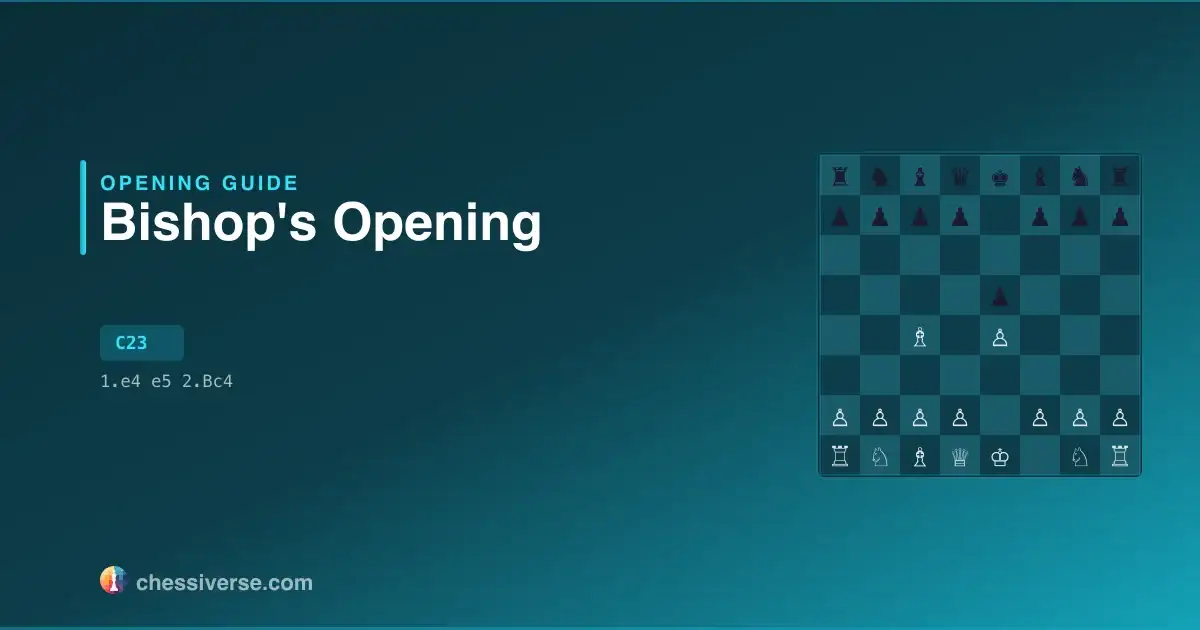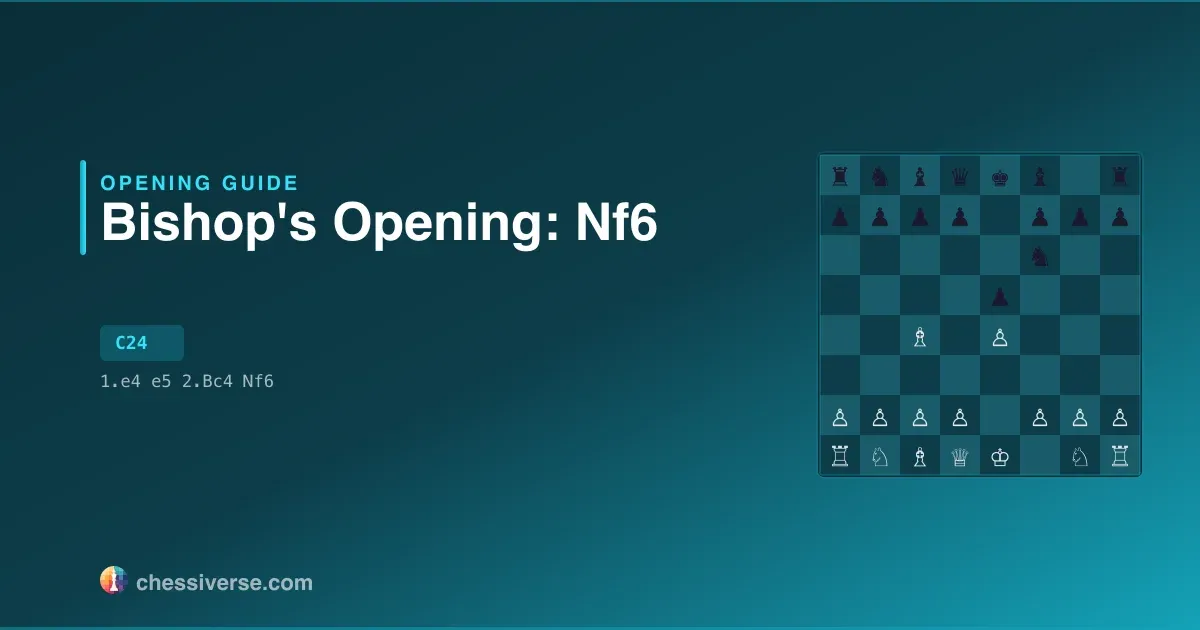
The Bishop's Opening: Berlin Defense begins with 1.e4 e5 2.Bc4 Nf6 (ECO C24). Black develops, hits e4, and shuts down the Scholar's Mate fantasies in one move, leaving White to find a real plan rather than a parlour-game queen sortie.
Strategic Overview
2...Nf6 is the most flexible answer to the Bishop's Opening. The knight does three good jobs simultaneously: it develops, it threatens e4, and it occupies f6 so that an early Qh5 or Qf3 will never threaten mate on f7. White's choice on move three defines the game. 3.d3 is the standard quiet move, supporting e4 and keeping options open for c3 and d4 later. 3.d4 leads to sharper waters, with the option to transpose into a Two Knights structure or related Italian setups after the right move order. 3.Nc3 swings the game into the Vienna where the knight pair faces off and where White retains the option of an early f4. 3.Nf3 simply transposes to a Petrov Defense and accepts that the Bishop's Opening identity is gone. Strategically, this is a flexible opening for both sides. Black wants to build a normal e5 setup with ...Nc6 and ...Bc5 or ...Be7, contest the centre with a timely ...d5, and outdevelop White if given the chance. White wants to keep the bishop on c4 pointing at f7 and find a way to play d4 under good circumstances. There is no forced theory you have to know; just normal chess where both sides need to handle the centre.
Key Ideas
The recurring motifs below distinguish a confident handler of this opening from a beginner:
- Knight attacks e4 and blocks the Scholar's Mate — Putting the knight on f6 hits e4 and shuts down Qh5 ideas in the same move. Any cheap mate-in-four plan from White is dead before it starts.
- 3.d3 is the standard quiet move — Supporting e4 with the pawn keeps the position flexible. White preserves the option of d3-d4 later and develops naturally with Nf3, c3, and O-O.
- 3.d4 opens up the centre — The aggressive push can lead to Two Knights structures or gambit lines by transposition. Black needs to be ready for sharper play if White goes this way.
- 3.Nc3 transposes into the Vienna — By bringing the knight out, White heads straight into Vienna Game territory with all its f4 attacking possibilities. Black should be comfortable in those structures.
- 3.Nf3 just becomes a Petrov — If White develops the knight to f3, the position is identical to the Petrov Defense. The Bishop's Opening has effectively been abandoned.
History and Notable Players
It arises from the Bishop's Opening. On the White side, Nikola Mitkov (72 games), Willy Hendriks (43 games), Sergei Tiviakov (43 games) top the database. Notable Black exponents: Atousa Pourkashiyan (25 games), Daniel Fridman (23 games), Ante Saric (15 games).
Performance Across Rating Levels
How well the Bishop's Opening: Berlin Defense works depends on what level you're playing at. Among 1200-rated players, it appears in 1.51% of games — 10,173,486 of them on record — with White winning 50.9% and Black 45.5%. At 1800 the opening surfaces in 0.62% of games; White wins 50%, Black 45.7%, draws 4.3%. Among 2500-rated players the line appears in 0.16% of games and draws spike to 9.4%, indicating tight preparation. Positions also become less sharp as level rises (sharpness 0.96 → 0.91).
Time Control Patterns
The Bishop's Opening: Berlin Defense skews toward rapid chess. In bullet, it appears in 0.35% of games (9,192,645); White wins 51.6%. Blitz shows 0.88% adoption across 31,797,120 games, White scoring 51%. In rapid, the share rises to 1.60% — 17,685,067 games, White 49.7%.
Move Diversity and Theory Depth
Move choice is far from uniform in the Bishop's Opening: Berlin Defense. At 1200 Elo (10,173,486 games), the top reply is d3, played 33% of the time. Four other moves each take at least 5% of games, and the top three moves account for 77.2% of games. Entropy: 2.48. By 2500 (21,779 games), d3 dominates at 71.8% of replies; only two other moves still reach 5% and the top three moves account for 93.9% of games. Entropy drops to 1.42. The narrowing is significant — strong players consolidate around a small set of best moves, while amateurs scatter across many plausible-looking options.
Historical Trends
Year-over-year data tells you whether this opening is a contemporary fixture or a fading one. Adoption peaked in 2013 at 1.63% (47,073 games). By 2025 it sits at 1.00%, down 39% from that high, leaving the line in decline.
Common Mistakes
- Drifting away from main theory — At 400 Elo, the three most-played moves cover 66.4% of games, against 78.5% at 2000. The most popular deviation is Qf3 (played 17.6% of the time at 400, much less so up top). It looks fine but quietly hands the better-prepared side an edge.
- Neglecting development — Extra pawn moves in the opening are tempting, especially when you "know the moves". Developing a piece each turn is the simple correction.
- Playing without a plan — Each Bishop's Opening: Berlin Defense middlegame demands a specific approach. Decide whether the position calls for attack, manoeuvre, or simplification before reaching for a move.
Practice on Chessiverse
Ready to try the Bishop's Opening: Berlin Defense against a bot? Pick an opponent at your level and play a game.