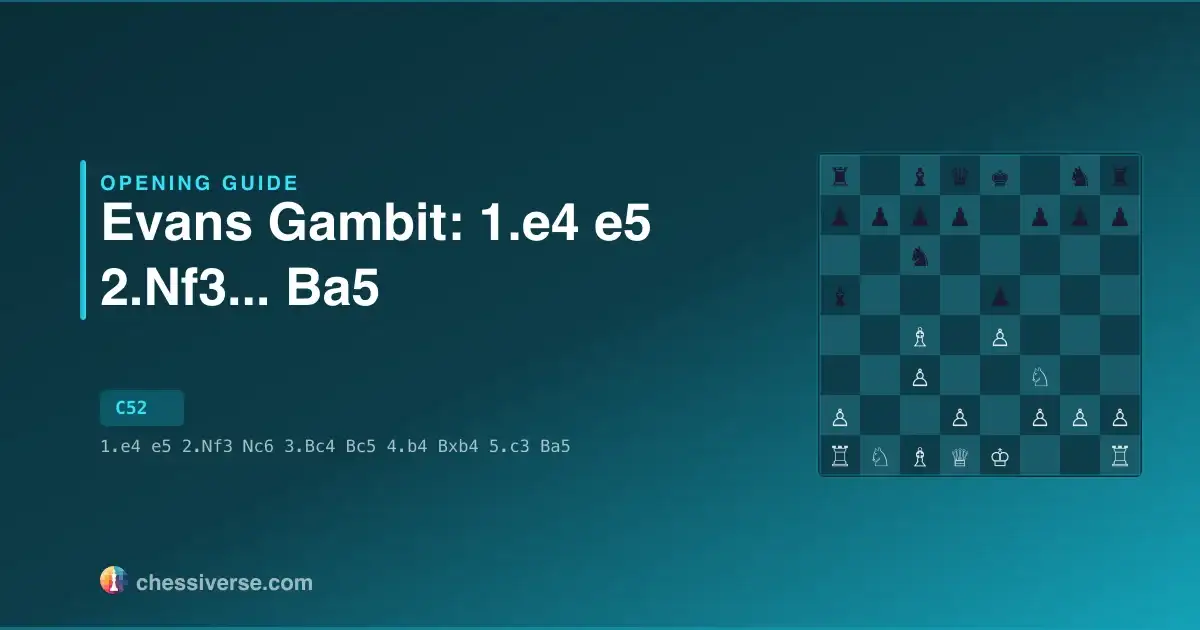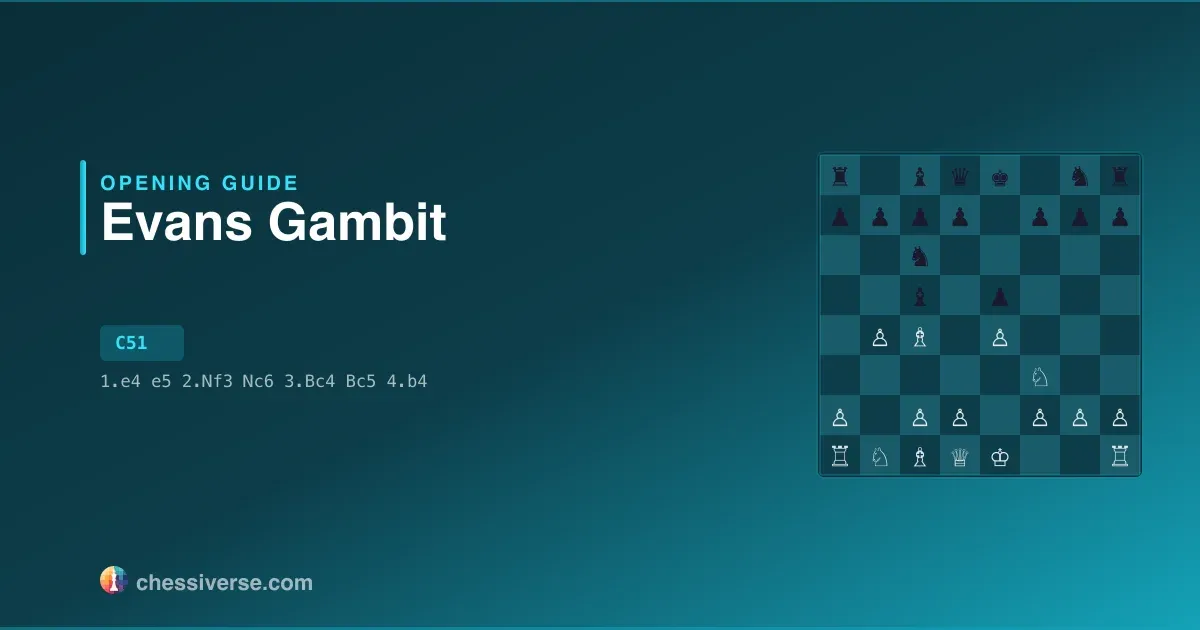
1.e4 e5 2.Nf3 Nc6 3.Bc4 Bc5 4.b4 opens the Evans Gambit, ECO C51. White throws a wing pawn at the Italian bishop, looking to gain time, force d4, and turn a quiet Giuoco Piano into a full-blooded attacking position.
Strategic Overview
The Evans Gambit is the romantic-era weapon that still has bite. White offers the b-pawn with the simple but powerful idea of dragging the c5 bishop off its strong square. The reason matters: in the standard Italian, Black's bishop on c5 prevents White from playing d4 cleanly because the d4 square is over-controlled by Black. If White can get the bishop to move and play c3 with tempo, then d4 becomes a real central thrust with the bishop already attacking c5 again. Compared to the classical 4.c3 lines of the Giuoco Piano, the Evans buys two crucial tempos at the cost of one pawn. If Black accepts with 4...Bxb4, the main path runs 5.c3, where the bishop must move again. Most lines continue with the bishop retreating to a5, and after 6.d4 White has the centre, the open lines, and a clear development lead. Black's main defensive idea in the modern era is to neutralise the attack through accurate piece play, often returning the pawn at the right moment to reach a balanced position. The Evans Gambit rewards aggressive play and concrete preparation. It is the kind of opening where Black can collapse quickly if they go on autopilot, and where White can produce some of the most spectacular attacking games in the entire repertoire if Black does not know exactly what to do.
Key Ideas
The recurring motifs below distinguish a confident handler of this opening from a beginner:
- Trade a pawn for two tempi — The gambit lures the bishop off c5, then forces it to move again with c3. Compared to the classical 4.c3 Italian, White effectively buys two tempi at the cost of one pawn.
- d4 becomes a real threat — Once Black's bishop is off the c5 diagonal, White can play d4 to claim the centre. The bishop pair plus a strong centre is the structural goal of the whole variation.
- Main line goes through 5.c3 and 6.d4 — After 4...Bxb4 5.c3, the bishop usually retreats to a5. Then 6.d4 establishes the central plan and forces Black to find concrete defensive resources.
- Pawn-grab attempts are deceptive — Lines where Black tries to keep the extra material often run into queen sorties to b3 and tactics on f7. White typically has long-lasting compensation even when material is even or down.
History and Notable Players
Documented study of this line goes back to 1827. The opening takes its name from William Davies Evans. It arises from the Italian Game: Giuoco Piano. On the White side, Adolf Anderssen (89 games), Paul Morphy (60 games), Mikhail Chigorin (46 games) top the database. Notable Black exponents: William Steinitz (61 games), Adolf Anderssen (44 games), Gustav Richard Neumann (23 games).
Captain Evans first played his gambit against McDonnell in London in 1827, and analysis appeared in William Lewis's 1832 lessons. It became a favorite of the Romantic era, starring in Anderssen's Evergreen Game, before Emanuel Lasker's defensive method pushed it out of fashion. Garry Kasparov revived it in the 1990s.
Named after: Named for William Davies Evans, a Welsh sea captain and the first player widely honored for an opening he is actually known to have played.
Notable players: Adolf Anderssen, Paul Morphy, Mikhail Chigorin, Garry Kasparov
When Kasparov dusted off the 19th-century gambit in Riga 1995, he beat Viswanathan Anand in just 25 moves, proving the old Romantic weapon still bites at the very top level.
Performance Across Rating Levels
The picture changes a lot as you climb the rating ladder. At 1200 Elo, the opening shows up in 0.10% of games (652,452 samples). White scores 53.5%, Black 43.7%, draws 2.8%. At 1800 the opening surfaces in 0.16% of games; White wins 52.8%, Black 43.9%, draws 3.3%. At the top end (2500+ Elo), popularity is 0.07% with 7.4% draws — a clear sign of how much theory rules the line at master level. White's edge erodes by 6.6pp from 1200 to 2500 Elo, suggesting Black's counterplay is easier to find with experience.
Time Control Patterns
Time control matters here: rapid players reach for this opening more than others. In bullet, it appears in 0.08% of games (2,049,969); White wins 53.1%. Blitz shows 0.12% adoption across 4,413,335 games, White scoring 52.4%. In rapid, the share rises to 0.13% — 1,423,268 games, White 53.6%.
Move Diversity and Theory Depth
Move choice is far from uniform in the Evans Gambit. At 1200 Elo (652,452 games), the top reply is Bxb4, played 65.5% of the time. Two other moves each take at least 5% of games, and the top three moves account for 91.1% of games. Entropy: 1.67. By 2500 (9,179 games), Bxb4 dominates at 79.6% of replies; only one other move still reaches 5% and the top three moves account for 98.7% of games. Entropy drops to 0.87. The narrowing is significant — strong players consolidate around a small set of best moves, while amateurs scatter across many plausible-looking options.
Historical Trends
Tracking the Evans Gambit year over year shows a clear story. Adoption peaked in 2021 at 0.15% (1,179,146 games). By 2025 it sits at 0.10%, 36% below the peak but still 20% above its 2013 level, so the line is up over the full period despite easing from the high.
Main Lines and Variations
From the position after 1.e4 e5 2.Nf3 Nc6 3.Bc4 Bc5 4.b4, the recognised continuations are:
Each branch leads to a different middlegame character — the resulting pawn structure decides what kind of game you get.
Common Mistakes
- Drifting away from main theory — At 400 Elo, the three most-played moves cover 87.9% of games, against 97.5% at 2000. The most popular deviation is Nxb4 (played 10.2% of the time at 400, much less so up top). It looks fine but quietly hands the better-prepared side an edge.
- Neglecting development — Extra pawn moves in the opening are tempting, especially when you "know the moves". Developing a piece each turn is the simple correction.
- Overextending the attack — Gambits look like permission to throw everything forward. They aren't — every attacking move should improve a piece. Random checks and threats burn the initiative once they fail to coordinate.
Practice on Chessiverse
Ready to try the Evans Gambit against a bot? Pick an opponent at your level and play a game.