





















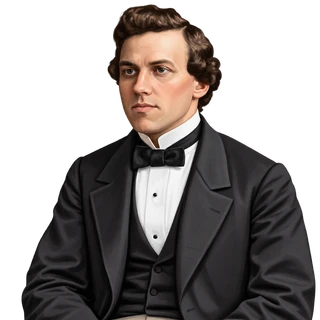
Paul Morphy
Paul Morphy says: Hello, and welcome to the board. I am Morphy, and I am glad to have a game with you. Take your seat, set up the pieces, and let us see what an open position can offer us both.
 United States
Free, independent historical simulation in the Hall of Legends
Paul Morphy was an American chess phenomenon whose brief career in the late 1850s established him as the greatest player of his era. A brilliant sacrificial attacker who embodied the Romantic style of chess, he was widely acknowledged as far ahead of his time by later commentators. His preferred weapons included the Evans Gambit and the King's Gambit.
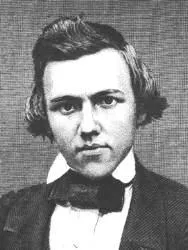
Paul Morphy (1837 to 1884) was an American chess player who, during a brief career in the late 1850s, was acknowledged as the world's greatest chess master. Later commentators concluded that he was far ahead of his time. He was born in New Orleans into a prominent family; his father was a lawyer and later a Louisiana Supreme Court Justice. By the age of nine he was considered one of the best players in the city. At twelve he played three games against the visiting Hungarian master Johann Löwenthal and did not lose any of them. He graduated from Spring Hill College in 1854.
Morphy emerged in 1857 by winning the First American Chess Congress, beating each opponent by a large margin. He then travelled to Europe. Repeated attempts to arrange a match with Howard Staunton came to nothing, but in Paris he soundly defeated Daniel Harrwitz and regularly gave blindfold exhibitions against eight opponents at a time. In December 1858, aged 21 and weakened by illness, he beat Adolf Anderssen, then considered by many to be Europe's leading player, with seven wins, two losses and two draws. He returned to the United States in 1859 and soon abandoned competitive chess. He died in New Orleans in 1884 at 47.
Morphy took the game more seriously than his strongest contemporaries. Garry Kasparov argued that his merit lay in grasping three principles vital to later chess: rapid development, control of the centre and the creation of open files, ideas only formulated by Wilhelm Steinitz a quarter of a century later. Anderssen and Löwenthal both said he was very hard to beat because he defended well, yet he was deadly when given a promising position.
With White he played 1.e4 and favoured gambits such as the King's Gambit and the Evans Gambit. As Black he usually answered 1.e4 with 1...e5, and the Morphy Defence in the Ruy Lopez (3...a6), the most popular reply for Black, is named after him. Against 1.d4 he favoured the Dutch Defence.
His best-known game is the "Opera Game" of 1858, a casual game played at the Italian Opera House in Paris against the Duke of Brunswick and Count Isouard. It became famous for its beauty and instructive value. His win over Louis Paulsen in the final of the 1857 First American Chess Congress is also widely studied.
You can play the Paul Morphy legend bot on Chessiverse. It is an independent historical simulation of his style, not endorsed by the player or his estate.
Sources: Paul Morphy on Wikipedia

Brilliant sacrificial attacker, emblem of the Romantic era
Players with this personality focus on rapid development and open lines for their pieces to attack the enemy king. They believe in the power of swift mobilization and are willing to sacrifice material for quick attacking chances. Their games exemplify classical attacking chess, where piece activity and king safety take priority over material considerations.
Picked for a similar opening repertoire, era and country.
These AI opponents play the same openings as Paul Morphy.
Free, independent historical simulation. Not endorsed by the player or their estate.
Paul Morphy says: Hello, and welcome to the board. I am Morphy, and I am glad to have a game with you. Take your seat, set up the pieces, and let us see what an open position can offer us both.
Are you an aggressive attacker like Tal, a positional genius like Carlsen, or a solid defender like Petrosian? Take our free personality test to find out which archetype matches your playing style.
Take the Chess Personality Test