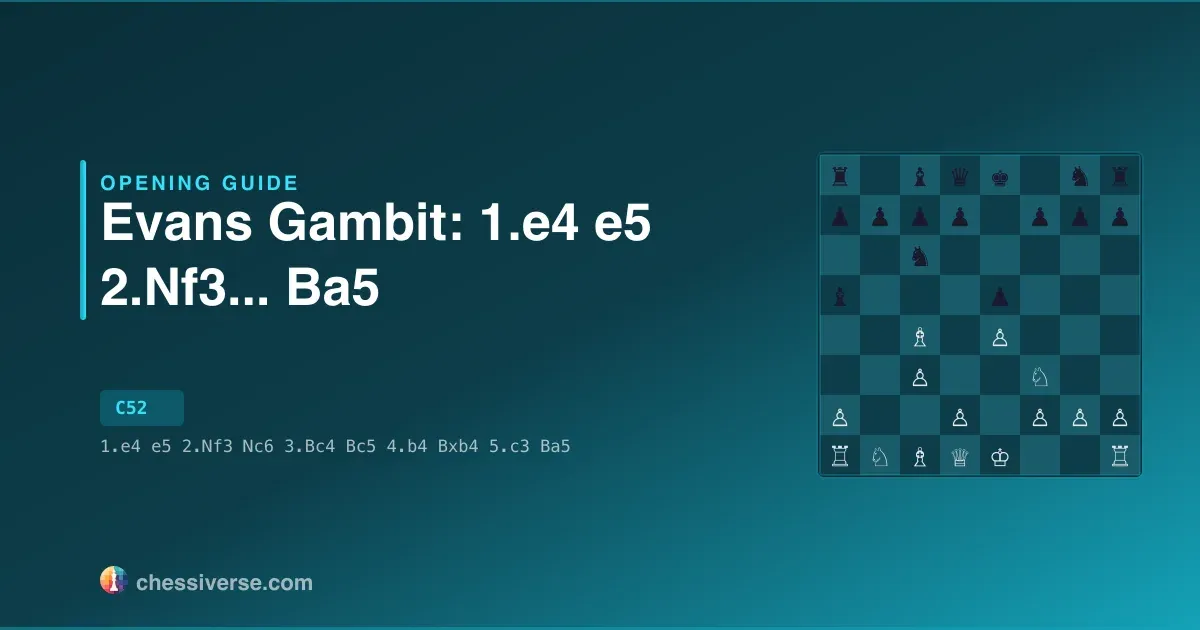
Starting from 1.e4 e5 2.Nf3 Nc6 3.Bc4 Bc5 4.b4 Bxb4 5.c3 Ba5, players enter the Italian Game: Evans Gambit, Main Line — ECO C52. Black retreats the bishop to a5, keeping pressure on the c3 knight and refusing to make life easy for the upcoming d4 push.
Strategic Overview
5...Ba5 is the principled retreat in the Evans Gambit accepted. The bishop stays on the a5-e1 diagonal, eyes the squares around White's king, and crucially keeps the pressure on the c3 pawn that would otherwise just smoothly support d4. Compared to the safer 5...Be7, retreating to a5 is the main attempt to prove that the gambit is unsound, because it makes White work harder to achieve the standard d4 setup. White's most ambitious continuation is 6.d4, throwing the central pawn forward immediately and accepting that the position will become extremely sharp. Black then has two principal options. Taking with 6...exd4 opens the position aggressively and invites a piece sacrifice race, while 6...d6 keeps the structure intact and tries to develop sensibly while holding onto the pawn. The strategic theme is consistent across all the resulting lines. White is trading material for a huge lead in development, the bishop pair, and concrete attacking chances against the still-uncastled Black king. Black's job is to consolidate, return the pawn at the right moment, and reach a position where the structural pluses outweigh the dynamic deficit. Both sides need to know specific lines because the position is too sharp to be navigated by general principles alone.
Key Ideas
When players succeed in this line, they usually do so by leaning on the following themes:
- Bishop stays active on the a5 diagonal — Unlike 5...Be7, the a5 square keeps the bishop pointing at White's queenside and king position. It is also harder for White to chase or trade.
- 6.d4 is the aggressive continuation — White's most ambitious move grabs the centre immediately and accepts whatever tactical chaos follows. The point is to convert the development edge before Black consolidates.
- Two main Black responses to d4 — Black can take in the centre with ...exd4 for an open piece-sacrifice race, or hold with ...d6 for a calmer structural defence. Each leads to a completely different middlegame.
- Best practical try to refute the gambit — Among the Evans retreats, 5...Ba5 puts the most pressure on White to prove dynamic compensation. It is the move you choose when you want to challenge the gambit head-on.
History and Notable Players
It arises from the Evans Gambit. On the White side, Adolf Anderssen (32 games), Mikhail Chigorin (27 games), Paul Morphy (21 games) top the database. Notable Black exponents: William Steinitz (38 games), Adolf Anderssen (25 games), Alexander McDonnell (12 games).
Performance Across Rating Levels
The picture changes a lot as you climb the rating ladder. Among 1200-rated players, it appears in 0.01% of games — 76,840 of them on record — with White winning 49.5% and Black 48.1%. Move up to 1800 Elo and the share shifts to 0.06%, with White winning 52.3% versus Black's 44.7%. Among 2500-rated players the line appears in 0.03% of games and draws spike to 7.1%, indicating tight preparation.
Time Control Patterns
Look at the same opening across time controls and blitz stands out. In bullet, it appears in 0.02% of games (586,583); White wins 51.8%. Blitz shows 0.03% adoption across 1,224,574 games, White scoring 51%. In rapid, the share rises to 0.03% — 313,332 games, White 50.4%.
Move Diversity and Theory Depth
Looking at move selection shows how forcing — or not — the position really is. At 1200 Elo (76,840 games), the top reply is d4, played 54.6% of the time. Two other moves each take at least 5% of games, and the top three moves account for 93.4% of games. Entropy: 1.78. By 2500 (4,012 games), d4 dominates at 91.3% of replies; only one other move still reaches 5% and the top three moves account for 99.9% of games. Entropy drops to 0.51. The narrowing is significant — strong players consolidate around a small set of best moves, while amateurs scatter across many plausible-looking options.
Historical Trends
Tracking the Italian Game: Evans Gambit, Main Line year over year shows a clear story. Adoption peaked in 2021 at 0.04% (309,191 games). By 2025 it sits at 0.03%, 36% below the peak but still 36% above its 2013 level, so the line is up over the full period despite easing from the high.
Common Mistakes
- Drifting away from main theory — At 400 Elo, the three most-played moves cover 91.2% of games, against 99.4% at 2000. The most popular deviation is O-O (played 18.4% of the time at 400, less so up top). It looks fine but quietly hands the better-prepared side an edge.
- Neglecting development — Extra pawn moves in the opening are tempting, especially when you "know the moves". Developing a piece each turn is the simple correction.
- Overextending the attack — Gambits look like permission to throw everything forward. They aren't — every attacking move should improve a piece. Random checks and threats burn the initiative once they fail to coordinate.
Practice on Chessiverse
Ready to try the Italian Game: Evans Gambit, Main Line against a bot? Pick an opponent at your level and play a game.