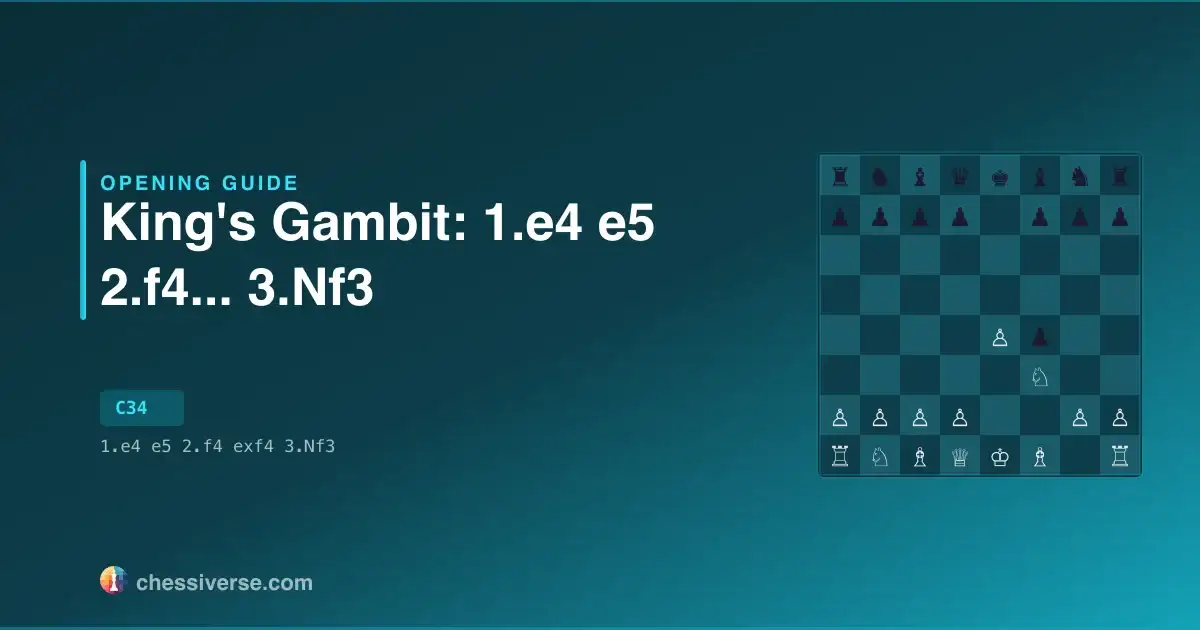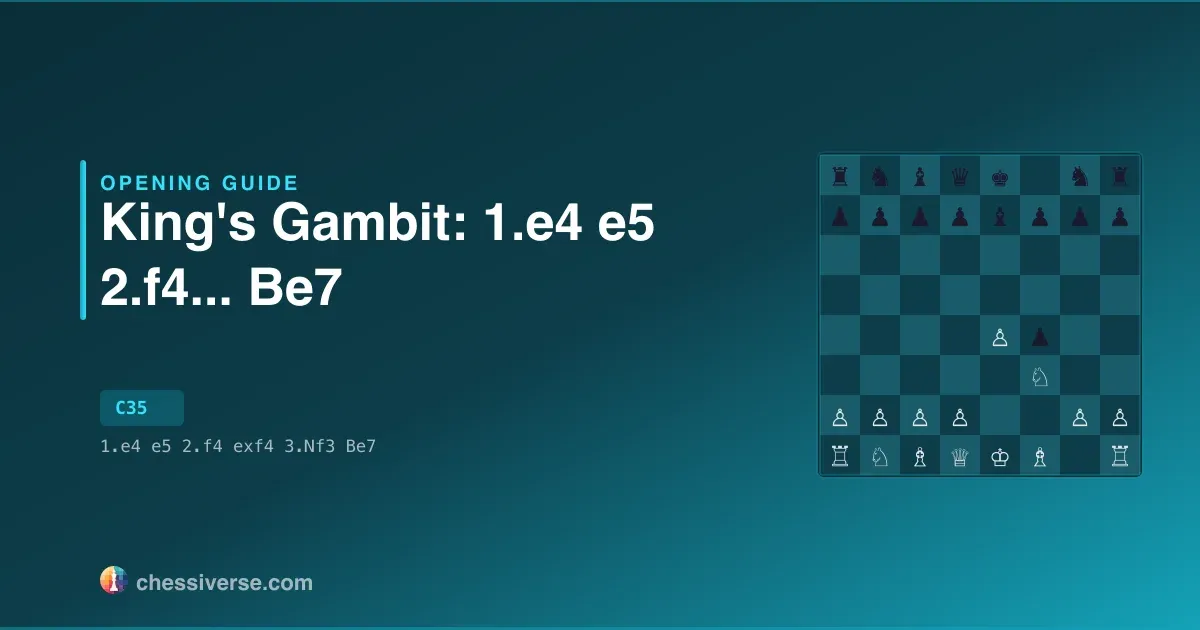
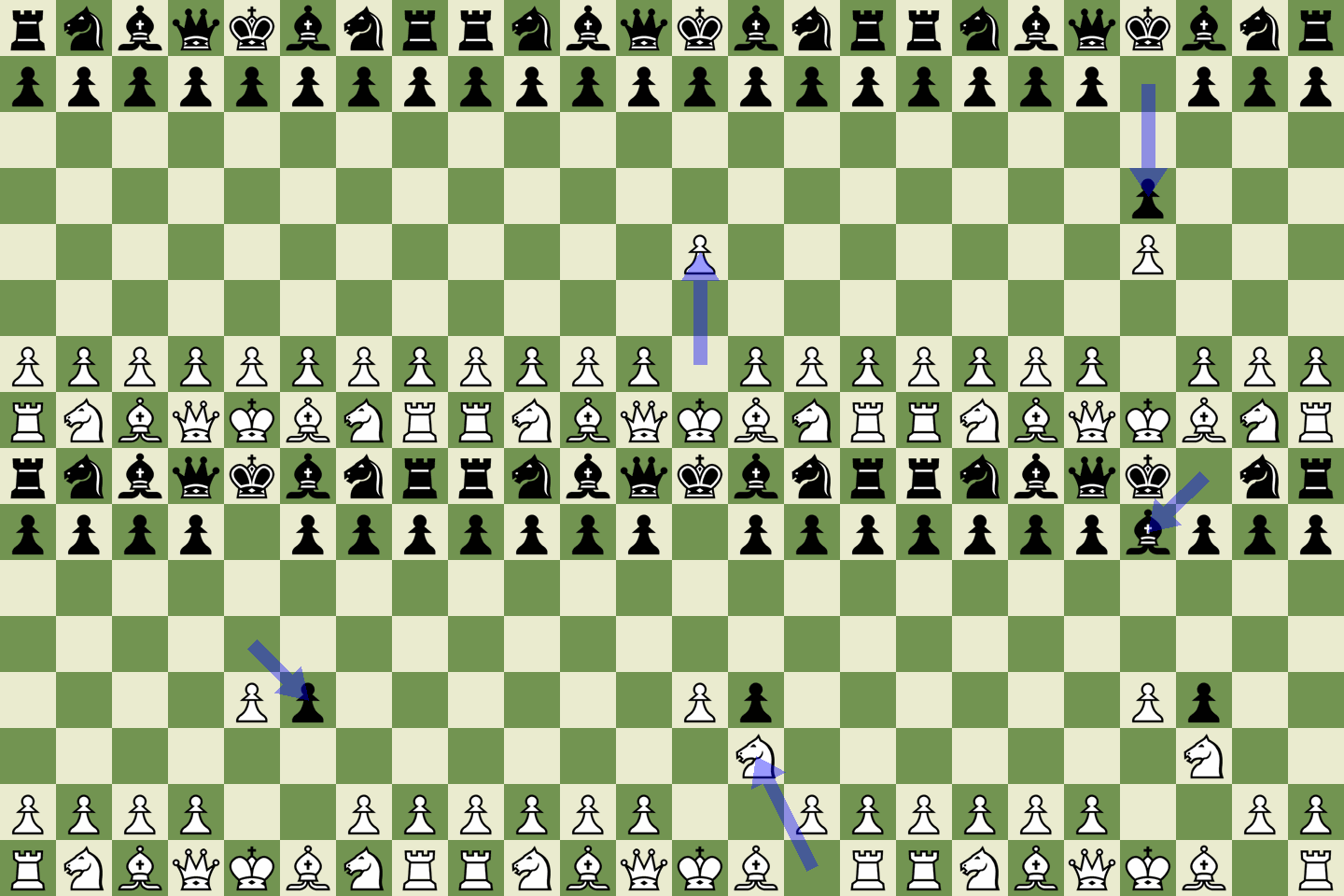
1.e4 e5 2.f4 exf4 3.Nf3 Be7 opens the King's Gambit Accepted: Cunningham Defense, ECO C35. Black slides the bishop to e7, gets ready to check on h4 again, and forces White to come up with a different way of dealing with the same old threat.
Strategic Overview
3...Be7 is the quiet, principled answer to the King's Knight Gambit. The bishop develops, prepares short castling, and crucially renews the threat of ...Bh4+, which would force White's king into the centre. White cannot block on g3 cleanly: 4.g3 fxg3 5.hxg3 leaves White with a weak isolated g-pawn and a useless half-open h-file. The natural 4.h4 only weakens the kingside further and delays development. So White has two serious continuations. 4.Bc4 is the main line. The bishop develops actively, clears f1 for the king to step there if checked, and lines up against f7. 4.Nc3 is the calm alternative, simple development with no immediate tactical commitment, planning to round up the f4 pawn later. There is also a third candidate, 4.d4, which gains central space and prepares to recover the pawn with Bxf4 while clearing d2 for the king as an escape square. Strategically, this is a less wild branch of the King's Gambit. Black is happy with quiet development and a slight material plus, planning to castle short and consolidate. White accepts that the romantic attacks are not in this line and has to build pressure through pieces and centre play. Patient players on both sides will find a position that rewards good positional judgement.
Key Ideas
When players succeed in this line, they usually do so by leaning on the following themes:
- Bh4+ threat is renewed — The bishop on e7 is one move from h4 with check, which would force White's king to walk. White cannot ignore this even though the knight is on f3.
- Pawn defences fail structurally — Trying to stop the check with g3 or h4 either creates a weak isolated pawn or delays development too much. Pieces have to handle the threat.
- 4.Bc4 is the principal line — Developing the bishop and clearing f1 is the most flexible response. It attacks f7 and prepares to escape from any future check by stepping to f1.
- 4.Nc3 develops without commitment — Simple development that keeps options open. White plans to slowly round up the f4 pawn rather than relying on tactical fireworks.
- 4.d4 grabs the centre — Pushing in the centre is a serious try, freeing the d2 square for the king and preparing Bxf4 to recover the pawn while controlling more space.
History and Notable Players
It arises from the King's Gambit Accepted: King's Knight's Gambit. Among the most prolific White practitioners are Joseph G Gallagher (6 games), Andrzej Filipowicz (5 games), Alexei Fedorov (5 games). Black-side regulars include Manfred Hermann (8 games), Mark L Hebden (7 games), Tri Hoang (6 games).
Performance Across Rating Levels
How well the King's Gambit Accepted: Cunningham Defense works depends on what level you're playing at. At 1200 Elo, the opening shows up in 0.01% of games (97,156 samples). White scores 44.3%, Black 53.4%, draws 2.3%. Move up to 1800 Elo and the share shifts to 0.13%, with White winning 48.7% versus Black's 47.8%. At the top end (2500+ Elo), popularity is 0.00% with 7.5% draws — a clear sign of how much theory rules the line at master level. Positions also become less sharp as level rises (sharpness 0.98 → 0.93).
Time Control Patterns
Look at the same opening across time controls and blitz stands out. In bullet, it appears in 0.03% of games (672,143); White wins 47.4%. Blitz shows 0.07% adoption across 2,393,885 games, White scoring 47.9%. In rapid, the share rises to 0.06% — 652,536 games, White 47.7%.
Move Diversity and Theory Depth
Looking at move selection shows how forcing — or not — the position really is. At 1200 Elo (97,156 games), the top reply is Bc4, played 45.7% of the time. Two other moves each take at least 5% of games, and the top three moves account for 88.8% of games. Entropy: 2.02. By 2500 (306 games), Bc4 dominates at 76.5% of replies; two other moves reach 5% and the top three moves account for 95.4% of games. Entropy drops to 1.20. That entropy collapse is the signature of a line where preparation pays off: at the top, players know the best move and play it.
Historical Trends
Year-over-year data tells you whether this opening is a contemporary fixture or a fading one. Adoption peaked in 2013 at 0.17% (4,993 games). By 2025 it sits at 0.06%, down 66% from that high, leaving the line in decline.
Common Mistakes
- Drifting away from main theory — At 400 Elo, the three most-played moves cover 82.2% of games, against 96.2% at 2000. The most popular deviation is Nc3 (played 7.9% of the time at 400, much less so up top). It looks fine but quietly hands the better-prepared side an edge.
- Neglecting development — It can feel productive to make extra pawn moves early, but falling behind in piece development is what loses most amateur games — especially in open positions where active pieces find squares fast.
- Overextending the attack — Gambits look like permission to throw everything forward. They aren't — every attacking move should improve a piece. Random checks and threats burn the initiative once they fail to coordinate.
Practice on Chessiverse
Ready to try the King's Gambit Accepted: Cunningham Defense against a bot? Pick an opponent at your level and play a game.