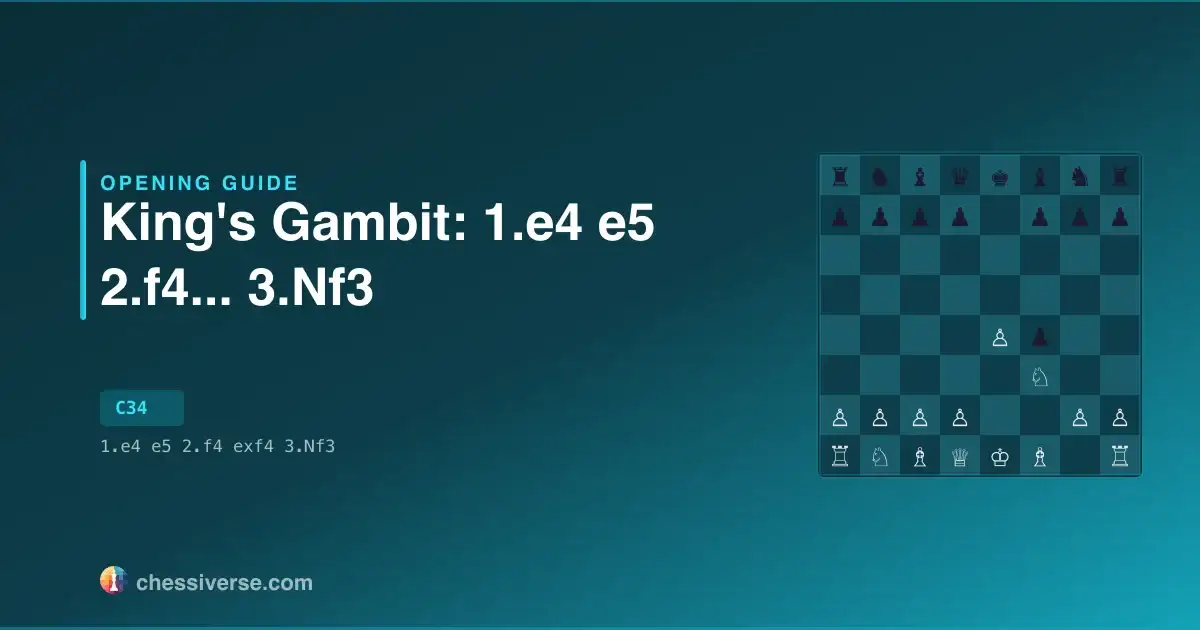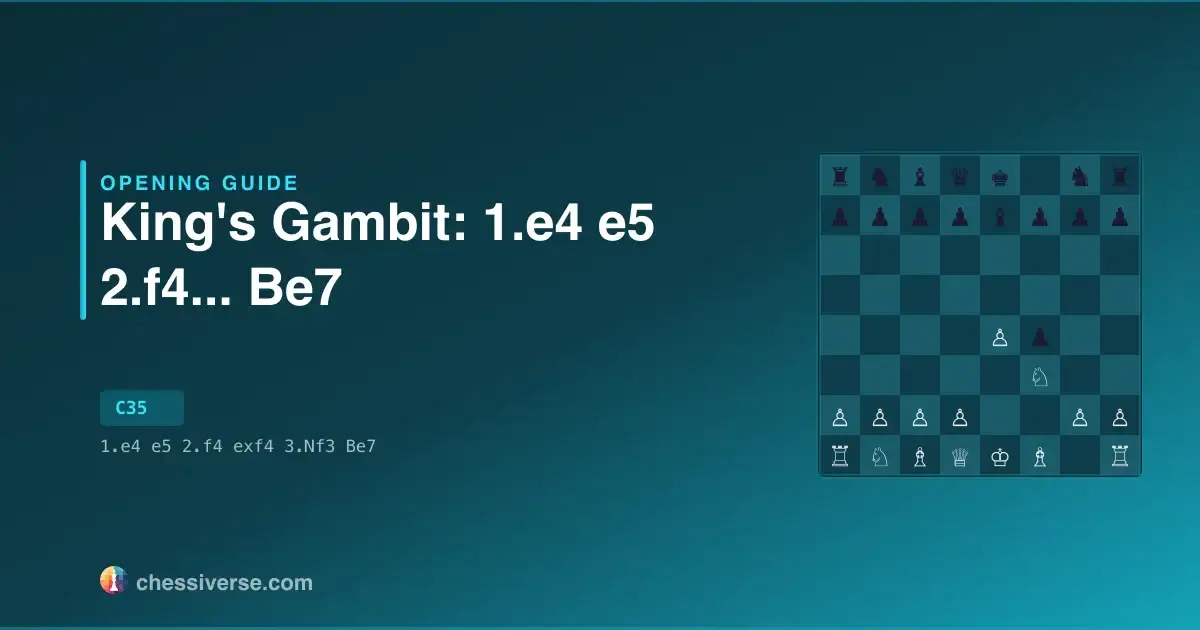
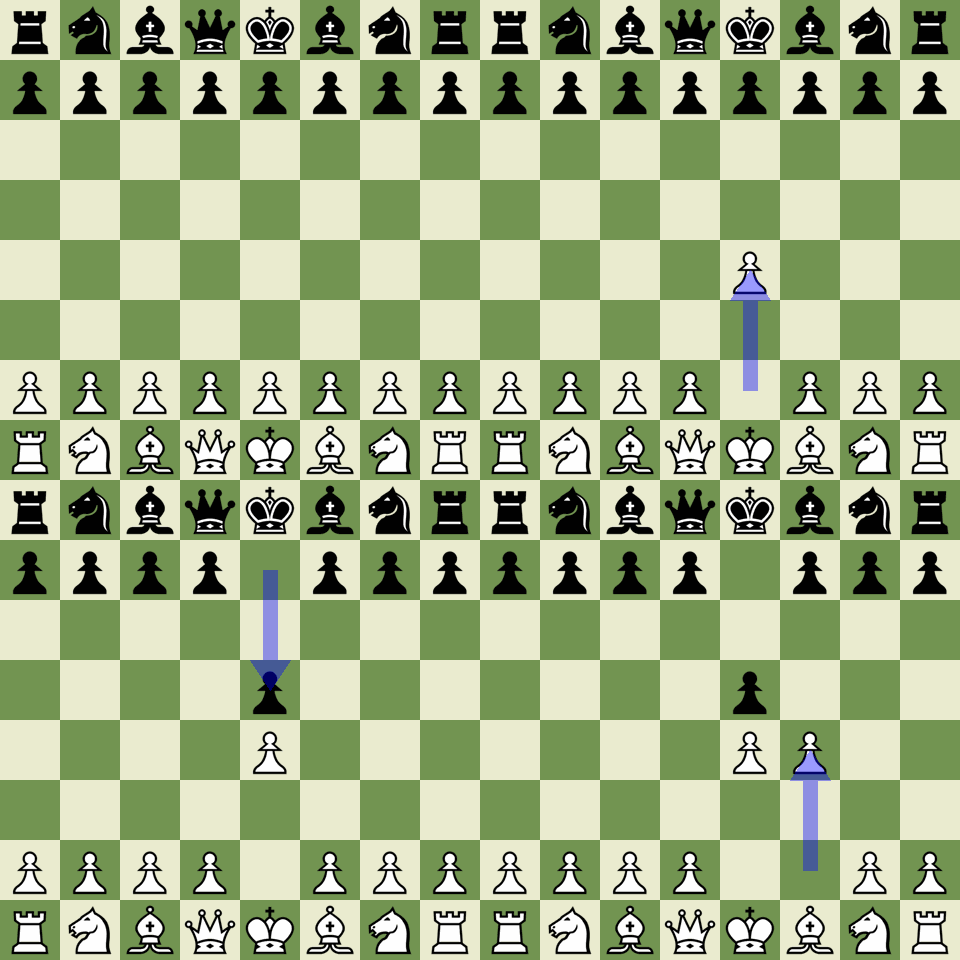
The King's Gambit arises after 1.e4 e5 2.f4 and falls under ECO code C30. White uses the f-pawn to challenge Black's e5 pawn, despite the fact that f4 is itself undefended and under attack. The strategic goals are twofold: to deflect Black's pawn from d4 so White can occupy it, and to pry open the f-file for the rook after castling. However, this comes at a steep price: advancing the f-pawn before castling severely compromises the kingside and leaves the king vulnerable. The main response is 2...exf4, accepting the gambit and pocketing the pawn, which represents the most challenging test of White's concept. Although the e5 pawn has been removed, White cannot immediately play 3. d4?! because of the threat 3...Qh4+. White therefore typically plays 3. Nf3 first (the King's Knight Gambit), covering h4 before proceeding. In the resulting positions, Black generally tries to retain the extra pawn with ...g5 and exploit the exposed diagonals e1-h4 and a7-g1 through moves like ...Qh4+ and ...Bc5. With 76.9 million Lichess games across all rating levels, it is a well-established opening choice.
- White gives up the f-pawn to drag Black's e-pawn away from the centre, then aims to build a big pawn centre with d4.
- After castling short, the half-open f-file and pressure against f7 hand White fast attacking chances.
- Black can grab the pawn and try to keep it with ...g5, or give it back with ...d5 for free piece play - and the early f-pawn push leaves White's own king airy.
History and Notable Players
The earliest known analysis of this opening dates back to No later than 16th century. It arises from the Open Games (1...e5). Among the most prolific practitioners on the White side are Heikki MJ Westerinen (102 games), Adolf Anderssen (90 games), Mikhail Chigorin (79 games). On the Black side, notable exponents include Adolf Anderssen (87 games), NN (80 games), Georg Marco (34 games).
One of the oldest recorded openings, it appears in Lucena's 1497 book, with Ruy Lopez the first to publish analysis and Polerio examining it later. It dominated the attack-happy Romantic era and featured in the famous Immortal Game of 1851, then fell from grace in the 20th century as Capablanca and the hypermoderns shunned it and Fischer published a famous attempted refutation in the 1960s.
Notable players: Rudolf Spielmann, Boris Spassky, Judit Polgar
After losing to Spassky's King's Gambit at Mar del Plata 1960, Fischer published 'A Bust to the King's Gambit', claiming the opening loses by force - yet he went on to play it himself afterwards.
Statistics
Based on 76.9 million Lichess games across all rating levels:
- White wins: 52.6%
- Black wins: 44.1%
- Draws: 3.3%
White holds a moderate edge statistically, though Black has good practical chances.
Main Lines and Variations
After 1.e4 e5 2.f4, the main continuations include:
Each of these lines leads to distinct types of positions and requires its own understanding of the resulting pawn structures and piece placements.
Common Mistakes to Avoid
- Overextending without backup: When playing a gambit, each attacking move should have a purpose. Random checks and threats without coordination can leave your own position exposed once the initiative fades.
Practice on Chessiverse
The best way to learn the King's Gambit is through practice. On Chessiverse, you can play chess against computer opponents that specialize in this opening. Our AI bots range from beginner to grandmaster level, each with unique playing styles — from aggressive attackers to solid defenders. Choose a bot that matches your rating and work your way up as you master the opening's key ideas.
Performance Across Rating Levels
Popularity and results vary sharply by rating level. Among 1200-rated players, it appears in 1.30% of games — 8,779,239 of them on record — with White winning 54.1% and Black 42.9%. At 1800 the opening surfaces in 2.06% of games; White wins 50.9%, Black 45.4%, draws 3.7%. Among 2500-rated players the line appears in 0.27% of games and draws spike to 7.2%, indicating tight preparation. White's edge erodes by 4.6pp from 1200 to 2500 Elo, suggesting Black's counterplay is easier to find with experience.
Time Control Patterns
The King's Gambit skews toward blitz chess. In bullet, it appears in 1.08% of games (28,597,336); White wins 51.9%. Blitz shows 1.67% adoption across 59,989,310 games, White scoring 52.3%. In rapid, the share rises to 1.53% — 16,904,401 games, White 53.5%.
Move Diversity and Theory Depth
Looking at move selection shows how forcing — or not — the position really is. At 1200 Elo (8,779,239 games), the top reply is exf4, played 45.5% of the time. Two other moves each take at least 5% of games, and the top three moves account for 82.1% of games. Entropy: 2.35. By 2500 (36,619 games), exf4 is still the top reply, at 45.2%; three other moves reach 5% and the top three moves account for 85.9% of games. Entropy drops to 2.10.
Historical Trends
Year-over-year data tells you whether this opening is a contemporary fixture or a fading one. Adoption peaked in 2013 at 2.59% (74,597 games). By 2025 it sits at 1.54%, down 40% from that high, leaving the line in decline.