



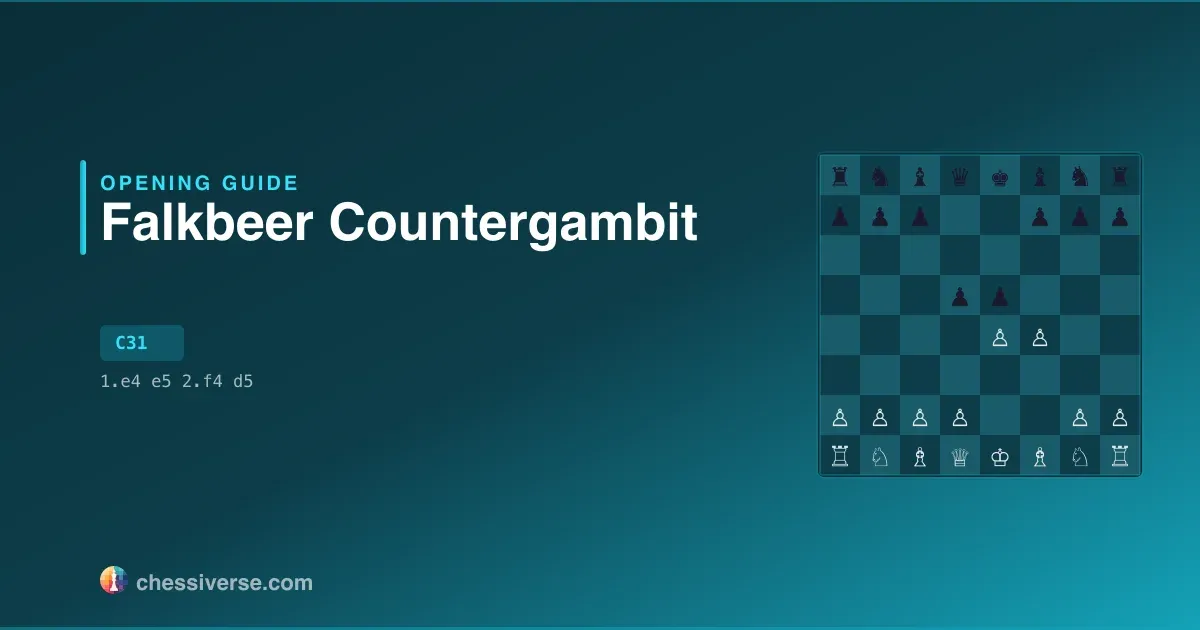
Starting from 1.e4 e5 2.f4 d5, players enter the Falkbeer Countergambit — ECO C31. Black declines the offered pawn, hits the centre with a counter-gambit of his own, and forces White to navigate a minefield where one careless capture loses on the spot.
Strategic Overview
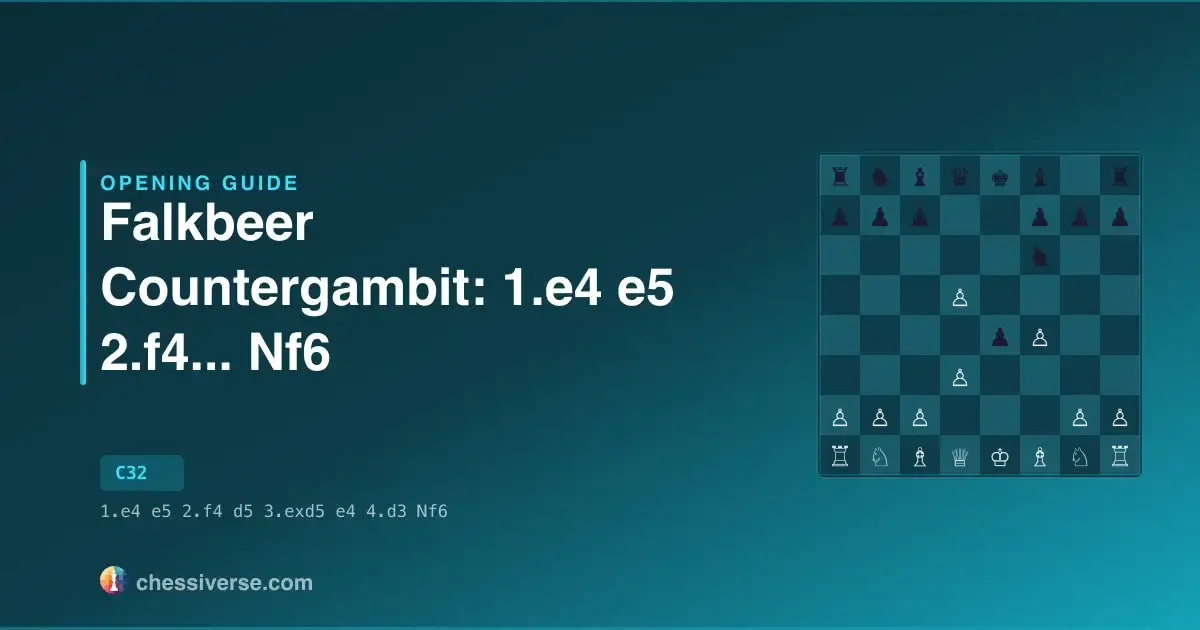
The Falkbeer is the classical, principled way to decline the King's Gambit. Black does not bother defending the e5 pawn and instead opens the position with ...d5, attacking e4 and threatening to take central control. The first lesson White has to learn is that 3.fxe5 is a blunder: ...Qh4+ and ...Qxe4+ pick up the rook on h1 with check, an embarrassing collapse that ends the game before it starts. White's two real moves are 3.exd5 and 3.Nf3. The classical 3.exd5 leads to a scramble for control of d5, e4, and e5. Black's old idea was 3...e4, the Staunton line, fixing the centre and going for a long structural game. Modern play prefers 3...exf4 followed by 4.Nf3, which simply transposes into a normal King's Gambit Accepted by another path. 3.Nf3, the Blackburne attack, is the patient development move. White declines to grab anything yet and instead controls h4 to stop the Qh4+ tactics, with the idea of taking on the centre after pieces have come out. Strategically, the Falkbeer is the move you choose when you do not want to defend an extra pawn under fire and prefer to fight for the centre with active piece play. The lines are sharp but well mapped, and Black gets a comfortable game with accurate play.
Key Ideas
When players succeed in this line, they usually do so by leaning on the following themes:
- Counter-gambit at the centre — Pushing ...d5 turns the tables: instead of defending the e5 pawn, Black attacks e4 and forces White to make the first central decision.
- 3.fxe5 loses on the spot — Taking the pawn is the classic blunder. ...Qh4+ followed by ...Qxe4+ collects the h1 rook with check and ends the game in the opening.
- 3.exd5 leads to a central scramble — The principled move keeps the option of either holding d5 or breaking it down. Modern theory often transposes through ...exf4 and 4.Nf3 into mainstream King's Gambit Accepted territory.
- 3.Nf3 is the calm developing move — The Blackburne attack ignores material in favour of controlling h4 and bringing pieces out. White plans to settle the centre once development is in place.
- Practical equaliser for Black — The Falkbeer is among the most reliable replies to the King's Gambit. It avoids the wild defensive task of holding an extra pawn while still fighting for full equality.
History and Notable Players
It arises from the King's Gambit. Among the most prolific White practitioners are Heikki MJ Westerinen (22 games), Mikhail Chigorin (17 games), Joseph G Gallagher (15 games). Black-side regulars include Frank James Marshall (11 games), Harry Nelson Pillsbury (6 games), Lucie Rerabkova (6 games).
Frank Marshall brought 3...c6 into master play by beating Richard Teichmann in 34 moves at Ostend 1905, and Aron Nimzowitsch scored with it against Spielmann at Munich 1906. The move then dropped out of sight for decades; today it is the most common reply to 3.exd5, and John Nunn is its best-known advocate.
Named after: Ernst Falkbeer, the Austrian master who used it against Adolf Anderssen in Berlin in 1851.
Notable players: Ernst Falkbeer, Frank Marshall, Aron Nimzowitsch, John Nunn
White must not grab the pawn with 3.fxe5: after 3...Qh4+ White either drops a whole rook (4.g3 Qxe4+) or ends up giving the queen for a bishop.
Performance Across Rating Levels
The picture changes a lot as you climb the rating ladder. Among 1200-rated players, it appears in 0.05% of games — 334,502 of them on record — with White winning 49.8% and Black 47.2%. By 1800, popularity is 0.29% and White's score is 46.5% to Black's 49.6%. At the top end (2500+ Elo), popularity is 0.07% with 8.3% draws — a clear sign of how much theory rules the line at master level. Positions also become less sharp as level rises (sharpness 0.97 → 0.92).
Time Control Patterns
Time control matters here: blitz players reach for this opening more than others. In bullet, it appears in 0.10% of games (2,532,710); White wins 47.6%. Blitz shows 0.17% adoption across 6,010,914 games, White scoring 47.1%. In rapid, the share rises to 0.12% — 1,319,603 games, White 47.7%.
Move Diversity and Theory Depth
What players actually play after the opening moves depends heavily on rating. At 1200 Elo (334,502 games), the top reply is exd5, played 47.2% of the time. Four other moves each take at least 5% of games, and the top three moves account for 80.3% of games. Entropy: 2.31. By 2500 (9,616 games), exd5 dominates at 87% of replies; only two other moves still reach 5% and the top three moves account for 98% of games. Entropy drops to 0.78. That entropy collapse is the signature of a line where preparation pays off: at the top, players know the best move and play it.
Historical Trends
Year-over-year data tells you whether this opening is a contemporary fixture or a fading one. Adoption peaked in 2015 at 0.24% (53,418 games). By 2025 it sits at 0.16%, 33% below the peak and 23% under its 2013 level, leaving the line in decline.
Main Lines and Variations
From the position after 1.e4 e5 2.f4 d5, the recognised continuations are:
Each branch leads to a different middlegame character — the resulting pawn structure decides what kind of game you get.
Common Mistakes
- Drifting away from main theory — At 400 Elo, the three most-played moves cover 65.6% of games, against 91.9% at 2000. The most popular deviation is fxe5 (played 22.5% of the time at 400, much less so up top). It looks fine but quietly hands the better-prepared side an edge.
- Neglecting development — It can feel productive to make extra pawn moves early, but falling behind in piece development is what loses most amateur games — especially in open positions where active pieces find squares fast.
- Overextending the attack — Gambits look like permission to throw everything forward. They aren't — every attacking move should improve a piece. Random checks and threats burn the initiative once they fail to coordinate.
Practice on Chessiverse
Ready to try the Falkbeer Countergambit against a bot? Pick an opponent at your level and play a game.