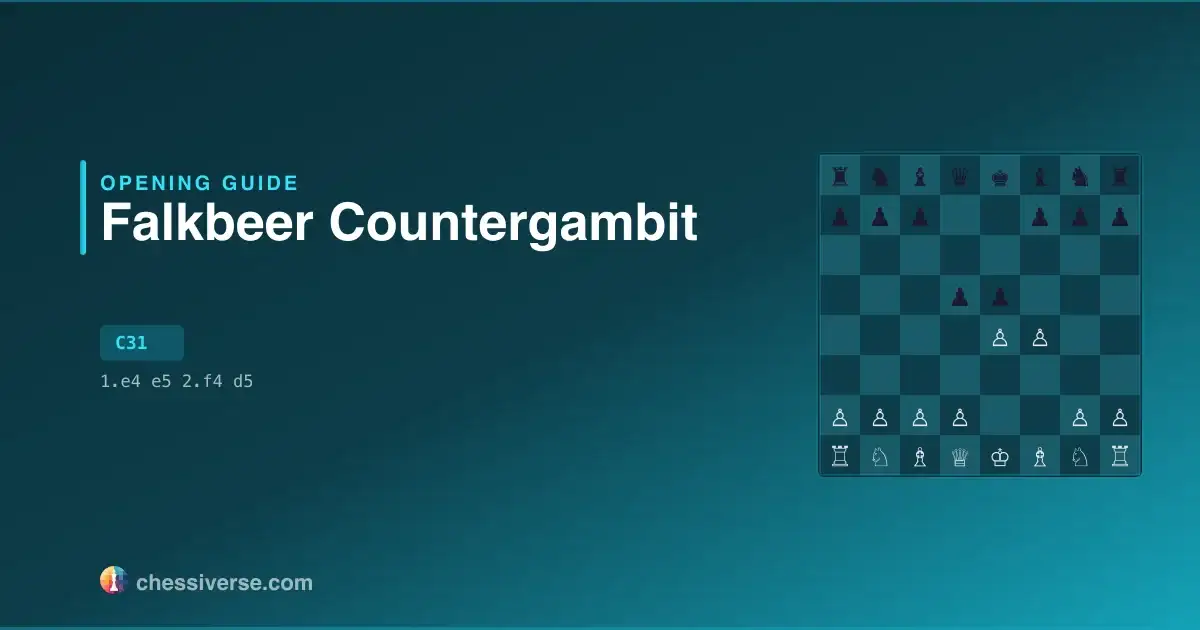




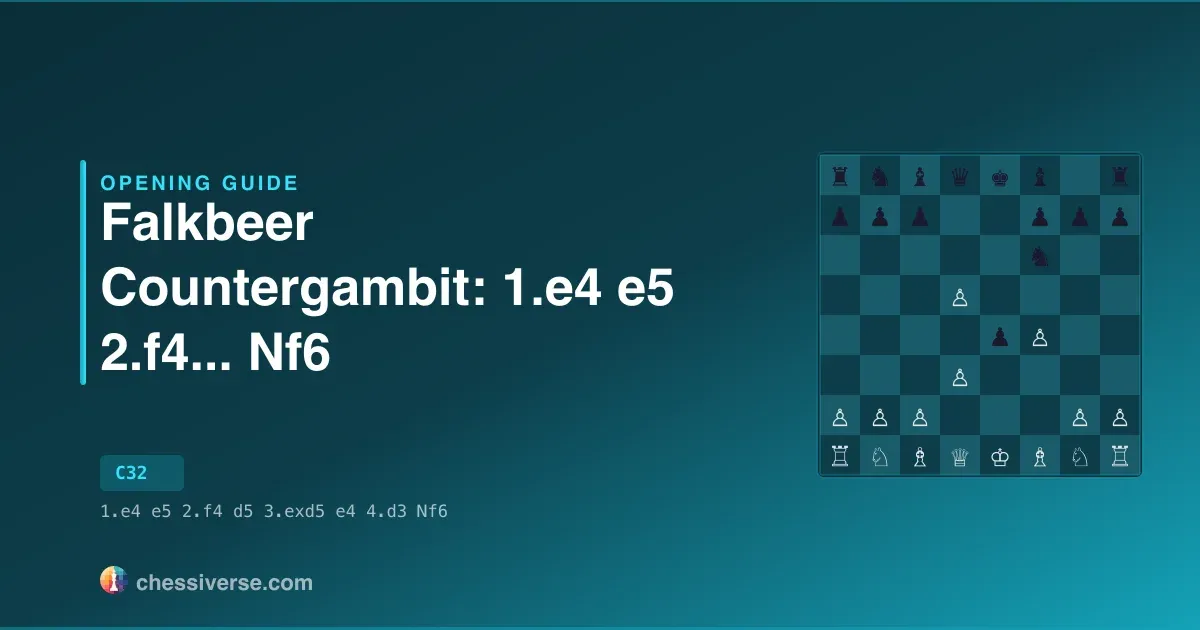
Starting from 1.e4 e5 2.f4 d5 3.exd5 e4 4.d3 Nf6, players enter the King's Gambit Declined: Falkbeer Countergambit, Charousek Gambit — ECO C32. Across rating levels it shows up in 283,123 recorded games — enough data to map exactly where it succeeds and where it stalls.
History and Notable Players
It arises from the Falkbeer Countergambit. Among the most prolific White practitioners are Rudolf Spielmann (6 games), Lukas Petrzilek (4 games), Simon Alapin (4 games). Black-side regulars include Olaf Lermen (4 games), Hans Juergen Schulz (3 games), Norbert Juergens (3 games).
Performance Across Rating Levels
The picture changes a lot as you climb the rating ladder. At 1200 Elo, the opening shows up in 0.00% of games (1,275 samples). White scores 50%, Black 47.8%, draws 2.2%. By 1800, popularity is 0.01% and White's score is 46.4% to Black's 49.6%. At 2500, 0.01% of games go into this opening; draws sit at 7.6% — the line is well-mapped at this level. Positions also become less sharp as level rises (sharpness 0.98 → 0.92).
Move Diversity and Theory Depth
What players actually play after the opening moves depends heavily on rating. At 1200 Elo (1,275 games), the top reply is dxe4, played 59.6% of the time. One other move takes at least 5% of games, and the top three moves account for 94.5% of games. Entropy: 1.54. By 2500 (1,189 games), dxe4 dominates at 82.3% of replies; two other moves reach 5% and the top three moves account for 98.3% of games. Entropy drops to 0.93. That entropy collapse is the signature of a line where preparation pays off: at the top, players know the best move and play it.
Historical Trends
Year-over-year data tells you whether this opening is a contemporary fixture or a fading one. Adoption peaked in 2014 at 0.02% (1,465 games). By 2025 it sits at 0.00%, 71% below the peak and 58% under its 2013 level, leaving the line in decline.
Common Mistakes
- Neglecting development — It can feel productive to make extra pawn moves early, but falling behind in piece development is what loses most amateur games — especially in open positions where active pieces find squares fast.
- Overextending the attack — Gambits look like permission to throw everything forward. They aren't — every attacking move should improve a piece. Random checks and threats burn the initiative once they fail to coordinate.
Practice on Chessiverse
Ready to try the King's Gambit Declined: Falkbeer Countergambit, Charousek Gambit against a bot? Pick an opponent at your level and play a game.