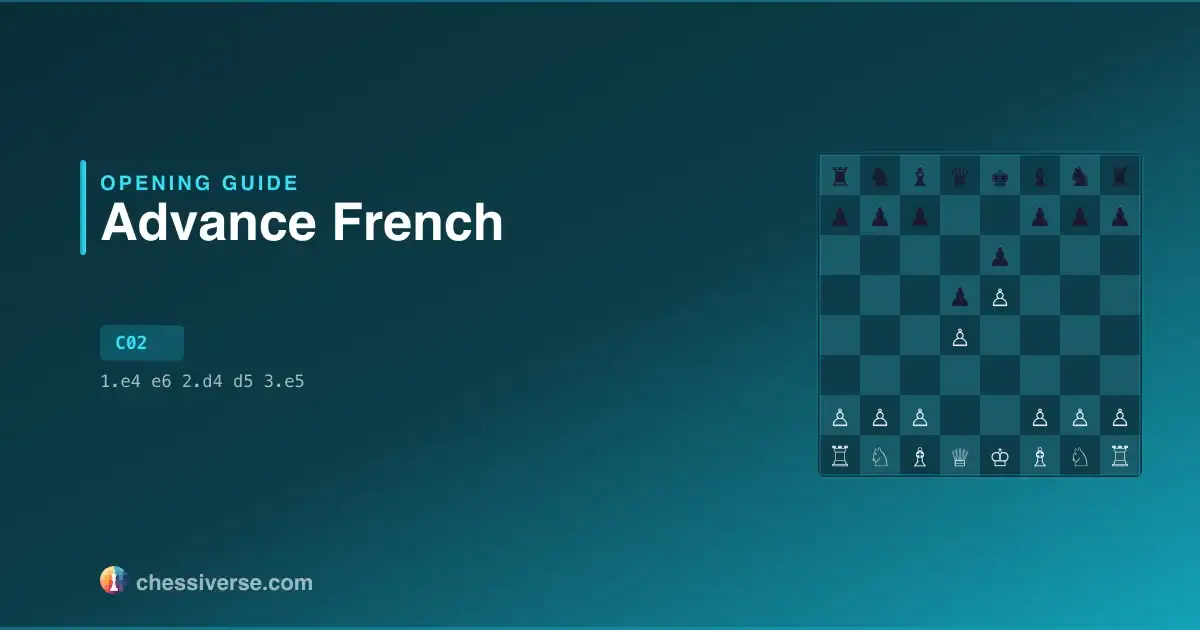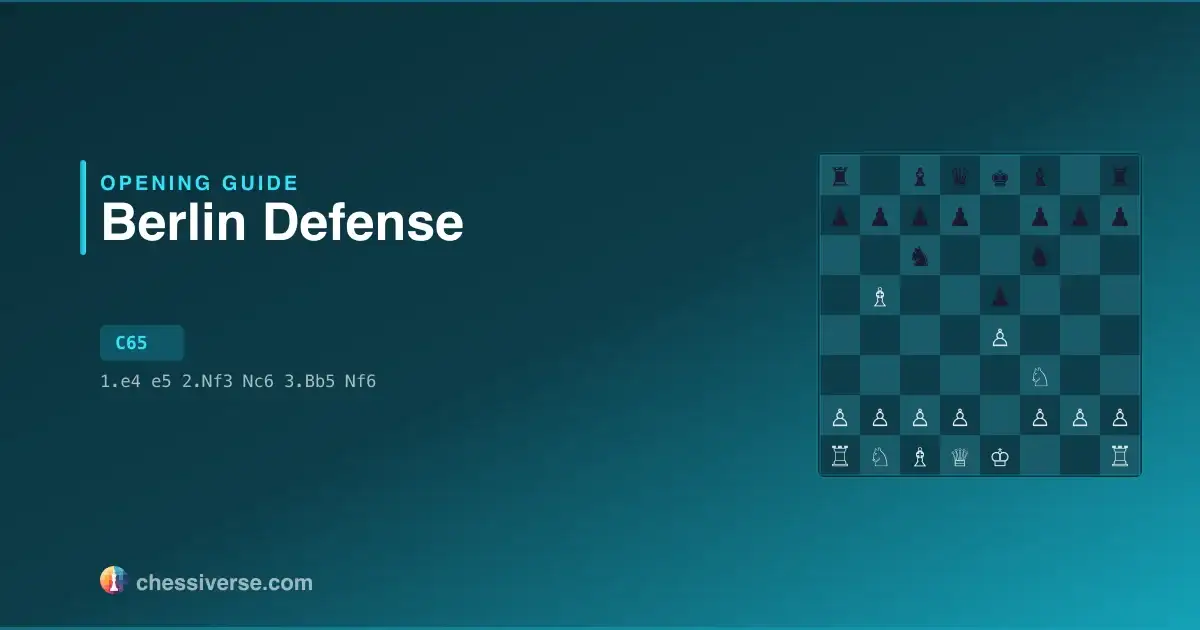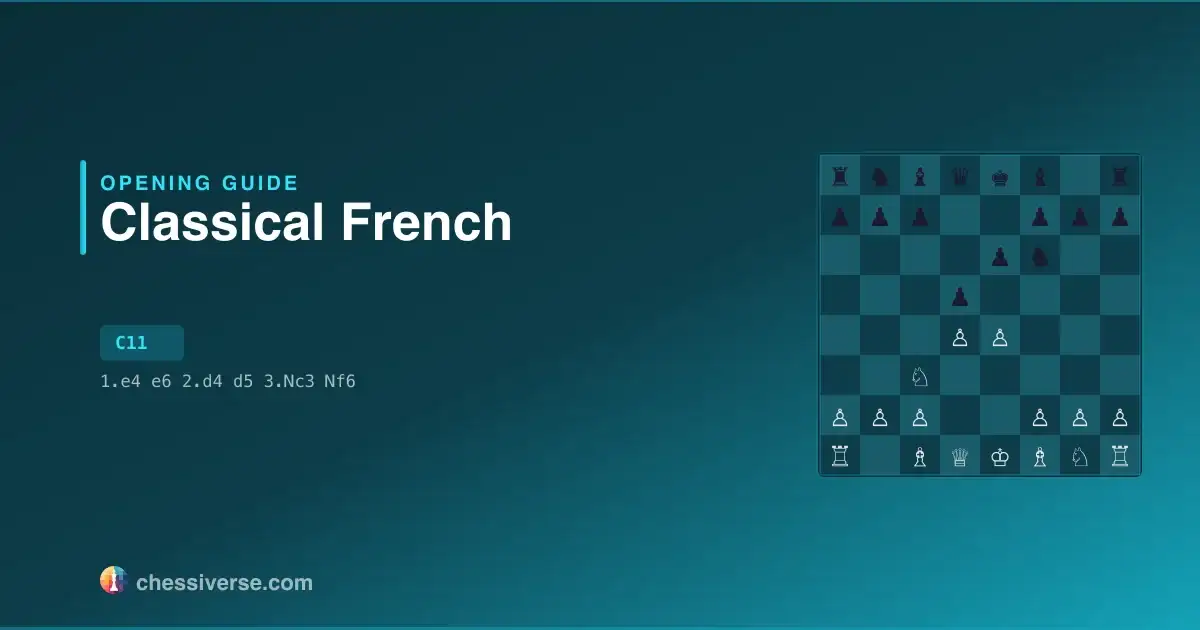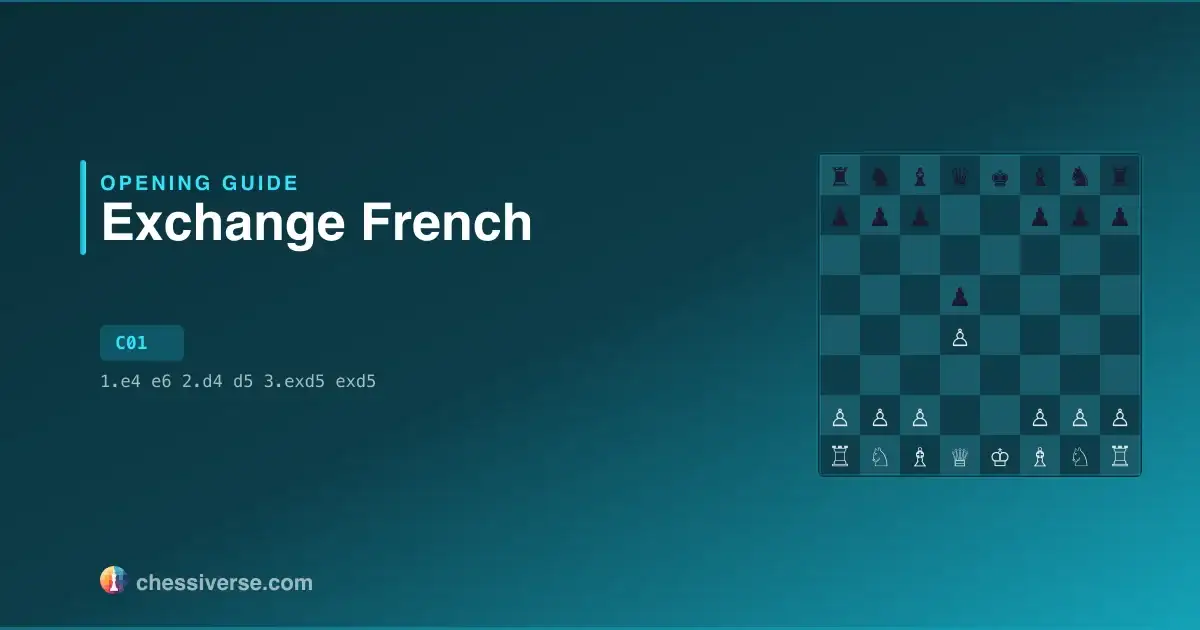




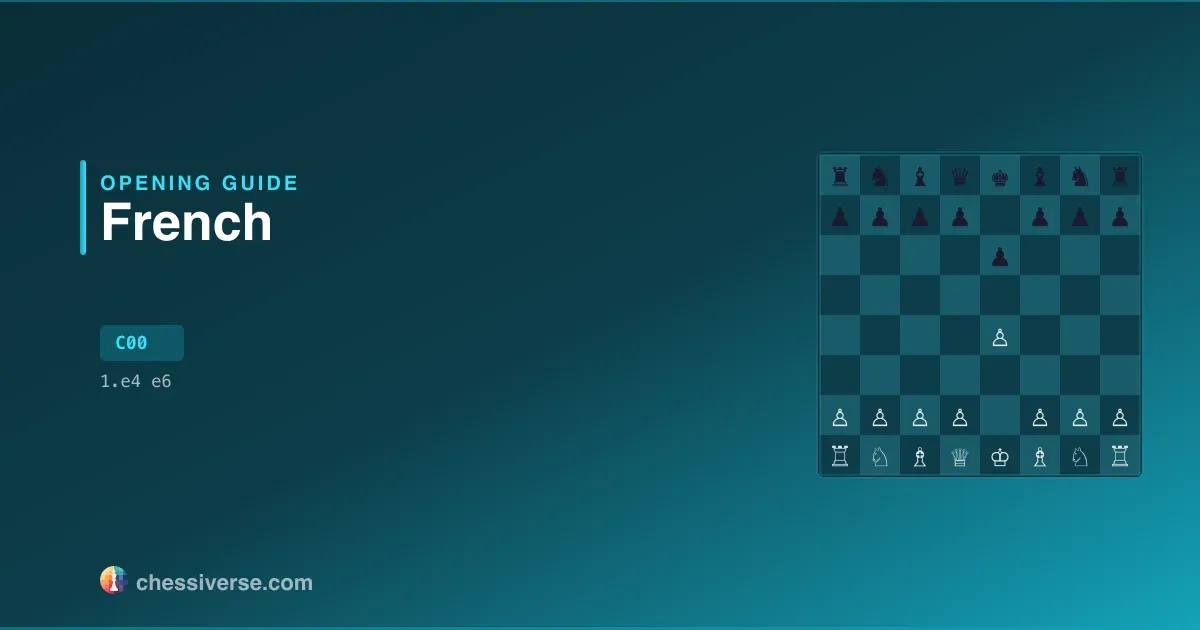
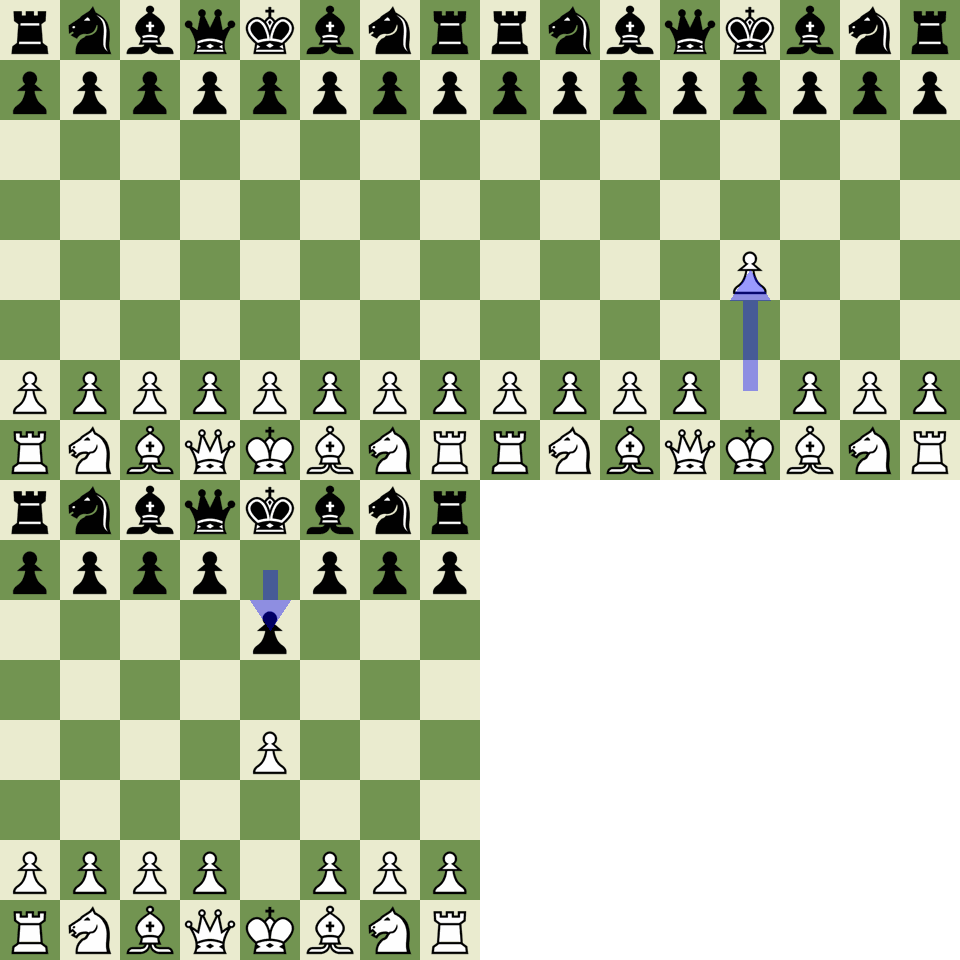
The French Defense arises after 1.e4 e6 and falls under ECO code C00. In the French Defense, Black's strategy revolves around challenging the centre with the d-pawn. Playing ...d5 on the first move would allow White to simply capture, so Black first bolsters the square with 1...e6, ensuring the ability to recapture and maintain a pawn on d5. The price of this preparation is that the e6 pawn shuts in the queenside bishop, creating the well-known problem of developing the so-called "French bishop." By contrast, the Caro-Kann (1...c6) also prepares ...d5 without blocking the bishop, but at the cost of ruling out ...Nc6 and losing a tempo should Black later want to play ...c5. In virtually all cases, White responds with 2. d4 to establish a broad two-pawn centre, after which Black continues with 2...d5. The sideline 2. d3, known as the King's Indian Attack, is a less common alternative. With 275.7 million Lichess games across all rating levels, it is one of the most popular openings.
- Black accepts a cramped but solid position early and strikes back at White's centre with the ...c5 pawn break.
- The bishop on c8 is hemmed in by its own e6 pawn, so freeing or trading that piece is a long-term project for Black.
- White typically grabs space and hunts for a kingside attack while Black counterattacks the white pawn chain.
History and Notable Players
Among the most prolific practitioners on the White side are Vlastimil Jansa (188 games), Heikki MJ Westerinen (185 games), Gyula Sax (185 games). On the Black side, notable exponents include Wolfgang Uhlmann (573 games), Ivan Farago (528 games), Sergey Volkov (425 games).
The defence got its name from an 1834 London vs Paris correspondence match. Steinitz dismissed it as the dullest of openings, but Geza Maroczy championed it in the early 1900s, and it grew into the third most popular reply to 1.e4, even edging past 1...e5 in popularity around 2006.
Named after: Named after an 1834 correspondence match between London and Paris, where Jacques Chamouillet persuaded the Paris team to answer 1.e4 with 1...e6.
Notable players: Mikhail Botvinnik, Viktor Korchnoi, Alexander Morozevich, Ding Liren
John Lindsay McCutcheon beat world champion Steinitz with his namesake French variation in an 1885 Manhattan simultaneous exhibition, and the McCutcheon line boomed from 1905 to 1925.
Statistics
Based on 275.7 million Lichess games across all rating levels:
- White wins: 48%
- Black wins: 47.5%
- Draws: 4.5%
The statistics show a roughly balanced opening where both sides have equal chances.
Main Lines and Variations
After 1.e4 e6, the main continuations include:
Each of these lines leads to distinct types of positions and requires its own understanding of the resulting pawn structures and piece placements.
Common Mistakes to Avoid
- Being too passive: While this opening is solid, playing without a plan can lead to a cramped position. Look for the right moment to break with a central pawn advance and free your pieces.
Practice on Chessiverse
The best way to learn the French Defense is through practice. On Chessiverse, you can play chess against computer opponents that specialize in this opening. Our AI bots range from beginner to grandmaster level, each with unique playing styles — from aggressive attackers to solid defenders. Choose a bot that matches your rating and work your way up as you master the opening's key ideas.
Performance Across Rating Levels
The picture changes a lot as you climb the rating ladder. The 1200 bracket has 32,997,919 games (4.89% of all games at that level); White wins 48.3%, Black 47.9%, 3.8% are drawn. By 1800, popularity is 6.98% and White's score is 47.8% to Black's 47.3%. At 2500, 5.29% of games go into this opening; draws sit at 9.6% — the line is well-mapped at this level.
Time Control Patterns
The French Defense skews toward bullet chess. In bullet, it appears in 6.13% of games (162,989,681); White wins 48.3%. Blitz shows 6.03% adoption across 216,858,170 games, White scoring 48.1%. In rapid, the share rises to 5.32% — 58,861,803 games, White 47.9%.
Move Diversity and Theory Depth
Looking at move selection shows how forcing — or not — the position really is. At 1200 Elo (32,997,919 games), the top reply is Nf3, played 36.5% of the time. Four other moves each take at least 5% of games, and the top three moves account for 78.5% of games. Entropy: 2.38. By 2500 (720,774 games), d4 takes over as the top reply at 77.9%; only two other moves still reach 5% and the top three moves account for 90.6% of games. Entropy drops to 1.32. The narrowing is significant — strong players consolidate around a small set of best moves, while amateurs scatter across many plausible-looking options.
Historical Trends
Long-term, the trajectory of this opening is informative. Adoption peaked in 2013 at 7.45% (214,792 games). By 2025 it sits at 5.98%, down 20% from that high, leaving the line in decline.