



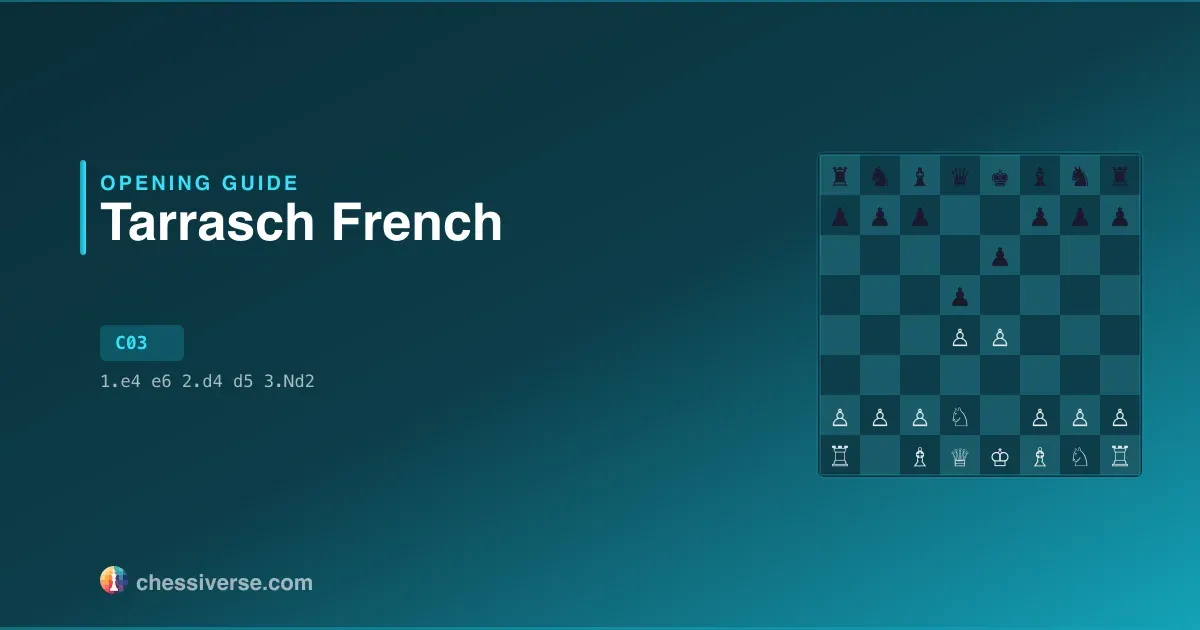
The French Defense: Tarrasch Variation arises after 1.e4 e6 2.d4 d5 3.Nd2 and falls under ECO code C03. Instead of exchanging pawns or developing to c3, White maintains the central tension by defending e4 with the knight on d2, adopting a more positional approach compared to the Paulsen variation (3. Nc3). Placing the knight on d2 keeps the c-pawn free to advance to c3 in support of the d4-e4 pawn chain, and it also sidesteps the Winawer (3. Nc3 Bb4!), since White can simply reply to ...Bb4 with c3. On the other hand, the knight on d2 blocks the development of White's dark-squared bishop, which will likely need to be moved again soon, and it exerts no pressure on d5. Black's two principal responses are 3...Nf6, which tends to produce closed positions, and 3...c5, which steers the game in a more open direction. With 9.1 million Lichess games across all rating levels, it is a well-established opening choice.
- By putting the knight on d2 White dodges the Winawer pin: 3...Bb4 can simply be met by c3.
- The knight keeps c3 free to support White's pawn chain, at the cost of temporarily blocking in the c1-bishop.
- Black picks a structure: 3...c5 (the Open Tarrasch) heads for isolated-pawn positions, while 3...Nf6 (the Closed Tarrasch) leads to advance-style chains.
History and Notable Players
It arises from the French Defense. Among the most prolific practitioners on the White side are Sergei Tiviakov (160 games), Vlastimil Jansa (149 games), Michele Godena (148 games). On the Black side, notable exponents include Wolfgang Uhlmann (209 games), Ivan Farago (192 games), Rafael A Vaganian (158 games).
Tarrasch introduced 3.Nd2 in 1889, but the line's profile rose sharply when Anatoly Karpov adopted it in the 1970s, and it has been a grandmaster staple ever since. It appeared as recently as the 2023 world championship match between Nepomniachtchi and Ding.
Named after: Siegbert Tarrasch, who first played 3.Nd2 against the French in 1889 versus Karl Eckart.
Notable players: Siegbert Tarrasch, Anatoly Karpov
Karl Eckart, the first opponent to face 3.Nd2, tried the closed defence against it in 1889 and the open one in 1890 - and lost both games.
Statistics
Based on 9.1 million Lichess games across all rating levels:
- White wins: 50.7%
- Black wins: 43.7%
- Draws: 5.6%
White holds a moderate edge statistically, though Black has good practical chances.
Main Lines and Variations
After 1.e4 e6 2.d4 d5 3.Nd2, the main continuations include:
- French Defense: Tarrasch Variation, Closed Variation
- French Defense: Tarrasch Variation, Open System (3...c5)
- French Defense: Tarrasch Variation, Guimard Defense, Main Line
Each of these lines leads to distinct types of positions and requires its own understanding of the resulting pawn structures and piece placements.
Common Mistakes to Avoid
- Being too passive: While this opening is solid, playing without a plan can lead to a cramped position. Look for the right moment to break with a central pawn advance and free your pieces.
Practice on Chessiverse
The best way to learn the French Defense: Tarrasch Variation is through practice. On Chessiverse, you can play chess against computer opponents that specialize in this opening. Our AI bots range from beginner to grandmaster level, each with unique playing styles — from aggressive attackers to solid defenders. Choose a bot that matches your rating and work your way up as you master the opening's key ideas.
Performance Across Rating Levels
Popularity and results vary sharply by rating level. Among 1200-rated players, it appears in 0.02% of games — 105,945 of them on record — with White winning 52.8% and Black 44%. Move up to 1800 Elo and the share shifts to 0.32%, with White winning 51.3% versus Black's 43.8%. At the top end (2500+ Elo), popularity is 1.06% with 10.6% draws — a clear sign of how much theory rules the line at master level. White's edge erodes by 5.8pp from 1200 to 2500 Elo, suggesting Black's counterplay is easier to find with experience.
Time Control Patterns
Time control matters here: blitz players reach for this opening more than others. In bullet, it appears in 0.15% of games (4,007,675); White wins 50.6%. Blitz shows 0.22% adoption across 7,903,556 games, White scoring 50.5%. In rapid, the share rises to 0.11% — 1,230,968 games, White 51.9%.
Move Diversity and Theory Depth
Move choice is far from uniform in the French Defense: Tarrasch Variation. At 1200 Elo (105,945 games), the top reply is c5, played 44.7% of the time. Three other moves each take at least 5% of games, and the top three moves account for 80.4% of games. Entropy: 2.32. By 2500 (145,157 games), c5 is still the top reply, at 33.8%; five other moves reach 5% and the top three moves account for 72.5% of games. Entropy rises to 2.53. Even elite players don't fully agree on the best continuation here, which keeps the position dynamic.
Historical Trends
Tracking the French Defense: Tarrasch Variation year over year shows a clear story. Adoption peaked in 2017 at 0.29% (332,415 games). By 2025 it sits at 0.18%, 40% below the peak but still 13% above its 2013 level, so the line is up over the full period despite easing from the high.