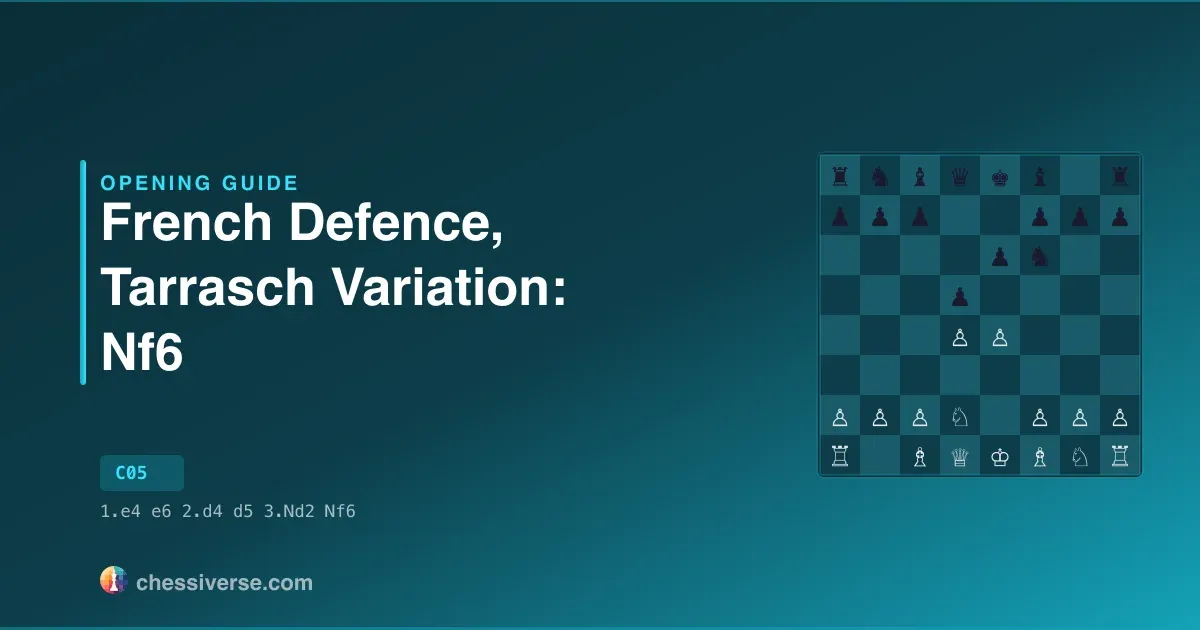
Starting from 1.e4 e6 2.d4 d5 3.Nd2 Nf6, players enter the French Defense: Tarrasch Variation, Closed Variation — ECO C05. Black skips the isolated queen's pawn structures of 3...c5 and instead piles a second attacker onto e4, forcing the position to close almost immediately.
Strategic Overview
3...Nf6 is the tactical wing of the Tarrasch French. Black is not interested in the standard IQP fight; the idea is to put two attackers on e4 against White's one defender and dictate the structure. White cannot prop the pawn up with f3 because ...exd4 opens a second target on the d-pawn, so 4.e5 is essentially forced. The knight retreats to d7, the e-file stays closed, and we land in a typical French pawn chain with White holding e5 and d4, Black with pawns on e6 and d5. From there the position takes on classical French character: Black's plans revolve around ...c5 to chip at the base of the chain, ...f6 to break the head, and reroutes for the cramped queen's bishop. White wants space, dark-square pressure, and a kingside attack with Nf3, Bd3 and eventually f4-f5 or h4-h5. The key strategic point is that 3...Nf6 commits Black to the closed, manoeuvring side of the French rather than the open structures of 3...c5. Players who like piece play, ...c5/...cxd4 ideas, and patient counter-attack tend to feel at home here. Players who hate cramped positions should pick the other Tarrasch move.
Key Ideas
The recurring motifs below distinguish a confident handler of this opening from a beginner:
- Two attackers on e4 force 4.e5 — With the knight on f6 added to the d5 pawn, White has no good way to defend e4. The pawn must advance, which closes the centre and defines the structure for the rest of the game.
- Avoids the isolated d-pawn structures — Unlike 3...c5 lines, where one side often ends up with an IQP after ...exd5 or ...Qxd5, this move keeps the centre closed. Black is committing to a pawn chain game from move three.
- Standard French levers come back into play — After the centre closes, Black aims for ...c5 against the base of the chain and ...f6 against its head. These breaks decide who gets a workable middlegame.
- Bad bishop is the long-term burden — Black's light-squared bishop is locked behind pawns on e6 and d5. Any plan that activates it cleanly is usually worth the tempo, even at the cost of structure.
History and Notable Players
It arises from the French Defense: Tarrasch Variation. Among the most prolific White practitioners are Michele Godena (54 games), Sergei Tiviakov (49 games), Vlastimil Jansa (45 games). Black-side regulars include Sergey Volkov (108 games), Ivan Farago (104 games), Evgeny Gleizerov (101 games).
Performance Across Rating Levels
The picture changes a lot as you climb the rating ladder. Among 1200-rated players, it appears in 0.00% of games — 17,173 of them on record — with White winning 51.5% and Black 45.5%. By 1800, popularity is 0.12% and White's score is 51.7% to Black's 44%. At the top end (2500+ Elo), popularity is 0.27% with 8.7% draws — a clear sign of how much theory rules the line at master level. Positions also become less sharp as level rises (sharpness 0.97 → 0.91).
Time Control Patterns
Look at the same opening across time controls and blitz stands out. In bullet, it appears in 0.05% of games (1,369,946); White wins 51.6%. Blitz shows 0.08% adoption across 2,994,950 games, White scoring 51.4%. In rapid, the share rises to 0.04% — 401,588 games, White 51.6%.
Move Diversity and Theory Depth
What players actually play after the opening moves depends heavily on rating. At 1200 Elo (17,173 games), the top reply is e5, played 73.8% of the time. One other move takes at least 5% of games, and the top three moves account for 91.6% of games. Entropy: 1.42. By 2500 (36,616 games), e5 dominates at 90.1% of replies; one other move reaches 5% and the top three moves account for 99.8% of games. Entropy drops to 0.51. That entropy collapse is the signature of a line where preparation pays off: at the top, players know the best move and play it.
Historical Trends
Tracking the French Defense: Tarrasch Variation, Closed Variation year over year shows a clear story. Adoption peaked in 2017 at 0.11% (129,960 games). By 2025 it sits at 0.06%, 46% below the peak but still 15% above its 2013 level, so the line is up over the full period despite easing from the high.
Main Lines and Variations
The main branches off 1.e4 e6 2.d4 d5 3.Nd2 Nf6 include:
Each branch leads to a different middlegame character — the resulting pawn structure decides what kind of game you get.
Common Mistakes
- Drifting away from main theory — At 400 Elo, the three most-played moves cover 68.7% of games, against 99.4% at 2000. The most popular deviation is f3 (played 13.2% of the time at 400, much less so up top). It looks fine but quietly hands the better-prepared side an edge.
- Neglecting development — It can feel productive to make extra pawn moves early, but falling behind in piece development is what loses most amateur games — especially in open positions where active pieces find squares fast.
- Drifting into passivity — These openings are solid, but solid is not synonymous with passive. Look for the right moment to break with a central pawn advance — without it, your pieces stay cramped.
Practice on Chessiverse
Ready to try the French Defense: Tarrasch Variation, Closed Variation against a bot? Pick an opponent at your level and play a game.