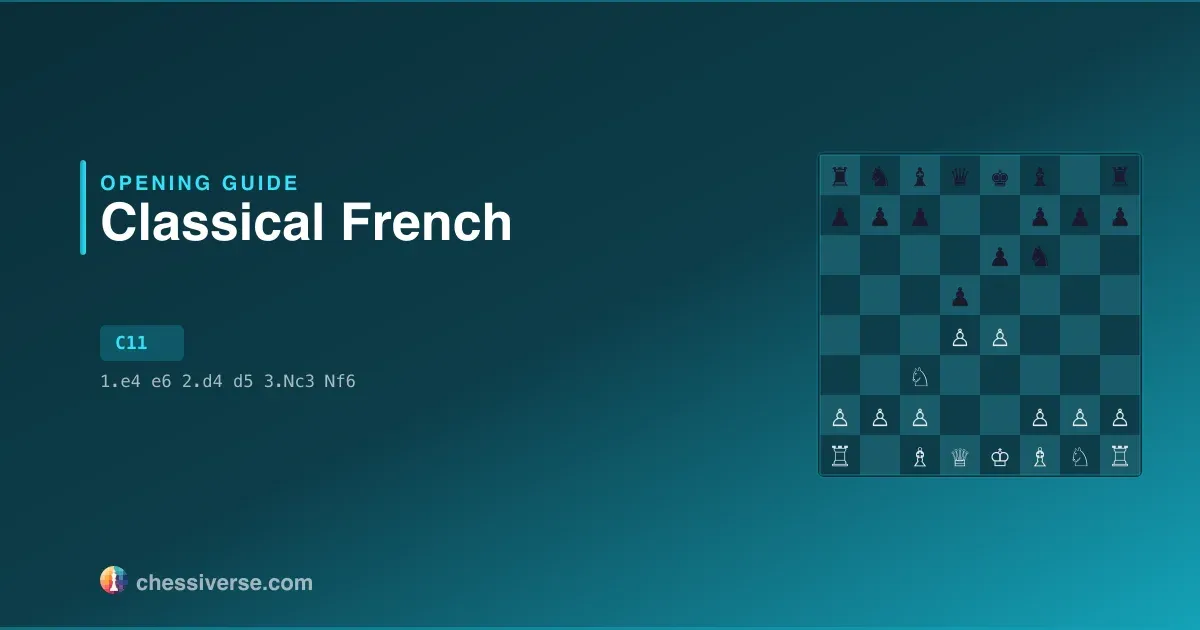
The French Defense: Classical Variation arises after 1.e4 e6 2.d4 d5 3.Nc3 Nf6 and falls under ECO code C11. In this line, both sides commit fully to the battle for central control. The tension escalates sharply if White continues with 4. Bg5, pinning the knight and adding pressure to the d5-e6 complex. Alternatively, White can choose 4. e5, immediately locking the pawn structure and gaining a tempo by forcing the newly developed knight to retreat. With 9.3 million Lichess games across all rating levels, it is a well-established opening choice.
- White pins the f6 knight with Bg5 or gains space with e5, then aims the pieces at Black's kingside
- Black's light-squared bishop, the famous 'French bishop', is walled in by the e6 pawn and can stay passive for a long time
- Black seeks queenside counterplay, using the ...c5 break to chip away at White's pawn centre
History and Notable Players
It arises from the French Defense. Among the most prolific practitioners on the White side are Friso Nijboer (64 games), Peter Leko (50 games), Emanuel Lasker (49 games). On the Black side, notable exponents include Sergey Volkov (173 games), Mikhail Gurevich (165 games), Igor Glek (136 games).
The French Defence earned its name in an 1834 London-Paris correspondence match and grew into one of Black's main answers to 1.e4. The Classical setup with 3.Nc3 Nf6 became a key battleground: its Steinitz, Burn and McCutcheon variations are named after Wilhelm Steinitz, Amos Burn and John Lindsay McCutcheon, and the Burn line is now the most common choice at the top level.
Named after: The parent French Defence got its name when the Paris team, urged on by Jacques Chamouillet, adopted it in an 1834 correspondence match against London.
Notable players: Amos Burn, Alexander Morozevich, Evgeny Bareev
Steinitz claimed he never once played the French, calling it 'the dullest of all openings' - yet 4.e5, one of White's two main replies in the Classical, is the Steinitz Variation, named after him.
Statistics
Based on 9.3 million Lichess games across all rating levels:
- White wins: 48.6%
- Black wins: 46.6%
- Draws: 4.8%
The statistics show a roughly balanced opening where both sides have equal chances.
Main Lines and Variations
After 1.e4 e6 2.d4 d5 3.Nc3 Nf6, the main continuations include:
Each of these lines leads to distinct types of positions and requires its own understanding of the resulting pawn structures and piece placements.
Common Mistakes to Avoid
- Being too passive: While this opening is solid, playing without a plan can lead to a cramped position. Look for the right moment to break with a central pawn advance and free your pieces.
Practice on Chessiverse
The best way to learn the French Defense: Classical Variation is through practice. On Chessiverse, you can play chess against computer opponents that specialize in this opening. Our AI bots range from beginner to grandmaster level, each with unique playing styles — from aggressive attackers to solid defenders. Choose a bot that matches your rating and work your way up as you master the opening's key ideas.
Performance Across Rating Levels
How well the French Defense: Classical Variation works depends on what level you're playing at. Among 1200-rated players, it appears in 0.06% of games — 415,311 of them on record — with White winning 48.3% and Black 48.3%. Move up to 1800 Elo and the share shifts to 0.29%, with White winning 48.4% versus Black's 47.1%. At 2500, 0.82% of games go into this opening; draws sit at 9.4% — the line is well-mapped at this level.
Time Control Patterns
Time control matters here: blitz players reach for this opening more than others. In bullet, it appears in 0.18% of games (4,889,040); White wins 50.7%. Blitz shows 0.22% adoption across 7,761,791 games, White scoring 48.8%. In rapid, the share rises to 0.14% — 1,561,485 games, White 47.4%. White's score swings 3.3pp across formats, so time control isn't just a stylistic choice here — it shifts the actual results.
Move Diversity and Theory Depth
Looking at move selection shows how forcing — or not — the position really is. At 1200 Elo (415,311 games), the top reply is e5, played 59.8% of the time. Three other moves each take at least 5% of games, and the top three moves account for 80.7% of games. Entropy: 2.06. By 2500 (111,725 games), e5 dominates at 54.2% of replies; only one other move still reaches 5% and the top three moves account for 97.5% of games. Entropy drops to 1.32. The narrowing is significant — strong players consolidate around a small set of best moves, while amateurs scatter across many plausible-looking options.
Historical Trends
Long-term, the trajectory of this opening is informative. Adoption peaked in 2018 at 0.24% (450,270 games). By 2025 it sits at 0.20%, 16% below the peak but still 27% above its 2013 level, so the line is up over the full period despite easing from the high.